Horseflies
Historical document, translated for reference. It reflects medical knowledge of the 1920s–30s and is not medical advice.
Summary
This article from the 1928–1936 Soviet Great Medical Encyclopedia discusses horseflies (Tabanidae), their biology, life cycle, and their significant role as bloodsuckers and vectors of dangerous diseases such as anthrax, tularemia, and trypanosomiasis. It also outlines control measures against these pests.
Encyclopedia article (1928–1936)
HORSEFLIES, family Tabanidae, large short-horned dipterans, the females of which, with very rare exceptions, are bloodsuckers. In the fauna of the USSR, the following genera are known: Tabanus, Chrysops (deerflies), Pangonia, Silvius, Chrysozona (= Haematopota, rain-tree fly), Heptatoma, Baikalomyia. The most important in significance are Tabanus, Chrysops, and Chrysozona (Figures 1 and 2). Adult horseflies appear with the onset of hot days and remain until early autumn. They fly at air temperatures no lower than 15–16 °C. The rain-tree fly attacks even in cloudy weather.
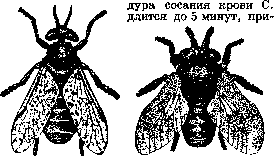
Figure 1. Chrysozona pluvialis L.
Figure 2. ♀ Chrysops quadratus Meig.
During which a horsefly (depending on the species) drinks up to 200 mg of blood. They attack humans and various mammals. Eggs are laid on leaves, stems, and branches in clusters of up to 1,000. The larvae live in damp soil or in water. The larvae lead a predatory lifestyle and feed on small insects, worms, etc. In rivers and lakes, horsefly larvae live in sand and silt; in swamps, they are found in masses of moss. The larvae overwinter and pupate in the spring, crawling beforehand into drier places. Before hatching, the horsefly pupa crawls to the surface of the soil. Horseflies are of very substantial importance as bloodsuckers that attack livestock in masses. Horsefly saliva possesses toxic properties; horses are especially sensitive to horsefly bites; other domestic animals also suffer from them. Horseflies are important as vectors of anthrax from diseased animals to healthy ones or to humans. This capability has been directly demonstrated for Tabanus striatus, T. nigrovittatus, T. rabidus, Chrysops flaviventris, T. autumnalis, T. solsticialis, T. bromius, T. bovinus, and Chrysozona pluvialis. N. Olsufev and Leley showed that in the mouthparts of horseflies, anthrax infection can persist for up to 5 days, and in the digestive tract for no more than 2 days, with the bacilli being excreted in the horsefly's feces. The transmission of anthrax by horseflies occurs mechanically, and for the infection of the horsefly itself, merely biting a diseased animal without becoming engorged with blood is sufficient. In nature, horseflies also become infected with anthrax bacilli by sucking on the carcasses of dead animals or by drinking water from infected bodies of water. In turn, horseflies infect water bodies, grass, and soil by excreting waste within the nearest two days. If the blood-sucking procedure on an infected animal was interrupted, the startled horsefly seeks a new source for engorgement, attacks other animals or humans, and transmits anthrax to them. Horseflies are also vectors of tularemia (especially Chrysops) and various trypanosomes (souma of camels and horses, Trypanosoma theileri of cattle, surra, el-debab, etc.). In addition, Chrysops silacea and Chrysops dimidiata are vectors
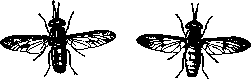
Figure 3. ♀ Chrysops silacea.
Figure 4. ♀ Chrysops dimidiata.
of the microfilariae Loa loa (the causative agent of "Calabar swelling") (Figures 3 and 4). - Control measures against horseflies: treatment of water bodies visited by horseflies for drinking with petroleum; sticky traps for rain-tree flies; protection of animals from horsefly attacks by the use of repellents (fish oil with creolin); night grazing of livestock and night field work in the northern half of the USSR; land reclamation to destroy horsefly breeding sites.
Related articles
Mentioned in
Cite this page
“Horseflies.” Soviet Medical Encyclopedia. English translation of Bolshaya Meditsinskaya Entsiklopediya, 1st ed. (Moscow, 1928–1936), ed. N. A. Semashko. https://sovietmedicalencyclopedia.pages.dev/article/horseflies/