Manometer
Historical document, translated for reference. It reflects medical knowledge of the 1920s–30s and is not medical advice.
Summary
This article from the 1928–1936 Soviet Medical Encyclopedia details various types of manometers used to measure gas pressure, including open, closed, and metal types, as well as specialized instruments for measuring very low pressures like the McLeod gauge and vacuum gauges based on electron emission.
Encyclopedia article (1928–1936)
MANOMETER, an instrument for measuring pressure (elasticity) of gases. -1) An open manometer consists of a U-shaped glass tube (Fig. 1) filled with a liquid (mercury, water, oil, etc.). One limb is connected to the place in the reservoir containing the gas where the pressure is to be measured. The other limb is 'open' and is connected to atmospheric air. The pressure of the gas is measured by the difference in height A h of the liquid levels in both limbs. An open manometer is used in physiological research, for example, when recording blood pressure in animals. -2) A closed manometer for pressures greater than atmospheric consists of a U-shaped glass tube (Fig. 2) with one limb sealed. In this limb, above the liquid, there is air at ordinary atmospheric pressure. If the other limb is connected to a reservoir containing gas, the air in the closed limb will be compressed, and the pressure in the reservoir can be judged by the decrease in its volume according to Boyle's law. The readings of this manometer for high pressures are not very accurate, as the divisions lie very close to each other. -3) A metal manometer, usually used for high pressures, for example, in autoclaves (Fig. 3), is based on the same principle as the Bourdon metal barometer. A bent brass tube, closed at one end, is equipped with a pointer-arrow; the open end is connected to a reservoir of compressed gas. As the pressure inside the brass tube increases, the tube unwinds, and the arrow deviates on a scale previously graduated on a mercury manometer. -4) An inclined manometer. To increase the sensitivity of an open manometer, the open end of its tube is inclined, then Ah = -., where A1 is the linear displacement of the liquid level, and a is the angle of inclination of the tube to the horizon. The principles of the open and inclined manometer are used in engineering to construct a whole series of different manometers - differential, compensating, micromanometers, etc. 5) For measuring very small pressures from 1 mm to 0.0001 mm of mercury column (for example, in X-ray tubes), a McLeod vacuum gauge is used, consisting of a glass bulb (Fig. 4) connected by a tube a to the vacuum being measured. Mercury is poured into the bulb G. When the bulb G is placed on the lower stand, the entire system of the bulb H and glass tubes will be filled with gas at the pressure existing in the measured vacuum. In the second position of the bulb G on the upper stand, the gas located in the bulb H will be separated from the rest of the mass of gas in the measured vacuum and will be compressed, and mercury will fill the entire bulb "L and part of the capillary K2. The difference in height h of mercury in the capillaries K1 and K2 is measured on the scale. Knowing the volume v of the bulb H and the diameter d of the capillaries K1 and K2 and applying Boyle's law, the measured pressure P (in the vacuum) is found by the formula: P = = *dl. h2 (mercury in capillary K2 is brought to the upper end of capillary K1). The McLeod manometer allows measuring pressures up to one hundred-thousandth of a millimeter of mercury column. -6) For measuring very small pressures from 10-* to 10-8 mm, a three-electrode cathode lamp can be used as a manometer, between the filament and grid of which there is a "potential difference accelerating the movement of electrons, and between the grid and anode of which a potential difference is applied such that electrons from the heated filament are not allowed

Fig. 3.
to the anode. As a result of ionization, positive ions are obtained, which settle on the anode. A positive current is obtained in the anode circuit, measured by a sensitive galvanometer. This current depends on the number of positive ions settling on the anode, which in turn depends on the degree of vacuum. In this method, it is necessary to strictly monitor (with an ammeter) the constancy of the filament heating current. -7) In recent times, the method of measuring vacuum by electrical discharge has become widespread. A Geissler tube is connected to a vessel with the vacuum being measured, powered by a small induction coil. The degree of vacuum can be qualitatively judged by the character of the discharge (glow) in the tube. Glowing in the form of a weak lilac-reddish thread begins at a pressure of 50 mm. At a pressure of 3-4 mm, the glow fills the entire tube, at 1 mm the glow divides into layers (strata), at about 102 mm the layers move apart by 3-4 cm, and the glass of the tube begins to fluoresce. At pressures less than 10-3-10-4 mm, fluorescence disappears, and the tube becomes dark. This method is very convenient for qualitatively determining the degree of evacuation of X-ray tubes, and it is not even necessary to connect a Geissler tube to them, since the discharge can be produced directly in the X-ray tube itself.
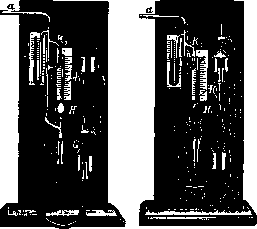
Fig. 4.
Manometer
Related articles
Mentioned in
Cite this page
“Manometer.” Soviet Medical Encyclopedia. English translation of Bolshaya Meditsinskaya Entsiklopediya, 1st ed. (Moscow, 1928–1936), ed. N. A. Semashko. https://sovietmedicalencyclopedia.pages.dev/article/manometer/