Hygrometers
Historical document, translated for reference. It reflects medical knowledge of the 1920s–30s and is not medical advice.
Summary
An overview of hygrometers from the 1930s, detailing various instruments used to measure absolute humidity, relative humidity, and dew point in sanitary and meteorological practice.
Encyclopedia article (1928–1936)
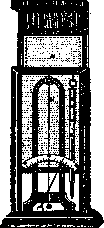
HYGROMETERS (from Greek hygros—moist and metron—measure), instruments for determining atmospheric humidity. There are three main types of hygrometers: some indicate absolute humidity, others relative humidity, and still others the dew point. Through simple calculations, the readings of one type of hygrometer can be converted to the readings of another type; for example, relative humidity or the dew point can be calculated from the absolute humidity, and vice versa. The weight or chemical method is considered the most accurate for determining the absolute humidity of the air.-The weight hygrometer consists of a series of U-shaped glass tubes filled with a substance that avidly absorbs water vapor, e.g., dry neutral calcium chloride, pieces of pumice impregnated with strong sulfuric acid, etc. The tubes are weighed individually before the experiment, then a specific volume of air is drawn through them using an aspirator, and they are weighed a second time. The weight gain indicates the amount of water vapor contained in the volume of air drawn through the tubes. The resulting value is converted to 1 cubic meter of air or translated into tension in millimeters of mercury. To obtain completely accurate results, it is necessary to reduce the volume of air that passed through the aspirator to the actual volume of the air under study, taking into account temperature, humidity, and air pressure. The weight method is complex, painstaking, requires a laboratory setting, and takes up a lot of the operator's time; therefore, it is rarely used in sanitary and meteorological practice.-Significantly simpler and faster, though less accurate, absolute humidity can be determined using the Edelmann hygrometer. This instrument consists of a reservoir into which the test air is introduced and a specific amount of concentrated sulfuric acid is then poured, which absorbs all water vapor, thereby reducing the tension of the air in the reservoir. A manometer included in the instrument shows in millimeters of mercury how much the tension of the air in the reservoir has decreased. This decrease provides the desired absolute humidity.-The hygrometers of Ge-sehux and Salvioni are based on the opposite principle—in them, the measurement of absolute humidity is based on the increase in the tension of the test air when it reaches saturation as a result of the evaporation of poured water. In addition, hygrometers called "psychrometers" (see) are especially frequently used to determine absolute humidity. Good psychrometers give very accurate readings. Among the instruments that determine relative humidity, hair hygrometers are the most widespread; they are based on the hygroscopicity of human hair, on its property of lengthening in moist air and shortening in dry air. In the Koppe hygrometer (see Figure 1), a cleaned and degreased female hair is attached by its upper end (a) to the frame of a stand, and its lower end is passed over a pulley and terminates in a small weight that tensions the hair. A long pointer is attached to the pulley, indicating percentages of relative humidity from 0 to 100% on a graduated scale. When studying relative humidity in any room, the Koppe hygrometer is brought into it and the front glass and rear metal plates, as well as the frame with gauze, are removed from the case. After 10-15 minutes, the hygroscopic state of the hair in the instrument comes into equilibrium with the surrounding air, and the pointer on the dial directly indicates the percentage of relative humidity. In order for hair hygrometers to give correct
Fig. 1. Koppe hygrometer. 763
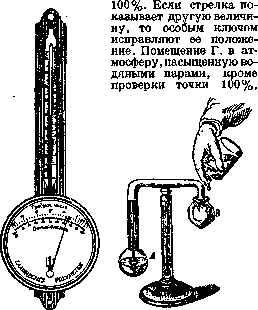
HYGROMETERS results, their readings should be checked from time to time using good psychrometers (for example, the Assmann system). The Koppe hygrometer has a special device for checking the 100% point. The hygrometer is enclosed in a metal box with a glass front wall. A frame with stretched gauze (Ж) is inserted into the box behind the hair. If the gauze is moistened with water, the closed box turns into a chamber with air saturated with water vapor, and the hygrometer pointer should indicate
Figure 2. Polymeter
Figure 3. Condensation
Lambrecht.
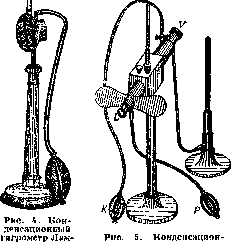
Daniel's hygrometer. It is also useful for restoring the normal sensitivity of the hair, which becomes blunted over time.-Hair hygrometers of the Saussure, Herrmann and Pfister, Lambrecht, and other systems differ from the Koppe hygrometer only in certain details of their design. In the Lambrecht hygrometer, called a "polymeter" (see Figure 2), the pointer shows not only the percentage of relative humidity, but also the "degree number," subtracting which from the thermometer reading determines the dew point.-In addition to hair hygrometers, so-called spiral hygrometers are also used to determine the relative humidity of the air. They have the appearance of a round metal box with a dial on which a metal spiral in the form of a clock spring is mounted, with one of its sides glued with paper. Due to the hygroscopicity of the glue, the spiral twists or untwists depending on the degree of air humidity. A pointer is connected to the spiral, indicating percentages of relative humidity on the scale. Spiral hygrometers belong to cheap, low-accuracy instruments and require frequent checking.-Finally, there are also hygrometers in which strings, whalebone, horn plates, fabrics impregnated with cobalt salts, etc., serve as the hygroscopic body; all of them are significantly inferior in accuracy to hair hygrometers. Hygrometers that determine air humidity by the dew point are called condensation hygrometers. They are based on the following principle: if the temperature of the air is gradually lowered, the vapors contained in it, while maintaining their tension, gradually approach a state of saturation and finally reach saturation and release dew. The temperature at which saturation occurs is called the dew point. Knowing the dew point temperature, the saturation vapor tension corresponding to it is found from tables; this tension expresses the absolute humidity. If the air temperature is known, the relative humidity can also be calculated. Among condensation hygrometers, the simplest design is found in the instruments of Daniell (see Figure 3) and Regnault; however, the results obtained from observing them are not distinguished by high accuracy. The instruments of Krova, Alluard, and Lambrecht have a more sophisticated design.-The Lambrecht condensation hygrometer (see Figure 4) consists of a metal chamber, the front part of which is smoothly polished; sulfuric ether is poured inside the chamber and a thermometer is inserted to measure the temperature of the ether. Two tubes enter the chamber, through which, by means of a rubber bulb, air is blown
through the ether; |
at the same time, the ether evaporates, |
and as a result the temperature of the chamber I
and of the layer of atmospheric air in contact with it |
gradually decreases.
brecht.
Krova condensation hygrometer.
As soon as cooling reaches the saturation temperature, a light coating of dew appears on the polished plate of the instrument. At this moment, the thermometer reading is recorded and ether blowing is stopped. Then the polished plate is monitored, and when the dew disappears from it, the temperature is recorded a second time at the exact moment the dew disappears. The average temperature from both readings gives the desired dew point. To better observe the moments of appearance and disappearance of dew, the polished surface of the chamber is divided by a narrow gap into two parts, of which dew settles on one part, while the other serves only for comparison and remains shiny all the time.-The Krova condensation hygrometer (see Figure 5) has some advantage over the described Lambrecht instrument, since its condensation surface is located inside, which makes it possible to protect the dew from the proximity of the observer and accidental air currents that interfere with the accuracy of observation. The Krova hygrometer has the appearance of a small brass box through which passes a tube equipped at one end with a magnifier eyepiece (L) and at the other with ground glass (V). Ether is poured into the box, which evaporates by blowing air through it using a bulb (K). If the air under study is passed through the tube (Lk) of the instrument, aspirating it with a rubber bulb (P), dew begins to settle on the walls of the tube. By regulating the rate of evaporation of the ether, the moment of appearance and disappearance of dew can be established with an accuracy of 0.1°. The appearance of dew is observed through the magnifier eyepiece (L). Both the ground plate (V) and its ring-shaped image on the inner polished surface of the tube are clearly visible in the field of view. Dew appears in the lower part of this image in the form of a light brownish coating. Good aspiration hygrometers are among the precise instruments; however, they are complex to handle and require a certain amount of experience; therefore, in routine sanitary practice, as well as for meteorological purposes, they are rarely used, preferring to use psychrometers and hair hygrometers.
Related articles
Mentioned in
Cite this page
“Hygrometers.” Soviet Medical Encyclopedia. English translation of Bolshaya Meditsinskaya Entsiklopediya, 1st ed. (Moscow, 1928–1936), ed. N. A. Semashko. https://sovietmedicalencyclopedia.pages.dev/article/hygrometers/