Hygrograph
Historical document, translated for reference. It reflects medical knowledge of the 1920s–30s and is not medical advice.
Summary
A hygrograph is a self-recording hygrometer used to continuously measure and record relative air humidity. This 1930s article describes the mechanical operation of the Richard-system hygrograph, which utilizes human hair to detect humidity changes, and provides instructions for its calibration and maintenance.
Encyclopedia article (1928–1936)
HYGROGRAPH, a self-recording hygrometer. At meteorological stations, as well as in sanitary practice when examining residential premises, the degree of their dryness, the proper functioning and suitability of heating and ventilation appliances, when monitoring the drying process of newly built houses, and generally in all cases where it is necessary to conduct prolonged systematic observations of the qualities of the surrounding air, it is very convenient and often necessary to have instruments that can automatically register the readings they provide. Among such instruments is the hygrograph of the Richard system, which records the relative humidity of the air in the form of a continuous curve. The figure shows a hygrograph manufactured by the firm R. Fuess in Berlin. The instrument consists of a bundle of carefully washed and degreased human hair (H), attached at the ends to terminals (L) and slightly tensioned by a spring (V). Depending on the degree of air humidity, the bundle of hair, due to its hygroscopicity, changes its physical properties and lengthens in moist air and shortens in dry air. These fluctuations in length are transmitted by means of a lever (S) to a writing pen, which draws a continuous curve of the relative humidity of the air on a drum. The drum is covered
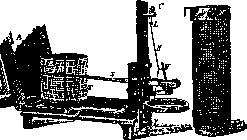
with a strip of paper graduated in days and hours; it is set into slow and uniform motion by a clock spring, which is wound daily or once a week. To protect the hair from accidental damage, there is a mesh box (K), which is inserted into a ring (L) and covers the most delicate parts of the instrument. The drum and pen are enclosed in a metal case (A) with glass walls. From time to time, the accuracy of the hygrograph's readings must be checked. For this purpose, a piece of linen is moistened with clean water and wrapped around the mesh box of the instrument in such a way as to cover all openings as much as possible. A second piece of the same material is placed over this piece of linen. After approximately 30 minutes, the air in the box becomes saturated with water vapor, and the instrument's writing pen should have its tip set at the division on the drum indicating 100% relative humidity. If this has not occurred, it is necessary to correct the position of the pen by means of the adjusting screw (C). The accuracy of the hygrograph's readings at other degrees of humidity must be checked by means of an aspiration psychrometer. The speed and uniformity of the drum's movement are checked by comparing it with the movement of a good pocket watch. The speed of movement can be regulated by turning a special pin located in the top cover of the drum. The dimensions of the Fuess hygrograph are 300x245x130 mm, and the weight is about 5 kg. The price is about 150 marks. Hygrographs from Richard, Lambrecht, D. R. G. M., and other firms are very similar in their appearance and design to the Fuess hygrograph. Lit.—see Hygrometers.
Related articles
Mentioned in
Cite this page
“Hygrograph.” Soviet Medical Encyclopedia. English translation of Bolshaya Meditsinskaya Entsiklopediya, 1st ed. (Moscow, 1928–1936), ed. N. A. Semashko. https://sovietmedicalencyclopedia.pages.dev/article/hygrograph/