Psychrometers
Historical document, translated for reference. It reflects medical knowledge of the 1920s–30s and is not medical advice.
Summary
This article from the 1930s Soviet medical encyclopedia details the principles and operation of psychrometers, instruments used to measure the absolute and relative humidity of air. It covers the August psychrometer, its reliance on evaporation and the difference between dry and wet bulb temperatures, and its limitations due to air movement. It then describes the aspirational psychrometer, specifically the Assmann psychrometer, which uses a constant airflow to eliminate this error and provide more accurate measurements.
Encyclopedia article (1928–1936)
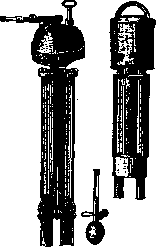
PSYCHROMETERS (from Greek psychros-cold and metron-measure), instruments for measuring the absolute and relative humidity of air (see). Psychrometers are based on the principle of determining the intensity of water evaporation by the degree of decrease in the temperature of the evaporating surface. In sanitary practice, psychrometers are most often used to determine the relative humidity of air. The simplest of all psychrometers is the August psychrometer. It consists of two thermometers mounted on a stand and a small measuring cylinder for water (Fig. 1). A cap made of thin paper fabric (batiste) is placed on the mercury bulb of one of the thermometers, the end of which in the form of a small wick dips into the water cylinder (wet thermometer); the other thermometer remains free (dry thermometer). When the batiste cap is moistened, the first thermometer will show a lower temperature than the other, due to the fact that a certain amount of heat is expended on the evaporation of water from its surface. In this case, the less saturated the air is with water vapor, the more intense the evaporation of water from the wet bulb and the greater the difference between the readings of the dry and wet thermometers. Absolute humidity is calculated in this case by the August formula: A = F_t - K(t - t_1) (1), where A is absolute humidity, F_t is the maximum tension of water vapor corresponding to the temperature of the wet thermometer, expressed in millimeters of mercury column, t is the temperature according to the dry thermometer, t_1 is the temperature according to the wet thermometer, H is the barometric pressure and K is the constant, the so-called psychrometric coefficient. Knowing the absolute humidity, the relative humidity is found by the following formula: R = (A / F) * 100 (2), where R is relative humidity expressed in percent, A is absolute humidity and F is the maximum tension of water vapor corresponding to the temperature of the dry thermometer (maximum humidity). The values of F and F_t in formulas (1) and (2) are found from tables of the elasticity of water vapor. The value of the psychrometric coefficient K changes depending on the movement of air; for different speeds of air movement the following values of K are obtained (according to Zvorykin): Speed of air movement in m/sec. K 0.13... 0.00130 0.00120 0.00110 0.00100 0.00090 2.3... 0.00030 0.00070 0.00069 0.00087 0.16... 0. 2... For simplification of work in calculating relative humidity, ready-made psychrometric tables (with corresponding values for K) are used, where by the readings of the dry and wet thermometers the corresponding value of relative humidity is found. Working with the August psychrometer is simple: the instrument is suspended at the appropriate place, the bulb of the wet thermometer is moistened and after 10 minutes the readings of both thermometers are taken. However, despite its cheapness and simplicity of operation, this instrument suffers from a very significant drawback, consisting in the fact that its readings are influenced by the movement of air. This drawback makes it unsuitable for more or less precise research in sanitary practice, especially in factory premises. This drawback is eliminated in the so-called aspirational psychrometers, the most popular representative of which is the aspirational psychrometer-Assmann. The determination of humidity by the Assmann psychrometer, as by the August psychrometer, is performed by the difference between the readings of the dry and wet thermometers. The essential difference of the Assmann psychrometer lies in the fact that it has a constant speed of air movement in the space surrounding the mercury bulbs of the thermometers. The Assmann psychrometer is arranged as follows (Fig. 2). Both of its thermometers are immersed with their lower ends in metal tubes, open at the bottom, and at the top connected into one central cylindrical tube. The tube contains an inner tube in which the mercury reservoir of the thermometer is located. Such a double shell has the task of isolating the thermometers from the influence of possible thermal radiation. The end of the common tube is connected to a small fan driven by a winding spring. When the fan is operating, a certain constant movement of air is created near the mercury bulbs, about 2.4 m per second. The calculation of absolute and relative humidity is performed by the Sprung formula: A = F_1 - 0.5(F - F_1) (3); R = (A / F) * 100, where A is absolute humidity, F_1 is the maximum tension of water vapor at the temperature of the wet thermometer, F is the same at the temperature of the dry thermometer, t and t_1 are respectively the readings of the dry and wet thermometers, H is the barometric pressure and R is relative humidity. The Sprung formula differs in no essential respect from the August formula; the difference is only that the former already has a constant psychrometric coefficient corresponding to the constant movement of air in the instrument. For the Assmann psychrometer, special psychrometric tables also exist, in which by the readings of the dry and wet thermometers the value of relative humidity is found immediately. Measurements with the Assmann psychrometer are carried out as follows: with a special pipette the wet thermometer is moistened, then the fan is wound with a key and after 3-5 minutes the readings are taken. The Assmann psychrometer is the most convenient and accurate instrument for measuring humidity in sanitary practice. In addition to the August and Assmann psychrometers, the so-called sling psychrometer is sometimes used (Fig. 3). In the investigation, the thermometers mounted in a frame are brought into rotational motion around a rod. The calculation of humidity can be performed by the formula and tables compiled for the Assmann psychrometer. Lit.: Kolobkov N., Meteorological instruments, their design and application, M., 1932; Marshak M., Meteorological factor and labor hygiene, pp. 72-78, M.-L., 1931 (Works and materials of the State Scientific Institute of Labor Protection, No. 13, vol. V, issue 2); Okhlyabin S., Meteorological instruments, production and processing of observations, L., 1915; Pakhomyshev A., Methodology of research of relative humidity of air and comparative evaluation of hygrometric instrumentation (Health improvement of labor and revolution of everyday life, issue 7, pp. 173-200, M., 1925, lit.); the same, Methods for determining the relative humidity of air in working and living premises, Labor Hygiene, 1925, No. 10, pp. 14-40, Rozanov S., Methods for determining the humidity of air, diss., M., 1899; Bongards H., Feuchtigkeitsmessung, Munchen-B., 1926.
Figure 2.
Figure 3.
Related articles
Mentioned in
Cite this page
“Psychrometers.” Soviet Medical Encyclopedia. English translation of Bolshaya Meditsinskaya Entsiklopediya, 1st ed. (Moscow, 1928–1936), ed. N. A. Semashko. https://sovietmedicalencyclopedia.pages.dev/article/psychrometers/