CATATHERMOMETRY
Historical document, translated for reference. It reflects medical knowledge of the 1920s–30s and is not medical advice.
Summary
Catathermometry is a method for determining the cooling capacity of air at human body temperature to establish hygienic norms for comfortable thermal sensation. It uses specialized instruments like the catathermometer to measure how quickly heated objects cool in different atmospheric conditions.
Encyclopedia article (1928–1936)
CATATHERMOMETRY, catathermometers. Catathermometry aims to determine the cooling capacity of air at human body temperature in order to establish hygienic norms for pleasant thermal sensation of a person in air. By cooling capacity of air is meant the combined effect of meteorological factors from which depend the cooling and thermal sensation of a person in air: temperature, humidity, air movement, and radiant energy. To determine this magnitude, a number of instruments have been proposed, of which the most convenient and practical in use, and therefore the most widespread, is the catathermometer (hence the method of determining the cooling capacity of air has been named C.). All instruments of C. can be divided into three groups. The first (A) includes instruments that account for the cooling effect of temperature and air movement, the second (B) - temperature, movement and humidity, and the third (C) - temperature, air movement and radiant heat. Table 1. Instruments Meteorol. factors A. 1. Homootherm of Frankenhauser .... 2. Thermometer of Grosse a. » of Jotten 4. Catathermometer of 5. Calorimeter of Hill b. Apparatus of Reichen- B. 1. Catathermometer 2. Homootherm moist- C. Frigorimeter of Dorn- Tilienius . . t° + air movement t° + movement and humid-( ity of air t° + air movement + radiant heat Homootherm of Frankenhauser represents a cylindrical vessel of thin copper with a surface of 100 cm2, containing 100 g of water, into which a thermometer is dipped. Before the experiment, the instrument is heated to 35° or 38° and then the magnitude of cooling of the instrument in 1 min is determined. The instrument is constructed in such a way that each degree of cooling corresponds to a loss of 1 g-calorie per 1 cm2 of surface of the instrument. Determinations of the cooling capacity of air are performed with a dry instrument, as well as covered with dry and moistened fabric. Grosse (1914) proposed to heat an ordinary thermometer 10° above the ambient air temperature, and then determine the time required for the excess temperature to drop by half, i.e., by 5°. Reichenbach considers that this temperature drop according to Grosse is a more precise measure for determining the cooling effect of air than the readings of the homootherm. Jotten (1924) used the August psychrometer thermometer or a specially constructed thermometer which had a cylindrical mercury vessel, 21/2 inches in height and circumference. To determine the magnitude of cooling, Jotten observed the time of cooling of the thermometer from 35° to 30° or from 35° to 34°. Jotten's experiments showed that his results agreed with the corresponding values of the homootherm. Calorimeter was proposed by Hill and is based on the same principle as the catathermometer. A coil of nickel wire is heated by electric current to human body temperature. The magnitude of air cooling is determined by the amount of current which is expended to maintain the wire temperature at the specified level under given atmospheric conditions. The instrument is recording. On the same principle is constructed the recording instrument of Reichenbach, consisting of a cylinder filled with oil. The temperature of the instrument is maintained at a constant level by means of a wire heated by electric current. Catathermometer was proposed by Hill in 1916. The name of the instrument means that measurements are made by the fall of the alcohol meniscus after preliminary heating of the instrument. The instrument is an alcohol thermometer adapted to measure the cooling produced by air in absolute heat units at human body temperature. It consists of a cylindrical reservoir (fig. 1), filled with colored alcohol. Dimensions of the reservoir: 4 cm in length, bottom hemispherical 1.6 cm in diameter, surface-22.6 cm2; thermometer tube-about 20 cm in length, scale divided into degrees (38-35° C or 100-95° F). The upper end of the capillary tube has an oval expansion into which the alcohol goes when heating the instrument above 38° C. The catathermometer is used dry and wet; in the latter case, a cap of cotton fabric or a finger of a paper glove is put on the reservoir of the catathermometer. The principle of the instrument is as follows: if the C. is heated above 38° C (or 100° F), then when cooling from 38° to 35° it always loses the same definite amount of heat under all possible atmospheric conditions, but the magnitude of this loss per unit time (in a second) varies depending on external conditions. The latter magnitude of cooling can be taken as a characteristic of the given physical conditions of the environment. To determine the magnitudes of cooling of the catathermometer, it is necessary to know the value of the so-called catafactor. This is the number of millicalories lost from 1 cm2 of surface of the C. reservoir during the entire time of cooling of the catathermometer from 38° to 35°. The catafactor is determined once for all for a given instrument and is marked by the workshop which manufactures catathermometers on the tube of the cata. The catafactor is usually denoted by the letter F. The magnitude of cooling of the catathermometer is obtained by dividing the factor by the number of seconds required for cooling of the catathermometer from 38° to 35° under given atmospheric conditions and expresses the number of millicalories of heat which 1 cm2 of surface of the catathermometer reservoir loses in 1 sec. The magnitude of cooling of the dry cata is denoted by the letter H, and of the wet-H1. Determination of the factor of the catathermometer. Griffith's method. The catafactor is determined by the empirical equation (proposed by Griffith): F = 0.27(36.5 - t)T, where t is the temperature of the surrounding air, and T is the number of seconds of cooling of the cata from 38° to 35°. Determinations are performed in a calorimeter or thermostat with double walls, capacity not less than 30 l. Into one of two openings in the upper cover of the thermostat is inserted an accurate thermometer, and into the other-the catathermometer, preliminarily heated in hot water (80°) above 38° (heating of the catathermometer in hot water is done until the alcohol fills half of the upper reservoir of the catathermometer); the time T of cooling of the catathermometer from 38° to 35° is noted and simultaneously the readings of the thermometer are recorded. The observation is performed 5 or more times and average values are taken. Example: average time of cooling of the catathermometer in the calorimeter (from 7 determinations) T=77.8, and average air temperature in the same calorimeter-18.6. Therefore F = 0.27(36.5 - t)T = 0.27(36.5-18.6)77.6 = 375.0. Griffith's method is so simple that it can be performed by everyone working with the catathermometer in a simple laboratory setting to check the factor indicated on the instrument or to establish it, if it was accidentally not indicated. Other methods of determining the catafactor require a complex laboratory setting as well as skill. Practice of catathermometry cells and measurements. Dry and wet catathermometers are used for two purposes: 1) to determine the magnitudes of air cooling, i.e., to judge whether the given atmospheric conditions are healthy and normal, as well as for a more detailed characterization of abnormal conditions and 2) as anemometers to determine the speed of air currents inside rooms. Observations with the dry catathermometer. To find the magnitude of cooling of the dry cata (H) in air, the reservoir of the catathermometer is first immersed in hot water (50-80°) and kept in it until the alcohol fills the capillary of the catathermometer and half of the expansion located in the upper part of the tube. Then the catathermometer is taken out of the water, quickly dried with a dry cloth and hung freely and immovably in the air being tested. The alcohol column begins to fall; at this time, the time of descent of the meniscus from the 38° to 35° division of the scale is noted as accurately as possible by a stopwatch (or second hand of a clock). Such observations are repeated 4 to 6 times; four,-if close data are obtained, and six,-if the data differ significantly. The first observation of four or six is usually discarded. The cooling time of the remaining three or five observations is added together and by dividing the total sum by the number of terms the average arithmetic numbers of cooling seconds (T) are obtained. After this, the factor of the instrument is divided by T and the magnitude of cooling (H) is obtained: H = F/T. Example: let a given catathermometer have a factor of 385 and let, when heated, the catathermometer cools from 38° to 35° in 55 sec. Then the magnitude of cooling characterizing the given atmospheric conditions will be: H = 385/55 = 7.0. The obtained value H=7 shows that under the given air conditions the catathermometer reservoir loses 7 millicalories from 1 cm2 in 1 sec. Heat loss by the dry catathermometer occurs by radiation and conduction. If the air temperature is above 38°, then the catathermometer may also show the magnitude of heating. In this case, the time in seconds for the rise of the catathermometer meniscus from 35° to 38 is determined and the factor of the instrument is divided by the found number of seconds of heating. Determination of the speed of air movement by means of the dry catathermometer.
To determine wind speed, in addition to the cooling value (H), the air temperature (t) during the experiment is determined (preferably with the help of an aspirating psychrometer by Asman). After this, the wind speed (v) is determined according to the formulas of Hill and Hargood-Ash: 1) for speeds less than 1 m/sec, v = 0.40 / H, and 2) for speeds greater than 1 m/sec, v = 36.5 - t, i.e., the difference between the average body temperature and the air temperature (t). If the value of H is less than 0.6, then v is determined by formula (I), but if H > 0.6, then equation (II) is applied. To facilitate calculations using equations (I) and (II), Hill proposed special auxiliary tables, in which v is determined from the value of H. Formulas (I) and (II) are applicable to wind speeds not exceeding 17 m/sec. Formula (I) was obtained on the basis of experiments conducted at an air temperature of 13.9°, and formula (II) at 19.4°. Therefore, formulas (I) and (II) give the actual air movement speeds in those cases when the determination is carried out at the indicated air temperatures. At other temperatures, the air movement values calculated from formulas (I) and (II) deviate from the true values: at lower air temperatures, smaller values actually occur, and at higher temperatures, larger values. In 1928, Hill, together with his collaborators Angus and Newbold, published instead of the previous two a new formula (III), which makes it possible to determine air speeds using a dry catathermometer at various air temperatures without making corrections: The given equation (III) differs from the previous ones only in the magnitude of the coefficients. On the basis of the latter equation, Hill, with the mentioned collaborators, also proposed the nomogram presented here (Fig. 2). The latter contains 3 variable quantities: the value of the dry catathermometer, the dry thermometer, and the speed of air movement. To determine one of these quantities, the found values of the other two should be connected with the edge of a ruler and the required value should be found at the point where the edge of the ruler intersects the third scale. Observations that form the basis of the given equation and nomogram were carried out within the following limits: air speeds from 0.31 to 5.2 m/sec, dry thermometer temperature from 0° to 44.5°, wet thermometer temperature from 0° to 33.5°, relative humidity from 28% to 95%, and barometric pressure from 735 to 760 mm Hg. Extrapolation beyond the indicated limits is not recommended. Values obtained by means of the equation and nomogram are approximate. Corrections for barometric pressure (e.g., in deep mines or in high mountains) can be made according to the formula: H = H0(1 + p0/pt), where H0 is the cooling value at standard pressure p0, and H1 is the same value at any other pressure pt. Observation with a wet catathermometer. Observations by Angus, which were also confirmed by Hill, showed that air humidity does not affect the cooling value of the dry catathermometer and the latter does not provide sufficient data for determining the effect of atmospheric conditions on human wet skin. For this purpose, the wet catathermometer serves. The dry catathermometer shows heat loss by radiation and conduction; the wet one indicates cooling by radiation, conduction, and evaporation. The difference between the readings of the wet and dry catathermometers indicates heat loss by evaporation. In research, the wet cat (an ordinary catathermometer, on the reservoir of which a finger of a glove made of silk or paper fabric is placed) is heated by immersion in water, just like the dry catathermometer. Excess water in the form of a hanging drop at the bottom of the reservoir is removed. The instrument then remains in the air being studied, and the number of seconds of cooling is observed, as in the dry catathermometer. The cooling value of the wet catathermometer is calculated in the same way as in the case of the dry catathermometer, by dividing the factor by the number of seconds of cooling of the instrument from 38° to 35°. The quotient gives the numerical expression of the heat loss value of the wet cat H1 from 1 m2 in 1 sec. In moving air, the ratio of the cooling value of the wet catathermometer H1 to the wind speed (v) is expressed by the following equation: H* = (1.115 H* + 0.268)(28.65 - 0.409 t - 0.00346 t2 - 0.000224 t3), and from this we obtain for v: 0.4/----------- "" У 5ЩГ ffi 0,4564,-0,00386 t* -0,000250tf -0,24.(IV) To determine wind speed according to equation (IV), it is necessary to preliminarily determine in the given air the readings (H1) of the wet catathermometer and (tx) of the wet thermometer. To facilitate calculations according to equation (IV), Hill proposed a nomogram, which greatly facilitates the determination of wind speed from the data H1 and tt. The nomogram is constructed in the same way as the nomogram for the dry catathermometer placed above (Fig. 3). The determination of tx must be made with the help of a wet thermometer, around the reservoir of which a certain constant air movement is ensured (e.g., in an aspirating psychrometer by Asman). Norms of catathermometer readings. The normal cooling value of the dry catathermometer, according to Hill, for a resting person or one performing light physical work lies between 6 and 7 millicalories. According to the wet catathermometer, the indicated limits are between 18 and 20. Under these conditions, a normally dressed healthy person has a normal pleasant thermal sensation in the air, which in America and England is determined by the word 'comfort'. A reading of the dry catathermometer below 5.5 indicates that the given atmospheric conditions have a weak cooling effect. In such air, the release of heat from the human body by conduction and radiation is hindered, and the body is threatened with overheating if increased sweating does not occur. According to Hill, sweating appears in a resting person at a cooling speed of the dry catathermometer of about 3, and of the wet one of 12, which is also confirmed by observations of other authors. When the cooling value of the dry catathermometer is greater than 7, the cooling power of the air is considered high for a resting person; such a person experiences a sensation of cold. According to Vernon, the norms of these values may vary depending on the acclimatization of the population to different air temperatures; thus, in summer, according to Vernon's experience, a person receives normal thermal sensation at cat readings closer to 5, and in winter the sensation of comfort shifts to 7. In addition to the time of year (acclimatization), the catathermometer norms, as well as the zone of comfort of effective temperatures, depend on the following factors: clothing, climate, amount of radiant heat falling on the human body, and the type and intensity of physical labor. On a sunny day, when the human body receives a certain amount of radiant energy, a person can have a normal thermal sensation or receive a sensation of excess heat at catathermometer readings in the shade significantly greater than 7. An example can be heliotherapy of children in Davos, where in winter, on sunny, windless days, they spend time naked in the open air, for example, skiing on snow. Undoubtedly, the type of heating can also change the optimal cooling values in rooms: with heating by stoves, which give off a large amount of radiant energy, or in workshops with heated machine and apparatus parts emitting heat, the catathermometer readings in the air in which workers feel 'comfort' should be higher than Hill's norms. The latter obviously apply only to rooms without an excess of radiant heat. For a working person and therefore releasing a large amount of heat, the cooling value must be greater than for a resting person. A person's well-being performing a certain physical work does not suffer as long as the cooling value of the air corresponds to the heat release by the body. For different types of work, different cooling of the body by the air is required. Hill gives the following two tables, which indicate the necessary cooling of the air at different physical work without impairing the worker's well-being. Table 2. Professions Tailor . . Bookbinder Shoemaker Carpenter1. Metalworker Painter . . Stonecutter Sawyer Total heat release in 1 hour of work (in large calories) Cooling value of the dry catathermometer required to prevent sweating 112 142 149 170-206 190 201 317 379 5.44 6.88 7.24 8.4-10.4 0.24 Й, 76 16.44 18.48 T a Г> Л. B. Type of work Hi 1U 18 25 30 Light physical work..... Heavy physical work .... If the catathermometer readings are below the indicated values, then, according to Hill, work takes place under unfavorable conditions due to impaired heat dissipation from the body. In 1922, Orenstein and Ireland from South African mines published the following scale of catathermometer readings and corresponding physiological reactions observed in workers carrying labor in the indicated mines naked (Table 4). From the given data, it is evident that the working capacity of naked workers in mines at high air temperatures begins to decrease at readings of the dry catathermometer below 6 and of the wet one below 16.
In the most favorable workplaces with readings of the dry catathermometer less than 1.5 and the wet one below 5, labor productivity decreased by 55% or more. * With readings of the wet catathermometer above or below 13.5-16 in still air, according to Heiman and Korff-Pettersen, unpleasant sensations are observed. Outdoors, when the body is heated by radiant heat from the sun, with a pleasant cool breeze, H1=20-35 is observed; on a windy sunny day, 30-45; with very cold wind, 80-90 millicalories. In the engine room, where the air feels stuffy and motionless, H1=15-16 or less. On stuffy days in Egypt on a veranda-12-15; in spinning departments of textile factories (Leningrad)-10-14 (people were sweating); under the forced ventilation pipe there-18-21; in a workshop for ammunition with poor ventilation-11-12 (people were sweating); in a well-ventilated forge-21. In mines, an average of about 13 is observed, in poor mine locations-10 or less. Disadvantages and advantages of the catathermometer. Various authors point out the following disadvantages of the catathermometer. 1. The readings of the catathermometer are inaccurate and approximate. Hill and his colleagues indicate that the instrument gives errors of 10-20%. Heiman and Korff-Pettersen note that the readings of the catathermometer show fluctuations of up to 8% on average. With increased air movement, the values found by the catathermometer show fluctuations of up to 12% (Yakovenko). 2. The reservoir of the catathermometer is not homogeneous and consists of glass and alcohol with very different thermal conductivities. During cooling in the catathermometer reservoir, convective currents occur, which disrupt the proper course of cooling. 3. The cylindrical shape of the catathermometer reservoir adversely affects the cooling process of the instrument. The most perfect would be a reservoir in the form of a sphere, in which all points of the surface are at the same distance from the center. 4. The cooling of the catathermometer proceeds differently depending on the speed of heating and even on the depth to which the reservoir was immersed when heated. 5. The instrument gives incorrect readings in the presence of bodies emitting radiant thermal energy (for example in mines with heated rocks, in foundry workshops with furnaces emitting heat). Despite these disadvantages, the catathermometer has acquired great practical importance, especially for industrial hygiene in investigating the physical conditions of air in industrial enterprises, since the readings of the catathermometer are very valuable for characterizing and improving the physical conditions of air for the working person. The catathermometer can render particularly great service in the study of ventilation installations, as shown by research in the USSR and abroad. The catathermometer was introduced into the practice of hygienic research in the USSR in early 1925-after the publication of articles by Prof. Khlopin and Dr. Yakovenko and after the Main Chamber of Weights and Measures began to produce the instrument on a mass scale. Laboratory research aimed at resolving a number of unclear methodological questions has been carried out to a small extent in the USSR (works of the Institute of Labor Protection, Leningrad Institute of Industrial Hygiene and Safety); most of the work was done under production conditions, and the scope of application of the cat was not precisely established. As a result, much material has accumulated, which, due to the lack of a unified plan and clearly defined objectives in the work on the application of the cat, has not yielded definite results. In that area where the application of the cat could give the most accurate results, namely in assessing the effectiveness of health measures carried out in enterprises, very little work has been done; in many cases, they limited themselves to only determining H and N1 with the aim of establishing the presence of comfort or discomfort; only in some works were there attempts to establish comfort indices for a number of professions, and even these works were random and sporadic. This unsatisfactoriness of the results obtained with an instrument that requires a great deal of time has led some authors (Khmaldze, Balabuyev, Landa) to question the very method of catathermometry. In order to summarize the work done in this field to date, to establish the precise scope of application of the instrument, and to introduce more planning into further work with it, a special all-union conference on this question was convened at the Institute of Labor Protection in early 1930. At the conference, a number of reports were read that critically evaluated catathermometry from both physical and hygienic points of view. The conference passed a resolution in which, recognizing all the shortcomings and imperfections of the cat, it nevertheless recognized the advisability of further work with it under production conditions, with its scope of application precisely limited to those limits in which it gives the best results, namely in assessing the effectiveness of health measures (mainly ventilation installations); a number of proposals were also made regarding changes in the construction of the cat itself. Questions about the formula for determining the catafactor, about the relationships between the cooling of the cat and the human body, about establishing comfort indices for a number of basic professions under various combinations of meteorological conditions-were recognized as requiring further in-depth study both in laboratory and production conditions.
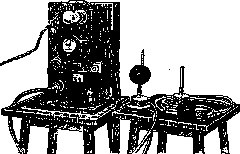
Figure 4.
The Dorno-Thilenius frigorimeter, or Davos. The instrument is designed to determine the physiological magnitude of cooling that occurs under the simultaneous action of the following meteorological factors: temperature, air movement, radiant energy of various wavelengths, and atmospheric precipitation (Fig. 4). An essential part of the instrument is a blackened copper sphere, the temperature of which during the determination of the cooling magnitude is maintained at 33°, the average temperature of human skin. The frigorimeter has the advantage over the catathermometer that it gives a magnitude of cooling that takes into account the action of surrounding radiant energy. The disadvantages of the frigorimeter include its inaccessibility and complexity of design. The frigorimeter should find wide application in the study of climates, as well as in enclosed spaces where a person, along with other factors, is subjected to increased action of radiant energy (mines, foundry workshops, etc.).- In conclusion, it can be said that none of the instruments described fully takes into account the combined effect of all factors acting on the human organism: temperature, humidity, air movement, and radiant heat. The readings of all instruments are conditional and approximate, and some of the described instruments, depending on the surrounding conditions, can give data closer to determining the cooling power of the air and the thermal well-being of a person in the air than others. For example, in the absence of radiant heat and sharp fluctuations in air humidity, the readings of the dry catathermometer at normal air temperatures can characterize with the greatest probability the thermal sensations of a person in the air, since the conditions acting on the cooling of the human body and the catathermometer will be the same: temperature and air movement. In the case of the simultaneous action of radiant energy (for example, open places on sunny days, workshops with strongly heated parts of machines, etc.), the readings of the catathermometer are insufficient for judging the thermal sensations of a person in the air under these conditions, and it is better to be guided by the readings of the frigorimeter.
V. Not markers.
Related articles
Mentioned in
Cite this page
“CATATHERMOMETRY.” Soviet Medical Encyclopedia. English translation of Bolshaya Meditsinskaya Entsiklopediya, 1st ed. (Moscow, 1928–1936), ed. N. A. Semashko. https://sovietmedicalencyclopedia.pages.dev/article/catathermometry/