MENISCUS
Historical document, translated for reference. It reflects medical knowledge of the 1920s–30s and is not medical advice.
Summary
The meniscus refers to the curved surface of a liquid in capillary tubes. Its shape—concave for wetting liquids like water in glass tubes and convex for non-wetting liquids like mercury in glass tubes—depends on the balance between molecular cohesion forces and adhesion forces to the tube walls.
Encyclopedia entry (1928–1936)
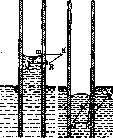
MENISCUS, the form of a liquid's surface in capillary tubes. If a liquid wets the walls of the tube (e.g., water in a glass capillary), the meniscus is concave; for a non-wetting liquid (e.g., mercury in a glass capillary), the M. is convex. The particular form of the M. depends on the relationship between the forces of molecular cohesion (M) and the forces of adhesion of the liquid to the wall (K). If K > M (the case of wetting), then the resultant of these two forces R is directed toward the wall (fig.); the liquid rises in the capillary, and its surface has a concave form, because at equilibrium the surface of the liquid is always perpendicular to the acting force. If however K < M (non-wetting liquid), then the resultant R is directed toward the liquid, and the M. has a convex form.
Related articles
Mentioned in
Cite this page
“MENISCUS.” Soviet Medical Encyclopedia. English translation of Bolshaya Meditsinskaya Entsiklopediya, 1st ed. (Moscow, 1928–1936), ed. N. A. Semashko. https://sovietmedicalencyclopedia.pages.dev/article/meniscus/