Burette
Historical document, translated for reference. It reflects medical knowledge of the 1920s–30s and is not medical advice.
Summary
This article from the 1928–1936 Great Medical Encyclopedia describes the construction and use of burettes and microburettes in chemical and medical analysis, alongside the functions of the All-Union Bureau of Foreign Sanitary Information.
Encyclopedia article (1928–1936)
BURETTE (from French burette - jug), a graduated glass tube used for precise measurement of liquid volumes.
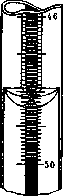
Figure 1.
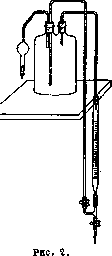
liquids (or gases in the case of gas burettes). To discharge liquid, the burette is equipped at the bottom with a stopcock or rubber tubing with a clamp. It is very convenient to use rubber tubing with a glass bead or short rod inserted in the middle. By pressing the rubber with fingers from two sides above the bead, a narrow slit is formed through which the liquid flows. Rubber closures are unsuitable when working with permanganate and iodine solutions, which destroy the rubber and decompose themselves. Stopcocks are inconvenient for alkaline solutions, which damage the ground glass joints and cause the stopcock to stick. To avoid errors associated with incorrect eye position when reading the liquid level in a burette, it is convenient to use a burette with a colored stripe on the back (Shellbach burette), reading not by the edge of the meniscus, as is usually done, but by the tip of the stripe (see Figure 1). With frequent use of a solution, the burette is usually directly connected to a bottle (see Figures 2 and 3), and there are a number of devices that ensure automatic adjustment of the liquid level to zero (see Figures 4 and 5). For measuring very small quantities of solutions, microburettes are used, with divisions down to hundredths of a cubic centimeter. Such microburettes are easily made from ordinary bacteriological pipettes by equipping them with a rubber closure (with a bead). Figure 6 shows such a burette connected to a bottle for solution.
V. Engelhardt. BUREAU, ALL-UNION OF FOREIGN SANITARY INFORMATION, established pursuant to the decree of the Council of People's Commissars of the USSR on July 1, 1927, is an all-Union body attached to the People's Commissariat of Health of the RSFSR; it carries out all types of official sanitary and scientific communication with foreign countries in the field of public health. Its duties include: summarizing, processing, and publishing information on the sanitary state of the Union based on materials received from the People's Commissars of Health of the union republics; liaison with the Office International d'Hygiène Publique regarding the course of epidemic diseases, the state of public health, and sanitary legislation in the Union, as well as the exchange of periodic information on the sanitary state of the Union with those states with which agreements on this matter exist. The Bureau oversees the implementation of measures arising from the Regulation on the Sanitary Protection of the Borders of the USSR (Collected Laws 1926, No. 69, Art. 532) and coordinates its actions with the People's Commissariat for Foreign Affairs. The Bureau includes one representative from the Commissariats of Health of all union republics. The Bureau conducts its relations with foreign countries on scientific, medical, and sanitary issues (scientific congresses, conferences, exhibitions, "scientists' weeks," etc.) through representatives in Germany, France, and America. All issues related to foreign business trips along the public health line (scientific, administrative assignments) are also resolved by the Bureau, which thus serves as the body regulating personal scientific ties with foreign countries. With the aid of its representations, the Bureau informs the public circles of the respective countries about the achievements of Soviet medicine and promotes mutual scientific exchange between the USSR and foreign countries ("Russian-German Medical Journal," etc.).
Related articles
Mentioned in
Cite this page
“Burette.” Soviet Medical Encyclopedia. English translation of Bolshaya Meditsinskaya Entsiklopediya, 1st ed. (Moscow, 1928–1936), ed. N. A. Semashko. https://sovietmedicalencyclopedia.pages.dev/article/burette/