Clamps
Historical document, translated for reference. It reflects medical knowledge of the 1920s–30s and is not medical advice.
Summary
This article from the 1928–1936 Soviet Great Medical Encyclopedia details the history, types, and uses of surgical clamps. It covers their design, materials, and specific applications for hemostasis, organ removal, and gastrointestinal surgery.
Encyclopedia article (1928–1936)
CLAMPS. A. Clamps as a surgical instrument serve for seizing bleeding vessels, as well as for crushing tissues to be removed; during removal they prevent bleeding and the outflow of organ contents, and facilitate the joining of the remaining part of the organ or tissue. Clamps are constructed on the principle of a lever and have, in comparison with the grasping surface, long, sturdy handles. For strength, they are made of the best steel and are well nickel-plated. Unplated, rusted clamps are unfit for use. A significant achievement is the application of stainless steel. Clamps consist of two crossing halves connected by a lock. For the convenience of sterilization and cleaning, the two halves are separated. Each half has at one end a grasping surface and at the other rings for fingers or sturdy handles with a ratchet for squeezing. Corresponding to their purpose, surgical clamps are divided into hemostatic and gastrointestinal (including clamps for other organs). A strict division of clamps cannot be made, as the same clamps are sometimes used for different purposes. The most delicate clamps are proposed for operations on organs requiring extreme caution, such as the eye and brain tissue, where both the vessels and the tissue itself are so delicate that the use of ordinary clamps not only hinders the operation but also harms it by grasping the tissue together with the vessels. Among these, the most commonly used are Halsted clamps, straight or curved under the name Mosquito (Fig. 1). For seizing vessels during ordinary operations on soft tissues, clamps proposed by Pean (Fig. 2) are widely used. They have a wide grasping surface equipped with small teeth and depressions. When closed, the teeth on one jaw fit into the depressions of the second and prevent the slipping of the clamp. Duvalen clamps (Fig. 3), which have more sturdy jaws, are more convenient. The grasping surface is of olive shape with a steeply cut end, beginning directly from the lock. The squeezing jaws are significantly longer than the grasping ones, and thus the point of application of force is located on a long lever capable of giving a secure closure of the ends with little force. In idea, these clamps were intended for crushing vessels to avoid ligating them. For this purpose, elevations and grooves are arranged on the contacting surfaces. But this is not always successful. Slightly different from Duvalen clamps is the Halsted clamp, which has a notch on the side of contact of the jaws (Fig. 7). The ingenious device has the Schumacher clamp in the form of a notch at the end for placing a ligature deep in the wound (Fig. 8). Kocher clamps are arranged differently; they are intended, depending on the operation, for seizing vessels or compressing tissues. They differ from the previous ones in that they have a long, narrow grasping surface with serrations and a triangular sharp projection at the end of one jaw with a corresponding sized notch on the other (Fig. 4). Unlike Pean clamps, they are extremely convenient for grasping tissues and vessels during bone operations, operations on tendons and fasciae. Thanks to their large grasping surface, clamps are also convenient for grasping and compressing bleeding parenchymatous organs where individual vessels are sometimes difficult to find. For this purpose, they were proposed by Kocher for operations on the thyroid gland. Clamps of Kocher's principle are arranged by Reverdin (Fig. 5), Collen, Pozzi, with curvature by Cournand (Fig. 9). For operations on the vascular system (during resection) or for temporarily stopping the flow of blood at a distance during tumor removal (resection of the upper jaw), to restore circulation at the end of the operation, Diffenbach (Fig. 14) and Heffner (Fig. 15) proposed special delicate clamps, upon application of which the vessel sheath suffers not at all. For precaution, thin rubber tubes are put on the jaws, which by their elasticity protect the vessel from damage. Holding a vessel without compression is well achieved by the Prat-Smith clamp (Fig. 6). When seizing large vessels, especially deep in the wound, or during organ removal (kidney, spleen), tumors on a stalk where slipping of a small clamp is possible or many clamps are required to be applied, large crushing clamps according to Collen, straight or curved (Fig. 10) and Pean (Fig. 28) are used. For compressing the renal or splenic stalk, more convenient are sharply curved Collen or Bobrov clamps (Fig. 11). When various tissues, sometimes infiltrated or edematous, enter the area to be ligated, one can use sturdy Landau, Billroth (Fig. 12), Duvalen (Fig. 13) clamps, which completely crush tissues and together with them vessels, which greatly facilitates ligating the stump en masse. During operations on parenchymatous organs, different clamps are used depending on the purpose: for temporary compression more delicate ones, for crushing sturdy ones (Collen). Clamps used during hemorrhoid operation have a round, oval, or triangular shape with a window (Hegar, Fig. 30; Louer, Fig. 31 and 32). For temporary compression of the penis to prevent bleeding during operation or to retain an injected into the urethra solution, special clamps (Lenstein, Fig. 22; Strauss, Fig. 23) have been proposed. For bloodless phimosis operations, Thorwaldt-Skillern clamps (Fig. 42) are convenient. Among fixing clamps, special ones for the kidney (Fedorov), for the prostate, for bladder tumors (Fedorov, Fig. 27) are applied. Gastrointestinal clamps represent great diversity in size and shape and are intended for two purposes: 1) for crushing the stomach or intestine at the boundary with the healthy part to facilitate subsequent suture and 2) for temporary compression of the lumen of the organ to prevent the outflow of contents. In the first case, the same clamps are used which were proposed by Collen, Duvalen, Billroth for mass compression of vessels with other tissues. A similar clamp was proposed by Zweifel (Fig. 25) and Martynov (Fig. 40) for compressing the appendix during appendectomy. In the second case, clamps are more delicate and should not cause tissue necrosis upon compression of the organ. At present, gastric and intestinal clamps are almost not distinguished, since both are used equally in operations on the stomach and intestine. The most common clamps are the Kocher model or more delicate, straight or curved Duvalen (Figs. 33 and 34). All of them have the disadvantage that when applied they compress tissues near the lock more strongly and barely hold at the end. Kocher clamps with a lock at the end (Fig. 36) and toothed (Fig. 37) to prevent slipping strongly compress and are therefore not always applicable. Until recently, Pein clamps were widely used during stomach resections (Figs. 29 and 35). Of those specially proposed for intestinal operations, Fig. 48.
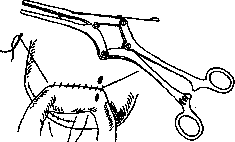
Figure 48.
There are delicate Kocher clamps with thin straight or curved blades and curved right-angle Mikulicz clamps (Fig. 16). In recent times, three-bladed Linartz clamps (Fig. 41), Haberer and Meyer clamps (Fig. 39), which greatly facilitate suture placement during gastroenterostomy, Billroth I resection, and intestinal operations, have become widely used. They have narrow, delicate blades, are easily taken apart and folded during the operation. The inconvenience is that in the absence of a ligature at the ends, sometimes the organ slips out and they are unsuitable for Billroth II resections. In this respect, Spasokukotsky clamps are extremely simple and convenient. They represent a metal gutter into which a sturdy rod is inserted. There is a lumen between the walls of the gutter and the rod (Fig. 38). The inserted stomach or intestine is fixed sufficiently firmly by the rod at the handle. The presence of a ring at the end of the clamp prevents the organ from slipping out. This clamp is applicable in all stomach and intestinal operations. All the clamps mentioned above still do not allow the maintenance of complete asepsis during suture placement. Therefore, there is a striving to improve suture technique—an aseptic suture. For this purpose, Oshman proposed clamps in connection with a suture machine at one time, and in 1926 Cukor proposed clamps in connection with a suture machine, which facilitate and accelerate suture placement (Fig. 24). The disadvantage is the complexity of the clamps. Complete asepsis can be maintained when using Duane clamps (Fig. 19) or Brown clamps (Fig. 48). The blades are introduced through small openings into the lumen of the contacting organs, and the suture is applied on both sides of the clamp. After the suture is completed, the surfaces of the organs are cut with a knife, the clamp is removed, and the opening is sutured. However, their field of application is limited to gastroenterostomy and enteroanastomosis. For the placement of an aseptic intestinal end-to-end suture, narrow Rostovtsev clamps (Fig. 17 and 18) are convenient. Among the fixing clamps used in operations, there are curved Mikulicz clamps (Fig. 26) for fixing the edges of the incised peritoneum and curved Bakhaus clamps (Fig. 21) and Schädel clamps (Fig. 20) for fastening sterile sheets or towels to the patient's body. B. Laboratory clamps are used 1) in experiments on animals and 2) for fixing various objects and compressing tubes. In the first case, the same clamps are used as in operations on humans. In the second case, clamps made of wood or metal have been proposed for fixing burettes on stands. The latter are the most common. There are one-, two- (Fig. 47) and four-bladed clamps, which move and spread with a screw. For fixing test tubes with liquid and during the boiling of the latter, special wooden (Fig. 44) or metal clamps are used. For various kinds of staining, spring metal Bitter clamps (Fig. 43) are convenient for holding cover slips and object glasses. For compressing rubber tubes, there are spring Moritz clamps (Fig. 46) or more precisely regulating Hoffmann clamps (Fig. 45).
Related articles
Mentioned in
Cite this page
“Clamps.” Soviet Medical Encyclopedia. English translation of Bolshaya Meditsinskaya Entsiklopediya, 1st ed. (Moscow, 1928–1936), ed. N. A. Semashko. https://sovietmedicalencyclopedia.pages.dev/article/clamps/