Ergography
Historical document, translated for reference. It reflects medical knowledge of the 1920s–30s and is not medical advice.
Summary
Ergography is a method and instrument for recording muscle work, developed by Mosso and others. It is used to study fatigue, muscle performance, and the effects of substances like alcohol and tobacco on the human body.
Encyclopedia article (1928–1936)
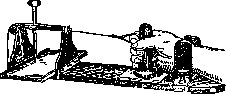
ERGOGRAPHY, ERGOGRAPH (from Greek ergon-work and grapho-write), a device and method proposed by Mosso for recording work. An ergograph consists of a stand for the forearm and an attachment for recording the movement of a weight (Fig. 1). To achieve immobility of the forearm, the stand is equipped with clamps. The fingers are placed in metal tubes, of which only one—for the middle finger—can move up and down; to this tube is attached a thick string (from a cello), at the other end of which, passing over a pulley, hangs a weight. When the muscles of the middle finger contract, the string lifts the weight upward, and the attached pen records on a kymograph the rises and falls of the weight (an ergogram). Binet proposed making the tube for the middle finger of two parts: a fixed and a movable one; then the tube, representing a kind of joint of the finger, gives more natural conditions for its bending. Binet also constructed an ergograph with a spring replacing the weight. Henry proposed a very simple and inexpensive mercury ergograph, consisting of a rubber bulb with a rubber tube and then a glass tube leading upward from it. All is filled with mercury, on which in the glass tube floats a float with a horizontal pen. When the bulb is compressed and relaxed, the mercury raises and lowers the pen, which records the ergogram. Dubois's ergograph is built on the same principle as Mosso's (Fig. 2), but the recording is done with a pencil on paper placed in a carriage moving perpendicular to the pencil's movement. The carriage's movement and the work are performed by the flexing index finger (through a special transmission mechanism). The non-working four fingers enclose a vertical wooden pillar. The disadvantage of Mosso's and Dubois's ergographs is that, despite the devices, they cannot completely isolate the working muscle from the non-working ones. With strong fatigue of the working muscle, the non-working ones begin to help it. Ergographs exist for the biceps, neck muscles, and legs. Sechenov constructed an ergograph for recording sawing movements of the hands. In the USSR, Mosso's and Dubois's ergographs are on sale. Dubois's ergograph is significantly cheaper than Mosso's, as it does not require a kymograph. A vast amount of experimental work has been done with ergographs to study fatigue in adults and children, in factories, schools, and laboratories. Studying the obtained ergograms from a mathematical point of view made it possible for Joteyko to express the work (at a rate of 30 times per minute) performed on the ergograph by the formula of a third-order parabola: n = H - aP + bt^2 - ct, where H is the maximum effort (in mm), n is the desired effort, and a, b, and c are constants. Mosso's old experiments showed that mental fatigue reduces work on the ergograph. Further research in ergography showed that four types of ergograms are obtained, having: 1) a convex shape at first, 2) a smooth gradual decrease in rises, 3) after initial large rises a rapid fall in their height, 4) a convex shape in the middle. Based on the study of ergograms, attempts were made to rationalize the work of schoolchildren. Examining ergograms before and after productive work, one also judged the fatigue of workers in factories, in sewing, porcelain, and other productions. With repeated work on the ergograph, a strong trainability is observed, especially expressed in the prolongation of the moment of muscle failure to lift a given weight. Treves showed that a muscle that has refused to lift a given weight can lift a smaller weight without rest; the same rule exists for the rate. Efimov found that with lifts of a medium weight to the same height at the maximum possible frequency, the obtained ergograms of "maximum frequency" show not a gradual but a stepwise decline in working capacity; about 5 steps are formed. Ergography is used to reveal diseases of muscles and the nervous system. Nervous patients, for example, hysterics, give characteristic deviations from the ergograms of healthy subjects. Schulze and Chuchmarev studied the emotional state of the subject through work on the ergograph. The ergograph is also used to study the action on the human body of alcohol, tobacco, caffeine, etc. Lit.: Bane A. and Henry V., Mental Fatigue, Moscow, 1899; Efimov V., Studies of Workers' Fatigue as a Method of Scientific Determination of Output Norms, Labor Hygiene, 1923, No. 8-9; Mosso A., Fatigue, St. Petersburg, 1899; Whipple G., Manual of the Study of Physical and Mental Activity of School Children, Moscow, 1893; Schulze R., Practice of Experimental Psychology, Pedology, and Psychotechnics, Moscow, 1926; Joteyko J., Lois de l'ergographie, Inst. Solvay. trav. du lab. de physiol., v. VI, 1904; Efimov W., Versuch die nerven-geistige Tatigkeit und Ermiidung vom Stand-punkt einiger Gesetze d. physikalischen Quantentheorie zu untersucheu, Seientia, v. LIV, 1933.
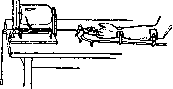
Fig. 1. Mosso's ergograph.
Fig. 2. Dubois's ergograph.
The disadvantage of Mosso's and Dubois's ergographs is that, despite the devices, they cannot completely isolate the working muscle from the non-working ones. With strong fatigue of the working muscle, the non-working ones begin to help it. Ergographs exist for the biceps, neck muscles, and legs. Sechenov constructed an ergograph for recording sawing movements of the hands. In the USSR, Mosso's and Dubois's ergographs are on sale. Dubois's ergograph is significantly cheaper than Mosso's, as it does not require a kymograph. A vast amount of experimental work has been done with ergographs to study fatigue in adults and children, in factories, schools, and laboratories. Studying the obtained ergograms from a mathematical point of view made it possible for Joteyko to express the work (at a rate of 30 times per minute) performed on the ergograph by the formula of a third-order parabola: n = H - aP + bt^2 - ct, where H is the maximum effort (in mm), n is the desired effort, and a, b, and c are constants. Mosso's old experiments showed that mental fatigue reduces work on the ergograph. Further research in ergography showed that four types of ergograms are obtained, having: 1) a convex shape at first, 2) a smooth gradual decrease in rises, 3) after initial large rises a rapid fall in their height, 4) a convex shape in the middle. Based on the study of ergograms, attempts were made to rationalize the work of schoolchildren. Examining ergograms before and after productive work, one also judged the fatigue of workers in factories, in sewing, porcelain, and other productions. With repeated work on the ergograph, a strong trainability is observed, especially expressed in the prolongation of the moment of muscle failure to lift a given weight. Treves showed that a muscle that has refused to lift a given weight can lift a smaller weight without rest; the same rule exists for the rate. Efimov found that with lifts of a medium weight to the same height at the maximum possible frequency, the obtained ergograms of "maximum frequency" show not a gradual but a stepwise decline in working capacity; about 5 steps are formed. Ergography is used to reveal diseases of muscles and the nervous system. Nervous patients, for example, hysterics, give characteristic deviations from the ergograms of healthy subjects. Schulze and Chuchmarev studied the emotional state of the subject through work on the ergograph. The ergograph is also used to study the action on the human body of alcohol, tobacco, caffeine, etc.
Ergography is used to reveal diseases of muscles and the nervous system. Nervous patients, for example, hysterics, give characteristic deviations from the ergograms of healthy subjects. Schulze and Chuchmarev studied the emotional state of the subject through work on the ergograph. The ergograph is also used to study the action on the human body of alcohol, tobacco, caffeine, etc.
Related articles
Mentioned in
Cite this page
“Ergography.” Soviet Medical Encyclopedia. English translation of Bolshaya Meditsinskaya Entsiklopediya, 1st ed. (Moscow, 1928–1936), ed. N. A. Semashko. https://sovietmedicalencyclopedia.pages.dev/article/ergography/