Ergometer
Historical document, translated for reference. It reflects medical knowledge of the 1920s–30s and is not medical advice.
Summary
An ergometer is a device for precise dosing of mechanical work applied to a subject. It is primarily used in labor physiology laboratories, with the most common type being the bicycle ergometer developed by American physiologist F. Benedict, which uses electromagnetic braking to measure work output.
Encyclopedia article (1928–1936)
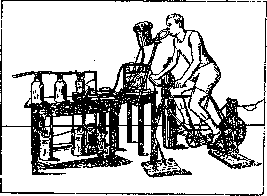
ERGOMETER, a device for precise dosing of mechanical work applied to a subject. It is used mainly in laboratories of labor physiology. The most widely used E. is that of American physiologist F. Benedict, the so-called bicycle-ergometer (see fig.). The device consists of a bicycle fixed on a wooden stand; instead of the rear wheel, a disk of red copper 7 mm thick and 42 cm in diameter is mounted on the axle. The disk passes between the poles of a strong electromagnet, through the coil of which flows an alternating electric current. The eddy currents developing in the disk due to this brake the movement of the latter. By means of special tables, it is possible to accurately calculate the amount of mechanical work performed by the subject at one or another current strength in the electromagnets.
Amar proposed an ergometric bicycle in which a steel band or belt acts as a brake on the rim of the rear wheel (bicycle à frein). This E. can also be used for dosed work of the hands. Amar's E. was used to study the work of amputees. For hand work, Kekcheev proposed the so-called vertical E., based on the use of an electromagnet to lift a dosed weight. The return movement is performed without load due to a special switch. An E. of this system is used to study the work of hands or legs.
Related articles
Cite this page
“Ergometer.” Soviet Medical Encyclopedia. English translation of Bolshaya Meditsinskaya Entsiklopediya, 1st ed. (Moscow, 1928–1936), ed. N. A. Semashko. https://sovietmedicalencyclopedia.pages.dev/article/ergometer/