Galvanometer
Historical document, translated for reference. It reflects medical knowledge of the 1920s–30s and is not medical advice.
Summary
This article from the 1928–1936 Great Medical Encyclopedia describes the principles and types of galvanometers, instruments used to measure electric current. It explains their operation based on electromagnetic interactions, detailing both moving-magnet and moving-coil designs such as those by Deprez-d'Arsonval and Einthoven, and notes their applications in physiology and medicine, including the electrocardiograph.
Encyclopedia article (1928–1936)
GALVANOMETER, an instrument used to measure the strength of an electric current. Conventional galvanometers are based on the interaction between a current and a magnet, which consists of the following: if there is a magnet positioned such that its north pole points upward (see Figure 1 A) and its south pole downward, and a conductor with an electric current flowing in the direction of the arrow is placed above the magnet as shown in the drawing, then for an observer moving in the direction of the current and looking at the north pole of the magnet, the deflection of the magnet would occur to the left. Conversely, if the magnet were held in place,
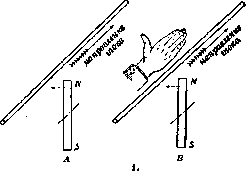
Fig.
then the deflection of the current would occur to the right from the same observer (Ampere's rule). If the right hand is placed on the current so that the current enters the base of the hand and exits through the fingers (see Figure 1 B) and the palm faces the current, the north pole will deflect toward the thumb (Maxwell's rule). The simplest galvanometer consists of a wire through which a current flows, with a magnetic needle placed beneath the wire. The plane of the wire without current is parallel to the plane of the needle, and the action exerted by the current on the north and south poles will be opposite, resulting in a deflection of the needle when the current is closed. Since the needle is held in a position of equilibrium by the action of the earth's magnetic field,
R____g representing a force directed from south to north for the north pole of the needle, and since the force arising under the influence of the electric current creates a component in a direction perpendicular to this first force, two forces act on the N end of the needle, combining according to the parallelogram rule (see Figure 2). Force A depends on the earth's field, and force B on the action of the current. Both forces produce a resultant R. The needle will deflect until this resultant R acts in the direction of the needle itself. Thus, the greater the current strength i and, consequently, the greater force B (B is proportional to i), the greater the deflection of the needle will be. Usually, in galvanometers, the needle is placed on a thin thread inside a vertical coil in which all parts act consonantly in terms of deflecting the north and south poles of the needle (see Figure 3). This produces an increase in action corresponding to the increase
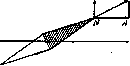
Fig.
in the number of turns, the so-called multiplication. In a galvanometer of another type, the magnet is stationary and the current is movable. Such galvanometers include the Deprez-d'Arsonval galvanometer and the Einthoven galvanometer, which consists of a thin wire AA (up to 1 µ in thickness; see Figure 4) placed in a strong magnetic field. Such a wire tends to move in a direction perpendicular to the magnetic lines of force and to the direction of the current (see arrow d); by observing the deflection of the wire under a microscope, one can obtain an idea of the current strength. The galvanometer allows the measurement of very small current strengths down to 10-17 amperes and serves physiological and medical purposes. Of great scientific and practical significance is the application of the galvanometer in well-known physiological and physicochemical instruments, such as: the Einthoven electrocardiograph (see Electrocardiography), potentiometers, a mirror galvanometer for studying chronaxie, and the like.
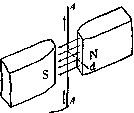
Figure 3.
Figure 4.
Related articles
Mentioned in
Cite this page
“Galvanometer.” Soviet Medical Encyclopedia. English translation of Bolshaya Meditsinskaya Entsiklopediya, 1st ed. (Moscow, 1928–1936), ed. N. A. Semashko. https://sovietmedicalencyclopedia.pages.dev/article/galvanometer/