Rheochord
Historical document, translated for reference. It reflects medical knowledge of the 1920s–30s and is not medical advice.
Summary
This article from the 1928–1936 Great Medical Encyclopedia describes the rheochord, an apparatus used for measuring conductor resistance or for determining the electromotive force of electrical sources such as elements, muscles, and nerves. It also covers the historical and methodological usage of the term 'reparation' in pathological processes, regeneration, and inflammation.
Encyclopedia article (1928–1936)
RHEOCHORD (from Greek rheos - current and chorde - string), an apparatus for measuring the resistance of conductors (part of the so-called Wheatstone bridge) or for determining by the compensation method the electromotive force of any source of electric current: a cell, muscle, nerve, etc.
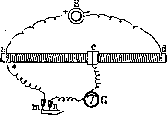
In its simplest design, the rheochord consists of a metal string ad (see figure), fixed by terminals a and d on a graduated wooden stand. A necessary accessory of the rheochord is a movable contact c, by means of which the current circulating in the string can be diverted from any point of the rheochord into an external side circuit. When determining, for example, the potential difference between two points of a muscle, the task reduces to branching off from the main circuit Eda into the side circuit aGc a current opposite in direction but equal in strength to the muscle current of the side circuit. Under these conditions, the muscle current will be completely compensated, and the galvanometer needle G will assume a zero position. The determination of the desired potential difference in the muscle thus reduces to determining the electromotive force between points a and c of the rheochord. If the electromotive force of cell E is equal to V, the sum of the resistances of segments aE and Ed = W, the resistance of the rheochord = r, then the potential difference at the extreme points of the rheochord will be equal to V · r / (W + r), and between a and c, equal to the desired Vx, it is determined from the proportion Vx : V · r / (W + r) = ac : ad, whence Vx = V · r · ac / [(W + r) · ad]. In the case where W is negligibly small compared to r and can be neglected, the equation takes the form: Vx = V · (ac / ad), i.e., the desired value will be equal to the electromotive force of cell E multiplied by the ratio of the length of the entire rheochord to the length of segment ac. Among other designs of rheochords, one should note the Du Bois-Reymond rheochord, in which, by connecting additional resistances to the main string, it is possible to vary the resistance of the rheochord within wide limits.
D. Romashov. REPARATION (from Latin reparare - to restore, to correct), correction; a term unsuccessful due to its theological undertone, sometimes applied in relation to various tissue processes that contribute to correcting certain damages in tissue; such processes are called reparative. Reparation is observed in regeneration and in inflammation. Some have a tendency to attribute the entire process of pathological regeneration to reparative processes. It is more correct, however, not to identify the concept of reparation with regeneration, but to consider that reparation is a component of the regenerative process, specifically representing that phase of it which is expressed in the resorption and removal of dead materials and blood clots, and which often precedes proper regeneration, i.e., the proliferation of permanent tissue elements. Similarly, in inflammation one can speak of reparation, implying by this only that phase of the inflammatory process when, as the proper inflammatory reaction subsides, the processes of resorption of the existing dead substrate come to the fore. It is entirely incorrect to call some forms of inflammation entirely reparative inflammations, as Aschoff does in relation to inflammations arising as a result of traumatic tissue damage; this naming of such inflammations, as well as Aschoff's general division of all inflammations into defensive (protective) and reparative (correcting), is incorrect both methodologically and in its essence. Recently, Aschoff has put forward the term repugnatio (from repugnare - to contradict, to resist), which in his opinion better expresses the essence of processes related to reparation.

(Article contains no further text)
Related articles
Mentioned in
Cite this page
“Rheochord.” Soviet Medical Encyclopedia. English translation of Bolshaya Meditsinskaya Entsiklopediya, 1st ed. (Moscow, 1928–1936), ed. N. A. Semashko. https://sovietmedicalencyclopedia.pages.dev/article/rheochord/