Nephropathy
Historical document, translated for reference. It reflects medical knowledge of the 1920s–30s and is not medical advice.
Summary
This article from the 1st edition of the Great Medical Encyclopedia discusses the historical and pathological classification of nephropathy as proposed by Aschoff and others, covering various forms of renal degeneration, vascular disorders, and sclerosis.
Encyclopedia article (1928–1936)
NEPHROPATHY, nephropathia, a term proposed by Aschoff to designate afflictions of the kidneys based on degenerative changes in the renal epithelium, in other words, everything that F. Müller designated as nephrosis. Later, Aschoff expanded the concept of nephropathy to all renal afflictions with the exception of acute inflammatory processes, the so-called nephritis, and the following classification of nephropathy was proposed: 1. Nephropathy on the basis of disturbed morphogenesis, so-called nephrodysplasia. This includes the so-called cystic kidney, hydronephrotic kidney, and kidney cancer (nephropathia carcinomatosa). 2. Nephropathy on the basis of metabolic disorders, the so-called n e p h r o d y s t r o p h y. Examples: nephropathia diabetica, urica (gouty deposition of urates), nephropathia amyloidea, basedowiana (fatty degeneration of the secretory part), nephropathia gravidarum (the same), nephropathia lipoides (lipoid nephrosis according to the terminology of Volhard and Fahr). 3. Nephropathy on the basis of vascular disorders, or so-called n e p h r o d i s e m i a, for example, nephropathia orthostatica, nephropathia cyanotica, nephropathia embolica (embolic contracted kidney, kidney after multiple infarctions), nephropathia arterio-, nephropathia arteriolosclerotica. 4. Nephropathies of inflammatory origin, or the so-called chronic nephrophlogoses of hematogenous and urinogenous origin. This includes secondary contracted kidneys in glomerulonephritis and nephrosis, in embolic purulent nephritis, in tuberculosis, syphilis, pyelonephritis, and traumatic cirrhosis. Such an expansive application of the term nephropathy, as well as auxiliary terms (nephrodisemia, nephrophlogoses, and the like), did not find supporters, although, as can be seen from the examples, the main mass of cases related to nephropathy fits the formal conception of a "pathy" as a more or less persistent pathological state, sometimes with persistent, but more often progressive functional disorders.
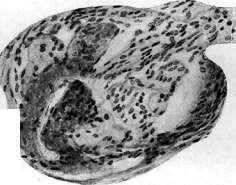
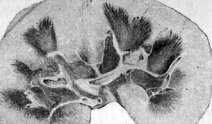
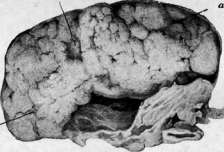
Fig. 1. Scarred glomerulus with remnants of hyalinosis and fatty degeneration of the loops; next to it is v. afferens with a closed lumen, hyalinosis, and fatty degeneration of the wall. Fig. 2. Nephrosclerosis in the stage of decompensation. In the arteriole—pure arteriosclerosis, i.e., hyalinosis and fatty degeneration. In the glomerulus—sluggish accumulation of nuclei in isolated loops. Fig. 3. The so-called "glomerular apoplexy". Necrosis and destruction of the glomerular loops. Significant hemorrhage into the space and around the capsule. In the loops—thrombotic homogeneous-filamentous mass and nuclear breakdown. Weak cellular reaction. Fig. 4. In addition to ordinary arteriosclerosis, there is also arteriolonecrotizing and glomerulonecrotizing nephrosclerosis. Relatively weak cellular reaction. Figure 5. Necrotic nephrosis. Swollen pale cortex. Figure 6. Arteriosclerotic nephrosclerosis. Multiple depressions corresponding to atrophic (a) areas of the parenchyma are visible on the surface of the kidney.
Fishberg encountered arteriosclerotic nephropathy in 2/3 of cases in the spleen, in 1/2 in the pancreas, in 1/3 in the liver, and in 1/6 in the brain. In cerebral vessels and coronary vessels of the heart, atherosclerosis of large trunks is frequently observed simultaneously in arteriosclerotic nephropathy. In the aorta, Rühl found exceptionally strong elastic-hyperplastic intimal thickening and muscular hypertrophy in arteriosclerotic nephropathy, and in prolonged courses and in connection with older age—the development of severe atherosclerosis of the aorta with calcification; whereas in peripheral arteries he found calcification of the muscular coat. Anatomically and even histologically, the differential diagnosis of various stages of arteriosclerotic nephropathy is more or less easy only in well-expressed cases. In earlier stages of nephropathy, i.e., with mild and moderate degrees of renal arteriosclerosis, macroscopic diagnosis is often almost impossible, since a minor percentage of scarred glomeruli and their systems makes the scars invisible to the naked eye; and microscopically, it is often difficult to draw a sharp boundary between benign nephropathy in the decompensated stage and malignant nephropathy due to the identity of the character of changes and the identical degree of arteriosclerosis, but the presence of arteriolonecrosis, strongly expressed glomerular changes, and hemorrhages will speak in favor of malignant nephrosclerosis; macroscopically, isolated punctate hemorrhages and yellow-gray spots on the surface are characteristic of malignant nephrosclerosis. The distinction between nephrosclerosis and glomerulonephritis, both in the induration stage and the contraction stage, is often impossible to the naked eye. The contraction of the organ in both cases can be more or less uniform, and even to an experienced eye, it is difficult to note barely perceptible variants of surface irregularity. In the presence of clearly expressed dystrophic changes in the tubules of corresponding systems and a significant number of glomeruli with hemorrhages in cases of malignant nephropathy, one can macroscopically erroneously assume hemorrhagic glomerulonephritis; only upon microscopic examination does the presence of a relatively large number of unchanged systems, arteriosclerosis, arteriolonecrosis, and glomerulonecrosis with various dystrophic changes in the tubules corresponding to the altered glomeruli give the right to determine malignant nephropathy. The acute stages of diffuse glomerulonephritis differ both in quality and diffuseness of glomerular changes, whereas in chronic glomerulonephritis there is greater parenchymal damage and a greater percentage of destroyed glomeruli. The combination of acute glomerulonephritides with arteriosclerosis and arteriolonecrosis of the kidneys is rare, whereas the combination of chronic glomerulonephritis and arteriosclerotic nephropathy is observed more often. Attempts to produce renal arteriolosclerosis and arteriosclerosis experimentally have so far failed. Feeding animals with lipoids and substances containing them leads to the deposition of the latter in the epithelium of various sections of the tubules, less frequently in the epithelium of the glomeruli, but the vascular system remains free. The combination of such feeding with poisonings causes only more severe epithelial damage and fat deposition in the interstitial tissue. Attention is merited by the experiments of M. Schmidtmann with feeding cholesterol to asplenic rats; this resulted, besides a nephrotic contracted kidney, in some deposition of lipoids in the arterioles, though without the arteriolosclerotic subsequent scarring of glomeruli characteristic of nephropathy. Finally, Baer, upon intra-arterial administration of uranyl nitrate, obtained glomerular changes that closely resemble those in malignant nephrosclerosis, i.e., glomerulonecrosis; at the same time, the arterioles often contained a fibrinous-necrotic plug; due to the rapidly ensuing death of the animal, contraction of the organ was not observed.
Zakharyevskaya Clinic. Nephropathy, as follows from the above, is a patho-anatomical concept uniting the late stages of a whole series of very diverse pathological processes leading to the induration of the kidney due to the development of connective tissue. In the clinic, the term nephropathy is used conditionally only in a narrower sense to designate arteriolosclerosis of the kidney, and specifically arteriolosclerosis of the kidneys rather than arteriosclerosis, because from a clinical point of view, only those forms of arteriosclerosis of the kidneys in which the arterioles are affected are of significance. This is explained by the fact that with such localization, the arteriosclerotic process in the kidneys is distinguished by a more diffuse spread and therefore often leads to renal insufficiency, whereas the involvement of only larger arteries, being always much less diffuse in spread, does not as a rule cause renal insufficiency or any clinical manifestations whatsoever. At the same time, in the clinic, the term nephropathy denotes arteriolosclerosis of the kidneys in general, and not only that stage or form when the kidneys appear to the anatomist by eye, resp. by touch, shrunken and indurated. True, in the majority of cases when arteriolosclerosis of the kidneys manifests itself clinically, the kidney already presents the changes just indicated. But the parallelism between the degree of impairment of renal function in arteriolosclerosis of the kidneys and the degree of development of connective tissue in them is far from complete, and in any case we do not have the possibility to clinically and precisely demarcate that stage of arteriolosclerosis of the kidneys when the organ is macroscopically already shrunken and indurated to the touch from earlier stages of this disease when these changes are not yet present. Therefore, it would undoubtedly be more correct to replace the clinical term nephropathy with the term arteriolosclerosis of the kidneys to designate arteriosclerosis of the small renal arteries. Lately, instead of the term nephropathy (in the clinical sense of the word just indicated), the term nephroangiosclerosis (Volhard) has been proposed, which undoubtedly deserves preference over the term nephropathy, since it contains an indication that nephropathy due to vascular damage is meant; yet it does not indicate that damage to the arterioles specifically and furthermore of a sclerotic nature is intended. Therefore, to replace the term nephropathy in the clinic, "arteriolosclerosis of the kidneys" is still better suited, and hereinafter nephrosclerosis will be understood exclusively as arteriolosclerosis of the kidneys. Table 2. Ratio. At present it is firmly established that arteriolosclerosis of the kidneys is only one variant of the late stage of a disease which is designated either simply as hypertension (see) or as essential or genuine hypertension. At the same time, it should be further pointed out that the delimitation of the stage of pure hypertension and the stage of arteriolosclerosis of the kidneys presents the following difficulty. Clinical observations reveal in hypertension, resp. nephrosclerosis, often pronounced fluctuations in renal function, i.e., after a period of pronounced renal insufficiency, a substantial improvement in renal function sometimes ensues. These observations fully correspond to the concept that has developed in recent years that the organic changes in the renal arteries and arterioles are not the cause, but the consequence of the impairment of their functions, in particular their narrowing due to "spastic" contraction of their musculature. In such a case, strictly speaking, we do not have the possibility to precisely demarcate the stage of hypertension when there is not yet organic damage to the renal arterioles, but there is impairment of renal function as a result of functional narrowing of the renal arterioles, from the stage when arteriolosclerosis of the kidneys is already present. It is clear, of course, that functional and organic changes in the renal arterioles usually superimpose on one another, i.e., after the initial period when there are only functional phenomena, there follows a period when both functional changes and those caused by them organic ones are present simultaneously. From what has just been said, it follows that there is no need here to set forth the etiology of nephropathy, since it coincides with that of hypertension and is set forth in the corresponding article. Here it is necessary to set forth in more detail only the already touched-upon problem of the relationship between hypertension and nephropathy and to dwell on those special influences and factors that contribute in certain cases of hypertension to a stronger and more rapid development of nephropathy. For a clearer understanding of the relationship between hypertension and arteriolosclerosis of the kidneys, a table according to Aschoff and a diagram (see p. 365) according to Löfflein are given here. Hypertension Malignant. From the table it follows that in cases where there is arteriolosclerosis of the kidneys, but no clinical signs of their damage yet and in particular renal function is still completely normal, from the patho-anatomical point of view a diagnosis of nephropathy must be made, and from the clinical point of view—essential hypertension. From the diagram it follows that the initial, fundamental pathological state must always be considered to be hypertension, that arteriolosclerosis of the kidneys subsequently joins necessarily, but only in a part of cases develops to such a degree and so rapidly that its manifestations dominate the clinical picture and it is the cause of death. From this it follows that it is necessary to distinguish between the patho-anatomical or, rather, pathohistological concept of arteriolosclerosis of the kidneys and the corresponding clinical concept or diagnosis. This diagnosis in the clinic is made only if direct or indirect data make it possible precisely in a given case of hypertension to assume the presence of changes in the renal arteries. Of course, as clinical methods are improved, this gap will gradually smooth out. The following figures give an idea of the frequency of hypertensive disease and its significance as a cause of death: according to Herxheimer and Schulz, hypertension, resp. arteriolosclerosis of the kidneys, occurs in 9.8% of all autopsies after 50 years. According to the statistics of American authors, hypertension is a cause of death more often; according to Bell and Clawson, in 9.2% of all fatal cases, after 50 years in approximately 16%, according to the less accurate statistics of G. Fahr, even in 23%. Concerning how often arteriolosclerosis in hypertensive disease manifests itself during life and is the cause of death, i.e., how often it is of significance from a clinical point of view, some idea is given by the data of Bell and Clawson. They established for 420 cases of hyper...
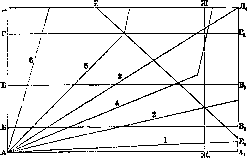
Diagram of the main variants of the course and development of hypertensive disease (according to Löfflein with additions): A—onset of disease; direction along the abscissa—time; direction along the ordinate—development of the process; B—B1—appearance of histological changes in the renal arterioles; B—B1—appearance of clinical signs of renal function impairment; Г—Г1—appearance of uremic symptoms; Д—Д1—death from renal insufficiency; E—E1—appearance of signs of heart failure; Ж—Ж1—appearance of cerebral symptoms; A—Д1—death from heart failure or cerebral hemorrhage; 2—б—main variants of the course of hypertensive disease; 1—в—benign; 5 and в—malignant form; 4—transition of the benign form into the malignant one; 2—hypertension, cerebral phenomena, death from cerebral hemorrhage; 2—hypertension, cerebral phenomena, phenomena of heart failure, death from heart failure; 3—the same + phenomena of renal insufficiency, death with combined phenomena of cardiac and renal insufficiency; 4—hypertension over a long period of time, phenomena of cardiac and renal insufficiency (benign phase), then rapid development of renal insufficiency (malignant phase) and death from uremia; 5—hypertension, phenomena of renal insufficiency, addition of heart failure, development of uremic phenomena, death from uremia; 6—hypertension, phenomena of renal insufficiency, death from uremia.
tention, death resulted from heart failure in 187 cases, from coronary artery disease in 67 cases, from cerebral hemorrhage and thrombosis in 81 cases, from accidental diseases in 49 cases, and from renal insufficiency in only 36 cases, i.e., 8.5%. Christian established an even smaller percentage of deaths from renal insufficiency in essential hypertension—only 4.5%. Regarding the relationship between hypertension and renal arteriolosclerosis, as revealed by autopsy (with histological verification) data, the following figures by Herxheimer and Schultz provide an idea: out of a total of 7,940 autopsies, they found 352 (4.5%) cases of cardiac hypertrophy that could not be explained by anything other than hypertension, respectively renal arteriolosclerosis. In 332 of these cases, there was more or less pronounced renal arteriolosclerosis, in 8 only sclerosis of the prearterioles, and in 12 there were no renal changes whatsoever. In these 20 cases, death resulted from cerebral hemorrhage. Consequently, in less than 4% or 6% of all cases of hypertension, renal arteriolosclerosis had not managed to develop by the time of death. Of course, among living hypertensives, this percentage must be significantly higher. Still, one must think that renal arteriolosclerosis develops very quickly in hypertension. The relationships between hypertension and renal arteriolosclerosis can be conceived in three ways: 1) renal arteriolosclerosis is the cause, and hypertension is the consequence; or 2) hypertension is the cause, and renal arteriolosclerosis is the consequence; or 3) hypertension and renal arteriolosclerosis represent coordinated consequences of one common cause. Of course, various combinations of these relationships are also possible, both simultaneously and sequentially during the course of the disease. Originally, renal changes were considered the primary phenomenon, and hypertension the consequence. At present, sufficient pathological-anatomical and clinical material has accumulated to state with complete certainty that the development of so-called essential or genuine hypertension is not a consequence of renal changes, since hypertension in its earliest stages is not accompanied by either clinical phenomena or anatomical changes on the part of the kidneys. In later stages of the disease, when the changes in the renal arterioles have already reached a certain degree, there is reason to assume that these changes in turn contribute to an increase in blood pressure. How exactly in these later stages the changes in the renal arterioles, in particular their narrowing, increase the general arterial pressure has not yet been definitively resolved: possibly by a reflex pathway due to the impediment of blood flow through the altered renal vessels (Frey), or possibly by a humoral pathway, i.e., by the retention (or formation) in the body—due to unsatisfactory renal function (caused by their insufficient blood supply)—of substances that act centrally or peripherally on the vasomotor nervous apparatus or directly on the arterial musculature, increasing blood pressure (Volhard, Huelse, Bonn). In this stage, hypertension can be considered, at least in part, as a compensatory phenomenon that helps maintain normal blood supply and sufficient diuresis when the renal arterioles are narrowed. Thus, in the earlier stages of its development, hypertension is undoubtedly not caused by changes in the kidneys, and its etiology and pathogenesis must be different. Consequently, the changes in the renal arterioles—developing sooner or later, more strongly or more weakly, but in any case apparently necessarily in every prolonged hypertension—must be either its consequence or a phenomenon coordinated with hypertension, caused by a common cause with it. At present, the view is beginning to dominate according to which the changes in the renal arterioles that join hypertension should be regarded as a consequence of hypertension or, more precisely, as a consequence of a disturbance of arterial function in the sense of their tendency to enhance tonic contraction, manifesting itself both in general hypertension and in local vascular "spasms." True, the mechanism, respectively chemism, by which arteriolosclerotic changes are caused in hypertension is still insufficiently clarified at present; one can assume either mechanical influences, wear and tear, or nutritional disturbance of the arterial walls due to the periodically and temporarily increasing tonic contraction ("spasm") of the arterioles themselves or of the larger arteries from which they branch. The latter explanation is based on the fact that in hypertension there is not only an enhancement of the tonic contraction of the entire arterial musculature, but also local enhanced contractions of the arteries, as they say—spasm. Such "spasms" of the cerebral arteries as the cause of cerebral hemorrhages, which are so frequent precisely in hypertension, can now be considered established (Westphal, Schwarz, and others). Therefore, the assumption is permissible that spastic contractions of the renal arterioles are the proximate cause of the nutritional disturbance of the walls of the corresponding arterioles and glomerular capillaries. In particular, the pictures of varying rapidity of glomerular destruction in renal arteriolosclerosis suggest the idea that this destruction is a consequence of the disturbance of their blood supply due not so much to organic as to functional narrowings of the arteries. Recent observations (Ricker) indicate the extreme sensitivity of vasomotor nerves to various irritations. Ricker believes that following strong irritation of the vasoconstrictors of the arterioles, their paralysis easily ensues, which results in the maximal dilation of the vessel. This paralytic dilation of the vessel is, according to his theory, the cause of disturbances in the nutrition of the vessel wall and the passage through it of not only plasma, but also red and white blood cells. The view that has prevailed until recently regarding various toxic influences on the renal vessels as the cause of their sclerotic changes, or the development of the latter as a result of the direct influence on them of products of improper metabolism, etc., must be recognized as even less concrete. The renal arterioles are affected most strongly and most frequently in hypertension. This is explained by the completely exceptional vascular system of the kidneys in its structure and degree of development, and by its completely special function (double capillary network, filtration work, etc.) (see Kidneys, anatomy and physiology). The cause of the tendency toward enhanced tonic contraction of the arterial musculature in hypertension must be sought primarily in pathological irritations of the vasoconstrictor nerves. Thus, we have reason to assume that the solution to the question of the pathogenesis of hypertension and renal arteriosclerosis must be sought in pathological nerve irritations that cause an excessive reaction of vascular contraction and, through this path, a disturbance in the nutrition of their walls. All the features of the development and course of this disease—beginning with a pathological functional state (hypertension) and ending with an organic lesion of the vessels, specifically renal arteriolosclerosis—best correspond to this view (Ricker, Volhard). From this point of view, the great influence of heredity on the development of this disease is also understandable, since increased, respectively decreased, reactive capacity of various parts of the nervous system undoubtedly belongs to the qualities that depend to a significant extent on hereditary factors. The influence of various infections and intoxications on the development of nephrosclerosis also does not contradict the indicated point of view, since they can also act primarily on the nervous system (for example, lead). As indicated above, hypertension always leads to renal arteriolosclerosis, but this arteriolosclerosis by no means always manifests itself during the patient's life; more often, before death, it does not manage to reach such a degree at which certain signs of kidney disease, in particular their insufficiency, occur. In these cases, which constitute the majority, the duration of the disease is longer—usually many years—and patients die from heart failure or cerebral hemorrhage more often than from renal insufficiency. In other cases, shortly—sometimes from the very moment of the detection of hypertension—signs of impaired renal function are determined, the disease rapidly develops with dominating phenomena on the part of the kidneys and ends in death from their insufficiency in 1–2 years. Between these two extreme types of nephropathy, all sorts of transitional forms are observed. Sometimes a transition of one form into the other is also observed in the sense that the disease proceeds first for many years as pure hypertension, and then signs of renal insufficiency appear, which rapidly progress and lead to death in 1/2 to 1 1/2 years. Some authors, such as Fahr, regard these two types as different kinds of nephropathy; others see the difference only in the pace at which renal changes develop (Leilein); still others (Herxheimer) consider these two forms always only as different stages of the same process (see above). The aforementioned table and diagram by Leilein give an idea of the various types of the course of hypertension, respectively nephrosclerosis in general, and of these two kinds of nephropathy in particular. NEPHROSCLEROSIS
To designate these two types, the terms proposed by Volhard and Fahr—"benign" and "malignant" hypertension, respectively nephrosclerosis—have taken root most of all. This name is not entirely successful, since the term "benign" in this case is inappropriate because the respective patients also die from the consequences of hypertension, specifically from heart failure or cerebral hemorrhages. This form can be considered benign only insofar as the duration of its course is longer and insofar as severe renal symptoms do not appear. What determines the different character of the course of the two types of nephrosclerosis, benign and malignant? The only distinct difference in the conditions of development of the malignant and benign types is the difference in age and sex. This difference is best illustrated by the table from Volhard. Table 3. Age ... That malignant hypertension develops more often at a comparatively younger age is confirmed by all other authors who had sufficient material. Out of 876 cases of nephropathy or hypertension in Volhard, 157 were malignant forms and 719 benign; of the patients with the malignant form, 78.3% were men and 21.7% were women, and of the patients with the benign form, 58.7% were men and 41.3% were women. It is not possible to establish the influence of a specific etiological factor on the development of one or another form. Fahr attaches importance to syphilis, gout, and lead poisoning in the origin of the malignant form. The etiological significance of syphilis is not confirmed by Volhard and Fishberg, but according to the observations of Korányi and the 1st Therapeutic Clinic of the 1st Leningrad Medical Institute, it must nevertheless be recognized. Volhard notes that among patients with the malignant form, persons engaged in mental labor and belonging to the wealthier classes predominate to a greater extent than among patients with the benign form. As the table just cited shows, nephropathy is generally a disease of a more advanced age, and therefore it is remarkable that its more severe forms are encountered more often in comparatively younger persons. Thus, the question of why in some cases of hypertension we observe a more rapid and severe development of changes in the renal arterioles remains open for the time being. Perhaps it should be linked to the question of the cause of the predominance in various cases of hypertensive disease of a certain localization and a stronger development of arteriosclerotic and arteriolosclerotic changes in various organs. Symptomatology. The clinical picture of nephropathy develops in the benign form against the background of the clinical picture of hypertension—in the sense of the appearance and more or less rapid increase in the phenomena of renal failure. In the malignant form, in some cases, the development of a picture resembling a purely renal disease is observed from the very beginning: elevated blood pressure, hemorrhagic neuroretinitis, etc. In others, the picture of renal failure develops more or less rapidly after the disease has proceeded for a long period of time (several or even many years) under the guise of hypertension, resp. benign nephropathy. In these cases, as nephropathy, resp. renal failure, develops, the arterial pressure becomes established at a higher level and at the same time—which is especially characteristic—becomes more stable and constant. Pronounced arteriolosclerosis of the kidneys, which has led to renal failure, is accompanied by the highest arterial pressure. In particular, in nephropathy, the pressure is usually higher than in chronic glomerulonephritis (in the so-called secondary contracted kidney). The maximum arterial pressure is as a rule higher than 200 mm Hg (200–300), and the minimum is higher than 100 (100–150). Fluctuations in this level, including daily ones, are very small. Only during developing severe heart failure or with a strong rise in temperature due to an infectious disease can a drop in arterial pressure be observed—sometimes even to normal. Corresponding to the high level and constancy of arterial pressure in pronounced nephropathy, strong hypertrophy and dilation of the heart are observed as a rule. Of all renal diseases, it is in nephropathy that the largest hearts are observed. Clinically, in the nephrosclerotic stage of hypertensive disease, more frequently than in the purely hypertensive one, a gallop rhythm is observed, predominantly presystolic, resp. diastolic, and pulsus alternans. Symptoms of heart failure in the nephrosclerotic stage develop faster and in a more severe form, edema of cardiac origin is more frequent; even more frequent are manifestations of heart failure in the form of attacks of (nocturnal) cardiac asthma, easily passing into pulmonary edema. However, asthma attacks in nephrosclerosis are not always the result of insufficient cardiac activity. They can also be a manifestation of the anemia of the respiratory center due to increased tonic contraction ("spasm") of the arteries supplying this center (Straub). Cheyne-Stokes respiration, which is often observed in nephropathy, may be of the same origin. As already indicated, in hypertensive disease, arteriolosclerotic changes in the kidneys, both in the initial stages of their development and in cases of a milder form, do not manifest themselves by any signs and are therefore not recognized clinically, but proceed in the clinic under the diagnosis of hypertension, since only elevated arterial pressure and symptoms associated with it are present. At this time, renal function is still completely normal, or there are changes in the urine that depend on heart failure due to sclerosis of the coronary arteries or overwork of the left ventricle, which overcomes the elevated arterial pressure with its increased work. Under the influence of weakened cardiac activity, the total daily amount of urine decreases, and nocturia appears, as in heart failure in general. It must be noted that nocturia is not an obligatory symptom of hypertension. Its appearance in hypertension is explained either by heart failure or by the fact that in persons suffering from hypertension, the tonic contraction of the renal arteries, as well as arteries in general, decreases significantly at night. This can be judged by the significant drop in arterial pressure in hypertensives during sleep. In the early stage and in cases of benign nephropathy, albuminuria is usually absent or there are only traces of protein in the urine; a more pronounced albuminuria is usually a manifestation of heart failure. The same applies to hematuria and cylindruria. Functional examination of the kidneys in these initial stages of renal arteriolosclerosis, resp. in its benign form, reveals for the most part a completely normal working capacity of the kidneys in the sense of concentration ability. The water test either also gives normal results or often reveals excessive water excretion, i.e., not only the introduced 1,500 cm3 are excreted within 4 hours, but in addition 250–500–750 cm3 of water. This phenomenon is explained by the increased excitability of the renal vessels or as a consequence of latently retained water. If in the initial stages of renal arteriolosclerosis in its benign form the water test indicates insufficient excretory capacity of the kidneys, it is necessary to think first of all about heart failure. The excretory capacity of the kidneys with respect to sodium chloride in these stages and in these forms of nephropathy is usually also within normal limits. The content of urea and residual nitrogen in the blood is also usually still normal. Only Ambard's constant—apparently the most sensitive indicator of the functional capacity of the kidneys—is often already under these conditions at the upper limits of norm (0.09–0.11), thereby already revealing a slightly reduced excretory function of the kidneys with respect to urea. An increased uric acid content in the blood in hypertension is pointed out, but this is hardly the result of renal failure. Grotehel established that only in hypertensives with a hypersthenic constitution is the blood uric acid content elevated against the average norm, while remaining, however, within the constitutional limits, which for hypertensives are higher than the average norm. What has been said so far refers to that stage of renal arteriolosclerosis when renal function is still almost undisturbed, i.e., to that intermediate stage when renal arteriolosclerosis turns from a histological concept into a clinical one. This transitional stage is followed by a more or less rapid development of renal failure; the ability of the kidneys to vary their function is gradually lost; this is manifested by narrower fluctuations in specific gravity and the amount of urine. Nocturia becomes the rule, but unlike nocturia due to heart failure, in which the daily amount of urine is usually reduced, nocturia as a result of renal failure is usually accompanied even by a certain increase in the amount of urine.
In this period, the concentration test usually yields a figure already at the lower limit of normal or below it—around 1,020. The water test reveals that the bulk of the administered water is excreted not during the first 2 hours of the test, but more evenly throughout all four hours. Ambard's constant already yields figures definitely above normal (0.12–0.14), and the blood urea and residual nitrogen content are already markedly elevated. Sometimes a slight albuminuria and cylindruria appear, and erythrocytes are increasingly detected in the urine in greater or lesser amounts. Patients who previously were typically characterized by a plethoric appearance (roter Hochdruck according to Volhard) become increasingly pale (blasser Hochdruck). Volhard explains this by a general narrowing of the vessels, particularly cutaneous ones. Indeed, the blood composition remains normal in this period, and this pallor of the integuments cannot be explained by anemia; later, in the stage of manifest renal insufficiency, a significant anemia of the so-called secondary type often develops. The phenomena of renal insufficiency may initially vary considerably in time; one can observe periods of significant intensification of all the listed renal phenomena, alternating with periods of improvement. Gradually, renal insufficiency becomes more and more pronounced and persistent. To understand such a development of renal insufficiency, one must imagine that it is based on phenomena of a twofold nature: on the one hand, a disturbance of the blood supply to the renal tissue due to enhanced tonic contraction ("spasm") of the renal arteries and the resulting functional impairments of the renal elements, and, on the other hand, organic persistent changes in the renal arteries caused by these spasms, which also impair nutrition, and through this, the function of the renal tissue. The fact is that if the circulatory disturbance is not too sharply expressed and not too prolonged, the function of the corresponding renal elements can more or less recover; but in cases of stronger and more prolonged circulatory disturbance, persistent changes in the arteriole walls (in the form of hyalinization and fatty degeneration) and persistent impairments of their function occur, as a result of which there is both a persistent disturbance of the blood supply to the renal tissue and an impairment of its function, and ultimately its atrophy. It is also possible that the circulatory disturbance due to a more prolonged and strong spasm of the arteries or arterioles in the most "malignant" cases leads directly to the death of the renal elements. Gradually, an ever-increasing number of the latter go out of action, and the steadily decreasing remainder of still-functioning renal tissue is forced to take on all the excretory work of the kidneys. It can fulfill this—and even then inadequately—only by functioning continuously to the maximum. Then a characteristic picture emerges. The excretion of light, liquid urine is evenly distributed over the round clock, its daily amount is somewhat elevated (1,800–2,200), while the specific gravity is fixed, i.e., the urine is always excreted at the same low concentration; the specific gravity fluctuates within very narrow limits—usually within 1.010–1.012 (isosthenuria). Neither the time of day nor the amount, order, and intake of water and food have any influence on this ratio in the excretion of solid constituents of urine and water. The specific gravity of the urine does not rise either with an increase in temperature or with a weakening of cardiac activity. During the concentration test, the specific gravity also does not rise any significant amount; on a dry diet, the same amount of urine continues to be excreted as before, the patient's weight drops, and he soon begins to feel an irresistible thirst. This is explained by the fact that the kidneys are under the influence of a maximum stimulus to diuresis at all times, emanating from the metabolic products accumulated in the organism that are subject to excretion, but nephroangiosclerotic kidneys can perform the task of excreting these substances to a certain extent only under the condition of a much stronger dilution, i.e., only under the condition of excreting a corresponding amount of water. However, in turn, the amount of water that the kidneys are able to excrete per day is limited already in this period by their reduced capacity in relation to water excretion as well, which is revealed during the water test, which does not lead to any significant increase in the amount of urine, since the kidneys, working constantly at maximum already in relation to water elimination, are not able to excrete an extra load, as a result of which all or almost all the water of the water test is retained in the organism. It must be pointed out, however, that the performance of the water test should be refrained from in all cases where blood pressure is very high and there are indications of the possibility of the development of heart failure. That it makes no sense to perform the water test in the presence of heart failure and especially in the presence of edema goes without saying. In this stage of arteriolosclerosis of the kidneys, the excretion of NaCl and especially of the products of nitrogen metabolism is also impaired; the amount of urea in the blood is usually greatly elevated (30–75 mg%), and the amount of residual nitrogen as well (100–200 mg%). Ambard's constant rises to 1.0. Less characteristic, even in the stage of manifest renal insufficiency, is the change in urine usual for diffuse renal diseases: for example, albuminuria may be absent, and if present, it is only to a moderate degree (1/2–1–2‰). Stronger degrees of albuminuria are usually explained by concomitant heart failure. Hematuria is frequent, but always only in the form of microhematuria; the number of red blood cells in the urinary sediment fluctuates within considerable limits and at times they completely disappear. Usually, the appearance or intensification of hematuria indicates an intensification of the underlying process, the appearance or intensification of the permeability of the glomerular capillary walls to erythrocytes as a result of the impairment of their blood supply due to the intensification of "spasm" of the corresponding small renal arteries. In some cases, the appearance of erythrocytes finds its explanation in the addition of phenomena of arteriolonecrosis (see) leading to afferent glomerular arterioles. In comparatively infrequent cases of nephropathy, the destruction of renal tissue as a result of circulatory disturbance manages, before death from heart failure or cerebral hemorrhage occurs, to reach such a degree that azotemic uremia develops (see Nephritis). Then a picture of the disease is obtained that does not differ essentially from the clinical picture of azotemic uremia in chronic glomerulonephritis (or secondary contracted kidney): a gradually increasing sense of fatigue, unquenchable thirst, aversion to any food intake, an unpleasant taste in the mouth, nausea and vomiting, headaches, itching, at times general restlessness superseded by somnolence, deep respiration analogous to Kussmaul respiration in diabetic coma, increased excitability of the motor apparatus; increased tendon reflexes, hand tremor, fibrillary muscle twitches, choreiform movements. In rare cases, eclamptic seizures. From the gastrointestinal tract, diarrhea of the colitis type is often observed, sometimes intensifying to the picture of dysentery. Toward the end of life, consciousness gradually darkens, and death usually occurs in a comatose state. From the manifestation of true uremia in nephropathy, it is necessary to distinguish the so-called pseudouremic phenomena, namely the clinical manifestations and consequences of transient, more or less severe ischemia of various parts of the central nervous system due to spastic contractions of the corresponding arteries, so characteristic of essential hypertension in general. These include, firstly, stubborn headaches that intensify or appear in the form of attacks. Secondly, as a manifestation of a more general insufficiency of cerebral blood supply—disturbances of mental functions: weakening of memory, irritability, decrease in mental abilities, disorientation, severe depressed state, attacks of intense fear, etc. As a manifestation of local ischemia (with subsequent hemorrhage or without it) in nephropathy, as in hypertension, so-called angiospastic strokes with temporary paralysis of the extremities, temporary loss of speech, fainting spells, severe dizziness, etc., are observed. On the part of the heart, as a manifestation of a similar tendency toward increased arterial narrowing in nephropathy, the picture of angina pectoris is very often observed up to the development of myomalactic phenomena in the myocardium. Of particular attention in nephropathy—from a pathological, diagnostic, and prognostic point of view—are changes in the fundus oculi. Sclerosis of the fundus oculi is nonspecific for nephropathy, but often encountered in it; it manifests as irregularity of the arterial lumen, increased tortuosity, and thickening of their walls. These arteriosclerotic changes are usually observed in older individuals and in cases where a multi-year period of hypertension preceded.
A characteristic feature of hypertension, or nephrosclerosis, should be considered the narrowing of the retinal arteries of the eye: it is detected by a greater narrowness of the arteries, a decrease in the number of their branches, and the fact that these branches become invisible at a closer distance from the optic disc than in the norm. The veins are usually dilated at the same time, and the result is a characteristic contrast between the narrow lumen of the arteries and the wide veins. The narrowing of the retinal arteries is one of the early symptoms of nephrosclerosis and represents a direct manifestation of that tendency to constriction of small arteries which should be considered the primary pathological phenomenon of hypertensive disease. Retinal hemorrhage should also be attributed to the early symptoms of nephropathy. As histological studies show, these hemorrhages occur exclusively per diapedesin. They often have a flame-like shape and are located radially around the disc and frequently along large vessels; closer to the periphery, hemorrhages are usually smaller and more often have an irregular or rounded shape. Hyperemia and edema of the optic nerve head, manifesting as a more sharp elevation of the disc, obscurity of its pattern, narrowing of the arteries within it, and dilation of the veins, should also be attributed to the characteristic and comparatively early changes in the fundus in hypertension or nephrosclerosis; the contours of the disc then become indistinct. Manifestations of more severe cases of nephrosclerosis on the part of the fundus include localized fatty (more precisely, lipoid, predominantly cholesterol-ester) infiltrates of the retina in the form of white spots resembling pieces of cotton wool or piles of snow. These changes are also located predominantly around the optic disc and the macula lutea. A stellate figure of the same spots, but having the shape of narrow strips and located radially around the fovea centralis, is less frequently observed. Detachment of the retina should be considered a rare complication of neuroretinitis in nephropathy. Of the described fundus changes, hemorrhages and white spots, if not too sharply expressed, may undergo regression, but usually fresh ones appear to replace the disappearing or disappeared ones. As for the narrowing of the arteries, they can vary in degree in connection with the development of the process. The described changes in the optic nerve head can occasionally, if very sharply expressed, lead to atrophy of the optic nerve as well; then a white, sharply demarcated spot is obtained in place of the disc. All the described changes in the fundus in nephropathy, depending on the degree and localization, cause corresponding visual disturbances. All these fundus changes are not mandatory phenomena in nephropathy. They are encountered more frequently and develop earlier the more malignant the character of hypertension or nephropathy (see above). It should be noted, however, that there is still no complete parallelism between the degree of renal changes and the degree of fundus changes and the time of their development. Cases of nephropathy with already expressed renal insufficiency but with a normal fundus are sometimes observed, while on the other hand, neuroretinitis sometimes develops in cases where there is only significant hypertension, and renal function is still entirely normal. In these latter cases, visual impairment is often the first subjective symptom that forces the patient to seek medical help; the patient reaches the therapist already from the ophthalmologist. But even in these cases, the clinical picture of the disease then usually develops more or less rapidly in the direction of severe renal insufficiency. The epithet albuminuric is least of all suitable for neuroretinitis in nephropathy. Volhard asserts that the basis is not an inflammatory process, but ischemia due to arterial spasms, and proposes the name neuroretinitis angiospastica. There are successive observations of fundus changes confirming Volhard's point of view. It is in any case beyond doubt that neuroretinitis is not a consequence of renal insufficiency or hypercholesterolemia. It is not causally related to them, but depends only on the increase in blood pressure, and it should in all probability be regarded indeed as one of the local manifestations of the tendency of blood vessels to increased contractions—spasms. Why in some cases this tendency manifests itself predominantly on the part of the renal vessels and leads to more severe renal changes, in others on the part of the retinal vessels, and in still others on the part of the cerebral arteries, is still unknown. Differential diagnosis. As follows from the foregoing, the combination of manifestations of essential hypertension with signs of renal insufficiency of a specific type is characteristic of the clinical picture of nephropathy. Catching and correctly assessing these latter signs in the early stages presents certain difficulties; these difficulties increase if the influence of cardiac insufficiency on renal function joins in, which so frequently develops in the later stages of hypertensive disease. As already indicated, the development of more pronounced arteriolosclerosis of the kidneys in essential hypertension is characterized by: a greater or more persistent increase in blood pressure, especially the minimum pressure, polyuria, nocturia, hyposthenuria, isosthenuria due to the loss of the concentration ability by the kidneys, the appearance of skin pallor and emaciation, the appearance of protein in the urine and erythrocytes, and an increase in Ambard's constant, azotemia, and especially the development of angiospastic neuroretinitis. When hypertension is complicated only by cardiac insufficiency, oliguria is observed rather, characteristically combined with nocturia; at the same time, the concentration ability of the kidneys does not decrease. Cases are observed when renal insufficiency acutely manifests itself for the first time in connection with the onset of cardiac decompensation. But it is not enough to establish the diagnosis of arteriolosclerosis of the kidneys. It is necessary to determine what form or phase of nephropathy is present in the given case. The malignant form includes those cases of nephropathy in which the clinical picture of sharply expressed hypertension with renal insufficiency and neuroretinitis develops without a preceding longer phase of "benign" hypertension; this form is observed predominantly at a relatively younger age. Benign is the name given to that form of nephropathy where for many years the signs of renal insufficiency are weakly expressed and develop slowly. If in such a case renal insufficiency begins to develop rapidly and pronounced neuroretinitis appears, it is said that the benign phase of hypertension or nephropathy has passed into the malignant one. Of the fundus changes described above, arterial sclerosis is not characteristic of nephropathy, since it is encountered in arteriolosclerosis even without nephropathy and even without hypertension. Sclerosis of the retinal arteries is also frequently encountered in the benign form of nephropathy—evidently due to the fact that this form proceeds more chronically and develops at an older age. More or less small hemorrhages can also be observed in the benign form, whereas pronounced narrowing of the retinal arteries, large hemorrhages, and especially white spots are characteristic of the malignant form or phase of nephrosclerosis. The pronounced picture of arteriolosclerotic nephropathy, the so-called primary granular contracted kidney, is largely similar to the picture of the so-called secondary contracted kidney, or glomerulonephritic nephropathy, i.e., the final stage of chronic glomerulonephritis. Regarding renal phenomena, especially regarding the manifestation of renal insufficiency, the pictures of both diseases are almost identical; only stronger albuminuria and hematuria are more characteristic of glomerulonephritis, conversely, higher blood pressure (above 225 for the maximum and above 125 for the minimum) and, accordingly, stronger cardiac hypertrophy (as a result of the preceding prolonged hypertensive stage) speak in favor of arteriolosclerosis of the kidneys. In both diseases, edema occurs only as a result of cardiac insufficiency and has a corresponding localization. But cardiac edema in glomerulonephritic nephropathy usually lasts for a longer period even after the restoration of cardiac activity. In chronic glomerulonephritis, urobilin and urobilinogen in the urine are as a rule absent, whereas in arteriolosclerosis of the kidneys they are frequently determined. If the anamnesis contains an indication of acute nephritis or nephritis-type edema, this gives a definite right to think first of all of chronic glomerulonephritis. The absence of the picture of acute glomerulonephritis in the analysis does not exclude the presence of chronic nephritis, since undoubtedly such can develop without an initial acute stage. The younger the age, the more likely is glomerulonephritic nephropathy and the less likely is arteriolosclerotic. But it must be borne in mind that arteriolosclerosis of the kidneys is also observed occasionally in the twenties and not so rarely in the thirties. Moreover, at a younger age (30–45) the so-called malignant form of arteriolosclerosis of the kidneys is precisely more frequently encountered, which in its clinical picture is especially similar to glomerulonephritis.
Of the above-described fundus changes, nephropathy is characterized mainly by arterial narrowing and, to some extent, hemorrhages; neuroretinitis (large white spots) is observed more frequently and in a more pronounced form in glomerulonephritis. The latter is characterized by retinal edema with significant retinal anemia and anemia of the optic disc. In nephropathy, conversely, there is usually pronounced venous dilation and disc edema, whereas edema of the entire retina is either absent or weakly expressed. Sclerosis of the retinal arteries cannot serve as a reliable sign to distinguish nephropathy from glomerulonephritis, because precisely when neuroretinitis is most common, namely in the so-called malignant form of nephropathy, it is frequently absent, which is explained by the comparatively younger age of these patients. On the other hand, sclerosis of the retinal arteries is also observed in glomerulonephritis developing at an older age. Other forms of nephropathy in the broader, anatomo-pathological sense of the word (from the standpoint of possible differential-diagnostic difficulties in recognizing renal arteriolosclerosis) do not have substantial practical significance, since these forms of nephropathy are encountered relatively rarely and since in most cases concomitant symptoms or anamnesis make it possible to determine the nature and origin of the nephropathy (nephrotic and amyloid contracted kidney, nephropathy due to pyelonephritis). Sometimes cystic degeneration of the kidneys gives a clinical picture of nephropathy, and the true nature of the disease in cases where the kidneys are not palpable as nodular tumors and there are no profuse hemorrhages may remain unrecognized. Neoplasms of the adrenal medulla also give a picture somewhat similar to nephropathy. But usually in these cases a tumor in the renal region is palpable and there are characteristic paroxysmal increases in blood pressure to an extraordinary height. The question of whether syphilitic vascular lesion of the kidneys or syphilitic endarteritis of the kidneys can be singled out as an independent form of the disease, as is already done by Volhard (1931), must remain open for the time being. In any case, it is currently impossible to distinguish this form clinically from renal arteriolosclerosis. Prognosis. Arterial changes in nephropathy apparently cannot undergo regression. Therefore, nephropathy must be considered an incurable disease insofar as the already developed changes in the renal vessels and the destruction of renal tissue elements caused by these changes are irreparable. However, on the other hand, it must still be noted that not all cases of hypertension in which signs of a certain renal insufficiency are already detected give an absolutely unfavorable prognosis in the sense of an unalterable progressive and comparatively rapid deterioration of renal function. Renal function insufficiency may be the result of functional or at least reversible changes in the renal arteries, namely their enhanced tonic contraction; this narrowing of the arterial lumen, provided it is of short duration and moderate degree, although it impairs the function of the renal tissue, may nevertheless not result in its destruction or irreparable changes. Under favorable conditions, these «spasms» pass, and normal renal function can be restored. Unfortunately, such early stages of renal arteriolar functional impairment are rarely caught, and furthermore it is rarely possible to eliminate that pathological tendency of arteries to «spasms», which represents the basic pathological phenomenon in hypertension. This tendency is expressed to varying degrees in different cases, and this degree apparently determines the benign or malignant character of the given case of hypertension, resp. renal arteriolosclerosis. This demarcation of nephropathy according to the character and rate of development of renal arteriolar changes into a benign and malignant form or into corresponding phases of the course is essentially of primary prognostic significance and therefore, when establishing the prognosis of a specific case of nephropathy, its character in this respect must first be elucidated. The malignant form, resp. phase, leads to death in 1–2 years; the benign form has an incomparably longer course—many years. In it, renal insufficiency usually progresses very slowly and, as they say, remains compensated for a very long time. Death in nephropathy by no means necessarily occurs as a result of renal insufficiency, but more often from heart failure or cerebral hemorrhage. But although the development of both heart failure and corresponding cerebral vessel changes in the malignant form also proceeds faster than in the benign form, nevertheless in the malignant form of nephropathy, more often than in the benign form, renal insufficiency outpaces cerebral and cardiac phenomena in its development and therefore more frequently is the cause of death. Thus, the most important criterion in determining the prognosis of nephropathy is the rate and character of the renal changes themselves. In second place as a prognostic factor one must place the state of the myocardium, which in turn is determined mainly by the degree of involvement of the coronary arteries of the heart. Heart failure caused by these changes not only threatens life in itself, but in the presence of renal insufficiency sharply aggravates the latter. The third factor determining the prognosis is the degree of tendency to those disturbances in the function of cerebral arteries that underlie cerebral hemorrhages. Finally, changes in the fundus of the eye are of very great importance for judging the character and rate of nephropathy. On the other hand, changes in the fundus allow one to judge not only the character and rate of renal changes, but to some extent also the propensity for analogous changes in the brain. As for other data from the standpoint of their prognostic significance, the importance of age for the prognosis deserves special attention. In general, the prognosis in nephropathy regarding the character and rate of the process in the kidneys, and consequently regarding the course of the entire disease, is the worse the younger the patient, since the propensity for the malignant form of nephropathy at a comparatively young age is undoubtedly greater (see Table 1). Under the age of 40, the development of nephropathy invariably proceeds according to the malignant type. The patient's sex determines the prognosis to a lesser extent, but nevertheless, in general, the prognosis in men with nephropathy is always somewhat worse, since their propensity for a malignant course of nephropathy is somewhat greater than in women. The greater persistence and height of blood pressure as characteristic manifestations of nephropathy have been pointed out above repeatedly. In prognostic terms as well, these data are of great importance, since between the degree of blood pressure elevation, especially the minimum pressure, and to an even greater extent between the stability of this high level on the one hand, and the degree of renal changes on the other hand, there is a direct and fairly regular correlation. One should not lose sight of the conditions available in the given case for proper treatment (rest, diet) when making a prognosis, since the character of the course of the process in the given case undoubtedly depends on them as well. What significance the height of blood pressure generally has for the prognosis is very demonstratively shown by Mayer's data, based on observations in one of the American insurance companies. If the average expected mortality of insured persons is taken as 100, the actual mortality with a blood pressure below 140 mm Hg was 102.8; from 140 to 170, 133.6; from 170 to 200, 219.6; above 200, 827.5. Prophylaxis and treatment. If nephropathy is understood as that initial period in the course of essential hypertension when definite organic changes in the renal arterioles have developed, more or less limiting the functional capacity of the kidneys, then the prophylaxis of nephropathy must coincide with the prophylaxis of hypertension and its treatment. The treatment of nephropathy, on the other hand, can seemingly have as its goal only the «arrest of the further development of the renal process.» It is necessary, however, to recall once again that there are clinical observations indicating that minor renal insufficiency in hypertension can disappear again under favorable conditions. In these cases, proper treatment can preserve adequate or even completely normal renal function for a long time yet. In the treatment of nephropathy, all those measures that are specifically indicated in hypertension must be carried out with particular energy—first of all, mental rest and a dietary regimen. At the beginning of treatment, prolonged bed rest must be considered quite appropriate. In the diet, the restriction of protein food to that minimum which is necessary to support normal nutrition must come first (approximately 0.5–0.75 g of protein per 1 kg of weight, i.e., with a weight of 70 kg—35–50 g of protein). With a milk-and-vegetable diet (including milk, sour cream, butter, bread, milk porridges, etc.), there is practically no danger of lowering the amount of proteins introduced with food below the required minimum, since these foodstuffs contain sufficient protein substances to ensure this minimum.
Protein restriction in diet in nephropathy is dictated by the same considerations as in hypertension, but in addition by renal insufficiency developing primarily in relation to the excretion of nitrogenous metabolism products. The necessary amount of protein should be given in the form of plant and dairy proteins. Meat, fish, and poultry are completely excluded from the diet; on the contrary, carbohydrates and fats are permitted in any quantity and form. Maximum restriction of common salt in the food is very advisable. Its elimination in nephropathy is hindered mainly due to the developing decrease in the concentration capacity of the kidneys, because NaCl requires the introduction and elimination of large amounts of water, while excessive intake and elimination of fluid undoubtedly complicate the work of the heart, which is already close to insufficiency. The introduction of NaCl is especially harmful in those stages of nephropathy when there is already a disturbance of renal function in relation to the excretion of water and partly of common salt. Clinical experience shows that the accumulation of NaCl (and water) in the body contributes to an increase in blood pressure. It cannot be denied that in some cases of hypertension, the maximum restriction of NaCl intake (less than 1.0 g per day—monitoring of NaCl excretion in the urine is necessary), as recommended by some (Allen, Volhard), has a very beneficial effect in the sense of lowering blood pressure and improving cardiac activity. Volhard also advises striving for enhanced elimination of NaCl from the body by increasing diuresis with conventional diuretics (diuretin, theocin, etc.) and even by injections of soluble mercury preparations (novasurol or salyrgan), if there are no contraindications on the part of the kidneys. The dietary regimen with the exclusion of common salt, meat, fish, and poultry from food, despite its very limited gustatory properties, in most cases does not threaten the nutrition of patients as long as they are sufficiently nourished and as long as their preserved appetite forces them to eat adequately even with a severely limited choice of food (as long as there is no pronounced azotemia yet). But in any case, body weight control is always necessary, and in patients with reduced nourishment, when following a diet according to these principles, one must first of all reckon with the need to maintain adequate nutrition. If weight drops, the stringency regarding strict adherence to the diet should be lowered. On the other hand, in case of excessive nourishment, it is necessary to carry out a dietary regimen that gradually lowers the patient's weight. When renal insufficiency phenomena develop in an excessively nourished hypertensive patient, it is very advisable to start the course of treatment with 1-2 days of almost complete starvation. Alcohol and tobacco are completely excluded. As for the amount of fluid that patients should drink per day, a certain restriction of it from the standpoint of hypertension is undoubtedly very desirable, but with a more pronounced degree of renal insufficiency, when there is a decrease in the concentration capacity of the kidneys and the body is able to excrete nitrogenous metabolic products only under the condition of excreting a certain, usually somewhat increased daily amount of water per day, restriction of the drunk fluid below this amount is contraindicated. In such cases, one has to look for the correct dosage of the drunk fluid, reckoning both with the undesirability for the cardiovascular system of introducing an excessive amount of fluid and with the necessity of excreting a sufficient amount of water in order to support the excretion of nitrogenous waste products at the proper level and with the usually simultaneously already existing limitation of the excretory capacity of the kidneys in relation to water as well. Most correctly in these cases, the amount of fluid that must be prescribed to the patient should be determined on the basis of determining the excretory capacity in relation to water (using the so-called water test). But the possibility of using this test in nephropathy with very high pressure and threatening cardiac and renal insufficiency is unfortunately very limited. Volhard advises giving as much fluid per day as the patient excreted urine for the previous day. At the nephrosclerotic stage of hypertensive disease, even greater doubts arise regarding the expediency of striving to lower blood pressure than in hypertension without renal insufficiency, because in nephropathy, the increase in blood pressure can with greater reason be regarded as a compensatory phenomenon aimed at supporting adequate diuresis. This theoretically controversial issue usually does not cause practically significant difficulties if, in nephropathy, agents that lower blood pressure to a reasonable extent and under the indispensable control of blood pressure, diuresis, and corresponding subjective symptoms are used. By appropriate measures (see Hypertension—treatment) in nephropathy, it is usually not possible to lower blood pressure to normal; often it remains invariably at its high level; but sometimes it is possible to lower hypertension even in nephropathy more or less significantly with an improvement in the patient's well-being, diuresis, and cardiac activity. In these cases, it must be assumed that the increase in blood pressure does not in any case have fully the character of a compensatory phenomenon and is caused, at least partially, by the primary enhancement of the tonic contraction of arterioles, including perhaps the arterioles of the kidneys. Spa treatment in nephropathy has very limited significance. Of climatic factors, warmth and dryness of the air must undoubtedly be recognized as useful for nephrosclerotics as well. Therefore, they should be resettled to the south into dry localities if possible. If heart failure develops in nephropathy, then first of all, energetic implementation of fluid and common salt intake restriction is necessary. Of medicinal measures, the use of preparations of the foxglove group is indicated. In heart failure with pronounced congestion in the veins of the systemic circulation and in the lungs, bloodletting is indicated, especially in plethoric patients; it is often accompanied by wonderful success. It is also definitely indicated in severe attacks of cardiac asthma with developing pulmonary edema. When renal insufficiency develops and uremic symptoms appear, treatment as in azotemic uremia in general (see Nephritis) is indicated. As already stated, renal insufficiency in arteriolosclerosis of the kidneys is identical in its character to that in chronic glomerulonephritis, and its treatment therefore coincides with the treatment of renal insufficiency in the so-called secondary granular contracted kidney. Counteracting the retention of nitrogenous metabolism products and common salt in the body with diuretics is possible only within very modest limits. Also, not much can be expected from counteracting the developing acidosis by the introduction of alkalis. In pronounced uremia, bloodlettings help better than lumbar puncture. In cerebral phenomena, the same measures are indicated, i.e., lumbar puncture and bloodletting. According to current knowledge of the etiology of nephrosclerosis, causal treatment cannot be carried out for it. The only etiological factor that undoubtedly plays a significant role in the origin of some cases of nephropathy and could create an indication for etiological treatment is syphilis. Unfortunately, however, nephropathy in these cases is in itself a contraindication to carrying out energetic antisyphilitic treatment, because increasingly energetic antisyphilitic agents—salvarsan, bismuth, and mercury—are very poorly tolerated by patients suffering from vascular lesions of the kidneys and even in small doses often cause a deterioration of the process. Even iodine is often poorly tolerated in pronounced nephropathy. It remains in such cases to make cautious attempts to use iodine or novasurol. But carrying out energetic antiluetic treatment is almost never successful.
G. Lang.
Related articles
Mentioned in
Cite this page
“Nephropathy.” Soviet Medical Encyclopedia. English translation of Bolshaya Meditsinskaya Entsiklopediya, 1st ed. (Moscow, 1928–1936), ed. N. A. Semashko. https://sovietmedicalencyclopedia.pages.dev/article/nephropathy/