Gallop Rhythm
Historical document, translated for reference. It reflects medical knowledge of the 1920s–30s and is not medical advice.
Summary
This article describes the clinical phenomenon of gallop rhythm, a cardiac sound pattern resembling the gait of a galloping horse. It details the various types of gallop rhythm, including presystolic and protodiastolic forms, and discusses their association with heart conditions such as hypertension, nephritis, and conduction disturbances.
Encyclopedia article (1928–1936)
GALLOP RHYTHM, a term first applied in 1847 by Bouillaud to denote a sound phenomenon heard over the heart that resembles in rhythm the combination of sounds produced by a galloping horse. A classical description and analysis of this phenomenon was provided by Potain. Gallop rhythm is usually heard best slightly above and medial to the apex of the heart and, as a rule, is better perceived when listening to the heart directly with the ear. This is explained in part by the fact that the additional tone of the gallop rhythm is often accompanied by the sensation of a weak impulse. Gallop rhythm consists of three tones: two normal heart sounds and a third, additional one; the latter is heard at such a distance from the first and second tones that it creates the impression of a rhythm in 3/4 time. The additional tone is almost always located in the long pause—at its beginning, middle, or end (proto-, mesodiastolic, and presystolic gallop rhythm). In one and the same case, upon a change in the frequency of the heart rhythm, one form may transition into another. The stress in gallop rhythm is always located on one of the two normal tones. Most often, the presystolic type of gallop rhythm is observed. Potain also distinguishes a 4th—systolic type of gallop rhythm, when the additional tone is located between the 1st and 2nd tones, in the short pause. Undoubtedly, this is the rarest form. Most often, gallop rhythm is encountered during accelerated heart activity; it is observed, primarily, in chronic nephritis, nephrosclerosis, hypertension, and cardiosclerosis during a period of weakened cardiac activity and forces one to assume a decrease in the tone and contractile force of the heart muscle. Less often, gallop rhythm is observed during acute infectious diseases (typhoid and typhus fevers and diphtheria). According to Potain's explanation, the additional tone of gallop rhythm with a diastolic additional tone is caused by the tension of the ventricular walls by the blood flowing into them at the beginning of diastole (protodiastolic and mesodiastolic types) or by the contraction of the atrium and the tension of the ventricular wall caused by this contraction due to a rapid increase in intraventricular pressure (presystolic type). A condition for the emergence of a tone during the filling of the ventricles with blood is a decrease in their elasticity due to a decrease in the tone of the ventricular musculature or due to its fibrous degeneration. This theory is supported by the fact that when recording heart sounds with special sensitive instruments (a microphone and a string galvanometer), it is possible to record the third heart sound in the beginning of diastole even in a normal state (Einthoven). On the other hand, electrocardiographic studies have discovered that gallop rhythm is often observed in cases of slowed impulse conduction along the bundle of His and during a block of one of the main branches of this bundle (see the curve). In the first case, one can assume that the additional tone is caused by the contraction of the atria (presystolic type); in the case of a block of one of the branches of the bundle of His, each ventricle produces a separate tone, since the contraction of that ventricle whose branch is blocked occurs with a certain delay (protodiastolic type).
1 1 2
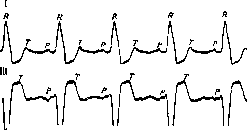
Protodiastolic gallop rhythm (I 1, 2) during a block of the right branch of the bundle of His (observation by Fogelson and Rozhkova).
Related articles
Mentioned in
Cite this page
“Gallop Rhythm.” Soviet Medical Encyclopedia. English translation of Bolshaya Meditsinskaya Entsiklopediya, 1st ed. (Moscow, 1928–1936), ed. N. A. Semashko. https://sovietmedicalencyclopedia.pages.dev/article/gallop-rhythm/