Telephone
Historical document, translated for reference. It reflects medical knowledge of the 1920s–30s and is not medical advice.
Summary
This article describes the early 20th-century technical principles of the telephone, focusing on the electromagnetic design developed by Bell. It explains the role of the diaphragm, the impact of resonance on sound quality, and the device's utility as a sensitive indicator for alternating current in laboratory measurements.
Encyclopedia article (1928–1936)
TELEPHONE, a device used for converting electric current oscillations into sound oscillations, was invented by Reis (1861); a more convenient design of the telephone, which has retained its basic features to this day, was provided by Bell (1875). Figure 1 shows a diagram of the most common type—the electromagnetic telephone, consisting of a magnet N carrying an insulated winding through which microphone current is passed (see Microphone), the oscillations of which must be converted into sound, and a plate M made of magnetic material (iron) placed in front of it, several tenths of a millimeter thick, clamped at the edge.
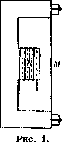
Changes in current cause changes in the magnetic field of magnet N, due to which the diaphragm M, by approaching and moving away from magnet N, causes the adjacent layers of air to oscillate. Since the diaphragm possesses a certain mass and a certain elasticity, it has a certain natural period of oscillation determined by these two quantities. The presence of a natural frequency in the diaphragm (which, in ordinary diaphragms, lies in the range of 800–1,000 oscillations per second) disrupts the accuracy of telephone transmission, as the diaphragm, by resonating at this frequency, amplifies it and isolates it from the general transmitted range. To weaken this effect, artificial measures are used to increase the damping of the diaphragm's oscillations (since the stronger the damping of oscillations in a system, the less pronounced the resonance in it). For the same reason, the resonant properties of a telephone diaphragm turn out to be different when the telephone radiates sound energy into free space or when it is pressed tightly against the ear: in the latter case, a closed air cavity is formed, bounded by the telephone diaphragm and the eardrum, which hinders the oscillations of the telephone diaphragm, thereby increasing the diaphragm's damping and weakening its resonance.
Besides the electromagnetic type, there are other types of telephones used mainly for loud transmission (loudspeakers). Since the telephone diaphragm does not oscillate when a direct current passes through the telephone winding, and sounds in the telephone are created only when an alternating current is passed through it, the telephone is used in measurement practice as a highly sensitive indicator of alternating current. For example, the telephone is used when measuring the resistance of electrolytes in alternating current measuring bridges (Kohlrausch bridge), where it is connected according to the diagram in Figure 2 into the diagonal of the bridge, just like a galvanometer in direct current bridges. The equilibrium of the bridge, at which the resistance measurement is performed, occurs at the moment when there is no sound in the telephone. The telephone can also be used to detect action currents (although with modern amplifiers, these currents can also be detected objectively on a galvanometer in an appropriate connection with an amplifier to which the action currents are fed).
P. Velik.
Related articles
Mentioned in
Cite this page
“Telephone.” Soviet Medical Encyclopedia. English translation of Bolshaya Meditsinskaya Entsiklopediya, 1st ed. (Moscow, 1928–1936), ed. N. A. Semashko. https://sovietmedicalencyclopedia.pages.dev/article/telephone/