Oscillations
Historical document, translated for reference. It reflects medical knowledge of the 1920s–30s and is not medical advice.
Summary
This article explains oscillations as periodic processes that change direction over time, focusing on simple harmonic motion, its mathematical representation, and its importance in various physical phenomena including electrical currents.
Encyclopedia article (1928–1936)
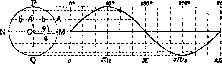
OSCILLATIONS, processes (in the most general sense) that periodically change their direction over time. These processes can be quite diverse. For example, if a heavy ball is suspended on a steel spiral spring, pulled away and then left to itself, it will oscillate under the action of elastic forces. Similarly, there are elastic oscillations of strings, rods, etc. The oscillating quantity can, however, also be the strength of an electric current (alternating current) and the voltage of an electric field (electrical oscillations), etc. The prototype of any oscillation can be the oscillatory motion of a point, i.e., its movement back and forth along a certain segment of a straight line between two extreme positions. Let us consider the simplest and at the same time most important oscillatory motion - the so-called simple harmonic oscillation. Let us imagine a point moving uniformly along a circle of radius a with period T. This means that if the point, starting from M, completes one full revolution, it will return to the same position. The projection of this point onto a vertical diameter PQ, i.e., the motion of the base of the perpendicular dropped from the point onto this diameter. It is easy to see that while the point moving along the circle counterclockwise, starting from M, completes one full revolution, its projection completes one full oscillation along the diameter, which consists of movement from O to P, then back from P to O, then from O to Q and back to O. Thus, the period T of the point's revolution along the circle will simultaneously be the period of the complete oscillation of the projection of this point onto the diameter. The quantity inverse to T obviously shows how many complete oscillations occur per unit time; it is called the frequency of oscillation and is usually denoted by the Greek letter v = 1/T. The distance of the oscillating point from its initial position O is called the elongation; the greatest distance of the oscillating point from the initial position (O in Fig. 1) characterizes the range of oscillation and is called the amplitude. The state of oscillation of the point, i.e., its position on the diameter PQ and the direction of its motion, is completely determined by the position of the auxiliary point moving along the circle. The latter in turn is known if the angle formed by the radius drawn to a given point and any diameter taken as initial, for example with the horizontal diameter MN, is given. This angle, which completely determines the state of the oscillatory motion of the point, is called the phase of oscillation. For example, the angle MOA will be the phase of oscillation of point A; the obtuse angle MOB will be the phase of oscillation of point B. If, as in this case, the phases differ by 180° (or, which is the same, by π), it is said that the points are in opposite phases: in this case they are located symmetrically with respect to point O and move in opposite directions. During the period T, the point completes one full oscillation, as a result of which its phase changes by a full circle, or by 2π. It is clear that at any moment t the phase φ of the oscillation will be related to the period T by the following relation: φ/T = t/T, or φ = 2πt/T = 2πvt.
(1) From consideration of triangle AOM on the basis of trigonometric rules, the following formula for the elongation s of the oscillating point is directly obtained: s = OA sin φ = a · sin 2πt/T = a · sin 2πvt, (2) where a = a - amplitude of oscillation. Formula (2) represents the fundamental law of harmonic oscillation. Since the sine value oscillates between +1 and -1, the elongation value oscillates between +a and -a. If the dependence between elongation and phase is represented graphically, a curve as shown in Fig. 2 will be obtained. This
Figure 2.
curve is called a sinusoid, and therefore the oscillation itself is called sinusoidal. As stated at the beginning, this applies not only to the oscillatory motion of a point, but can also apply, for example, to alternating electric current. Hence the origin of such terms as 'sinusoidal currents of electrotherapy'.
The speed of a point performing harmonic oscillation does not remain constant during the period. Indeed, at points M and N, the point on the circle and its projection move parallel to each other, while near P and Q they move almost perpendicularly. From this it follows that a harmonically oscillating point has the greatest speed when passing through the middle O of the segment along which it moves, and the smallest speed at the ends of this segment; at P and Q it stops for a moment and then changes the direction of its motion. Mathematically, the law of change of speed with time is expressed by the formula u = -a(2π/T)cos2πt/T = -a(2π/T)cos2πvt, or, if instead of the period T we introduce the frequency v=1/T, u = 2πva cos 2πvt. Since with continuous change of angle the cosine oscillates, like the sine, within the limits from +1 to -1, the speed will also change periodically, oscillating between the values +2πa/T and -2πa/T. The acceleration (w) can also be easily found mathematically, and it is equal to w = -a(2π/T)²sin2πt/T; if we compare this expression with formula (2), we find w = -(2π/T)²s or, denoting the constant quantity (2π/T)² by k, we get w = -ks. We thus see that if a point oscillates harmonically, its acceleration is directed toward the center (the minus sign in the previous formula) and is proportional to the elongation, the distance from the center. This property is generally true and usually serves as a criterion that the given oscillatory motion is harmonic. Finally, the energy of oscillation turns out to be proportional to the square of the amplitude.
Harmonic oscillation is the most important because, according to Fourier's theorem, any periodic motion can be represented as a collection of harmonic oscillations with different amplitudes but with frequencies in the ratio 1:2:3:4 (fundamental tone, octave, fourth, fifth, etc.). Such a decomposition of periodic motions is important in many practical applications. There are devices that allow this decomposition to be carried out mechanically (harmonic analyzers).
Related articles
Mentioned in
Cite this page
“Oscillations.” Soviet Medical Encyclopedia. English translation of Bolshaya Meditsinskaya Entsiklopediya, 1st ed. (Moscow, 1928–1936), ed. N. A. Semashko. https://sovietmedicalencyclopedia.pages.dev/article/oscillations/