Energometry
Historical document, translated for reference. It reflects medical knowledge of the 1920s–30s and is not medical advice.
Summary
Energometry is a historical method proposed by Christen for measuring the energy and work of the pulse in a specific arterial segment to estimate the work of an individual cardiac contraction. The method uses a cuff and manometer to gauge relative energy values, though it has largely fallen out of use due to technical limitations and lack of precision regarding systolic volume.
Encyclopedia article (1928–1936)
ENERGOMETRY. A method proposed by Christen for measuring the energy and work of the pulse in a specific segment of an artery with the aim of obtaining an idea of the work of an individual cardiac contraction. Thus, in energometry, an attempt is made to measure a specific, always equal part of the energy of a cardiac contraction and, from this part, to judge the energy of the cardiac contraction as a whole. The figures obtained by this method are relative, not absolute. The principle of energometry lies in the fact that the kinetic energy of the pulse wave is converted as completely as possible into the pulsatory oscillations of a manometer, which can be counted.
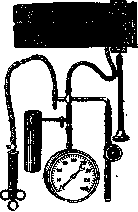
Christen's energometer.
The pressure in the manometer is increased until the oscillations of the manometer become maximal (see figure). Technique of energometry: a cuff is placed on the arm or, better, on the lower leg, connected to a highly sensitive manometer and a graduated piston. When the pressure in the cuff is increased, part of the blood will flow freely, while another part will perform specific work, changing the volume of air, or rather the pressure in the cuff, and thereby causing oscillations of the manometer. At a certain pressure, the energy of the pulse wave will be captured by the cuff. With the help of a graduated syringe, one can introduce into the cuff a precisely measured amount of air, which produces the same changes in pressure in the cuff or, which is the same thing, the same oscillations of the manometer as the energy of the pulse wave. By multiplying the amount of introduced air by the value of the corresponding pressure, we obtain the E-energy of the pulse wave of a specific arterial segment at a given pressure. If one determines the energy of the pulse wave at different pressures, one can obtain energometric curves. Energometry shows that the maximum change in volume in the cuff fluctuates from 0.9 to 1.6 cm; the pressure at this time fluctuates from 90 to 130 mm of mercury, and consequently, the energy of an individual contraction = 125-235. By multiplying the obtained figures of the energy of an individual contraction by the number of cardiac contractions, one obtains the L-work of the heart. When evaluating the results obtained by the energometer, one must take into account that the figures obtained are relative. Furthermore, one cannot be certain that a specific, uniformly equal part of the energy of the cardiac contraction is being measured. The energometer is also not devoid of purely technical shortcomings. A significant question is whether the energometer makes it possible to judge the strength of a cardiac contraction and the magnitude of the systolic volume. The data obtained do not represent an exact expression of the systolic volume, expressed even in relative figures. They provide a general idea of the systolic volume, but this idea is close to that which is obtained by ordinary palpation of the pulse. This explains why energometry has not gained wide distribution.
Related articles
Cite this page
“Energometry.” Soviet Medical Encyclopedia. English translation of Bolshaya Meditsinskaya Entsiklopediya, 1st ed. (Moscow, 1928–1936), ed. N. A. Semashko. https://sovietmedicalencyclopedia.pages.dev/article/energometry/