Tachography
Historical document, translated for reference. It reflects medical knowledge of the 1920s–30s and is not medical advice.
Summary
This article from the 1928–1936 Soviet medical encyclopedia describes tachography, a graphical method for registering the speed of liquid flow, specifically applied to measure blood flow velocity in vessels. It details the historical instruments used, including the Chauveau and Lortet hemodromograph and the Cibulski photohemotachometer, and explains the principles behind their operation and the recording of tachograms.
Encyclopedia article (1928–1936)
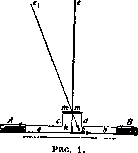
TACHOGRAPHY (from Greek tachys- swift and grapho- write), a graphical method for registering the speed of liquid flow, applied for determining fluctuations in the speed of the blood current in vessels. Among many instruments intended for this purpose, the hemodromograph of Chauveau and Lortet should be placed first. A metal tube ab (Fig. 1) is equipped in the middle with a wide short process ed. The upper opening of this process is covered with a dense rubber membrane mm, through the center of which a thin lever ke is passed, having at its end a small flat disk k. The lever is set up so that the center of the disk stands perpendicular to the axis of the tube ab. The apparatus, previously filled with blood or a physiological solution, is inserted into both ends (A and B) of a cut artery. The blood current, encountering resistance in the disk k, deflects it in the direction of the blood flow (Fig. 1, kfr); on the other hand, the elastic membrane strives to give the lever its original position. As a result of the action of these forces, oscillations of the lever are obtained, which can be recorded on a kymograph. For a correct evaluation of the results obtained in tachography, the recording of the oscillations of speed, a tachogram, is usually carried out in parallel with the recording of blood pressure. Fig. 2 presents two graphs obtained in an experiment on the speed of blood in the carotid artery of a horse. From the comparison of both curves it becomes obvious that this speed is in direct dependence on the periodic work of the heart and that each change in blood pressure corresponds to a definite change in speed. If the apparatus has been previously calibrated by passing liquids through it with definite speeds, then from the obtained tachogram one can judge the speed of the blood and the nature of its changes over a definite period of time. In the form of tachogram presented in Fig. 2, the value of the speed at any moment can be easily determined by the height of the corresponding ordinate.
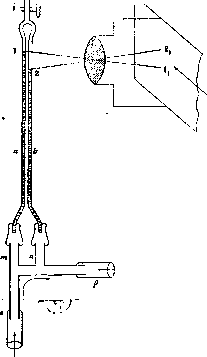
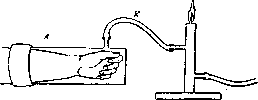
Since the hemodromograph of Chauveau can be used only in experiments on large animals, attempts were made to construct an instrument suitable for measuring speed in vessels of smaller caliber. Using the principle of the Pitot tube, Cibulski proposed a photohemotachometer, by means of which the oscillations of speed are registered on a photographic plate. The essence of Cibulski's method consists in the fact that two tubes bent at a right angle are included in the liquid current, the open ends of which are directed in opposite directions, as can be seen from Fig. 3. The stream of liquid, meeting on its path the opening c, is held back, and the speed of its particles is reduced to zero. The kinetic energy of these particles acquires another form - pressure energy, owing to which the level of the liquid in the manometer ca rises. In the manometer b1, turned with its end in the opposite direction, the reverse phenomenon will be observed: its level should slightly decrease due to the suction action of the stream striving to carry away with itself the particles located in the bend h. Since both pressure and the suction action depend entirely on speed, it is understandable that the difference in levels in both manometers will change in parallel with the change of this speed; in other words, this difference, with appropriate calibration, can serve as a measure of this speed. Cibulski in his apparatus slightly changed the form of the Pitot tube, which in a considerable degree facilitated both the manufacture of the receiving cannula and the very technique of the experiment. In its finished form (Fig. 4) the apparatus consists of two parts: the cannula er and the manometer ab with a tap g. The end of the cannula c is inserted into the central, r- peripheral end of the cut artery, and the branches t and n are connected by rubber tubes to the free ends of the manometer ab, previously filled with a weakly colored liquid. After the liquid has run down to a known height, the tap g is closed, and by opening the clamp of the previously clamped artery, blood is let into the apparatus. The oscillations of the levels 1 and 2 in both tubes are photographed (11 and 22) on a moving photographic plate. Fig. 4 depicts Cibulski's apparatus with a diagram of its photographic installation. The principle of the tachograph of Kries (v. Kries) is understandable from Fig. 5. The plethysmograph (see Plethysmography) L is connected with a small gas burner. The increase in the volume of the hand, finger, etc. under the influence of the systolic pressure of the blood is reflected in the increase of pressure in the plethysmograph, which through the rubber tube K is transmitted to the burner and causes corresponding oscillations of the flame, which can also be fixed with the help of photography. The appearance of such a tachogram is shown in Fig. 6. The first tachometer was proposed by Vierordt in 1858, but due to great defects of construction it did not find further application.


Related articles
Cite this page
“Tachography.” Soviet Medical Encyclopedia. English translation of Bolshaya Meditsinskaya Entsiklopediya, 1st ed. (Moscow, 1928–1936), ed. N. A. Semashko. https://sovietmedicalencyclopedia.pages.dev/article/tachography/