Tachistoscope
Historical document, translated for reference. It reflects medical knowledge of the 1920s–30s and is not medical advice.
Summary
The article discusses two distinct concepts: 1) Tachycardia (rapid heart rate) as a physiological response to venous pressure changes or underlying cardiac conditions, with diagnostic approaches and treatment considerations; 2) The tachistoscope as an experimental apparatus in psychology for studying visual perception by exposing objects for precisely controlled brief durations.
Encyclopedia article (1928–1936)
TACHISTOSCOPE, TACHISTOSCOPY. Venous pressure (when the hollow veins and atria are filled with blood) causes an increase in heart rate (Bainbridge's reflex). In diseases of the cardiovascular system accompanied by cardiac weakness, venous pressure usually increases, while arterial pressure falls. Both of these factors act in the same direction, accelerating the heart rhythm. The diagnosis of sinus T. usually presents no difficulties and can be made on the basis of the more or less gradual development of a correct but significantly accelerated heart rhythm, which in most cases has a temporary nature. In particularly difficult cases, electrocardiography helps to determine the origin of T. The prognosis for sinus T. depends on the nature of the underlying disease causing T. For the most part, sinus T. are temporary, beginning and ending simultaneously with the cause that produces them (increase in temperature, reflexive, toxic, etc. T.). The prognosis in these cases is favorable. However, cases are not uncommon where sinus T. acquire a persistent and prolonged nature, which occurs with deep disturbances in the physicochemical state of the myocardium (myocardial dystrophy, myocarditis), with prolonged effects of infectious or toxic factors on the nervous apparatus of the heart (Basedow's disease, intestinal dyspepsias, chronic pulmonary diseases, etc.) and with lesions of the bulbar center. The treatment of T. must first be directed toward eliminating the cause that produces them.
D. Grotal.
TACHISTOSCOPE, TACHISTOSCOPY (from Greek tachistos-very quick and scopeo-I observe). The tachistoscope is an apparatus for exposing visual objects (the name T. was proposed by Volkmann in 1859); it is used in experimental psychology for the study of visual perceptions. The essence of these studies is that the process of perception, which proceeds quickly and continuously under ordinary conditions, is artificially broken down into separate moments in the experiment for analyzing the composition of perceptions, for studying the gradualness and sequence of the unfolding of this process. According to the requirements of the experiment, the T. must carry out the idea of exposing visual objects for a strictly defined and arbitrarily variable time. Many modifications of apparatus for tachistoscopy have been proposed. The simplest in construction is Wundt's tachistoscope (Fig. 1). The apparatus of this author consists
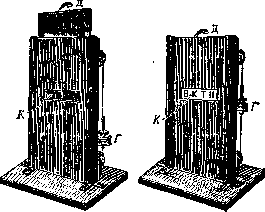
Figure 1. Wundt's tachistoscope. Before the experiment begins, the board D is raised and closes the visual stimulus. On the right - the tachistoscope at the moment the board D falls, revealing the visual stimulus for a brief moment; G-weight; K-circle, serving as a fixation point.
of a black screen sliding along grooves in front of a vertical wall painted black; the screen falls when a button that holds it before the beginning of the experiment at the upper edge of the vertical wall is pressed. The screen is provided with a square hole located in its upper third. This hole, as the screen falls, successively opens for a very short time before the viewer the surface of the wall behind it and consequently those visual objects that may be located on one of its sections. The location of the exposed objects is marked by a small white circle on the falling screen, placed below the square hole and at the level of the visual object. This circle serves as a fixation point to give the eye a favorable position for assimilating impressions. The change in the falling speed of the screen and consequently the exposure time of the visual object is achieved by changing the height from which the screen falls. To make the exposure time as variable as possible, the construction of Wundt's tachistoscope is complicated by attaching to the falling screen by means of a pulley weights of different weight (the principle of Atwood's machine). A number of authors (Helmholtz, Exner, Goldscheider, Müller) instead of a falling screen use a rotating disk, and the same principle was used by Wirth in the construction of a T. with a rotating mirror. Then T. with a pendulum were proposed, which opened the visual object at a certain moment during its swing; the pendulum became a component part of T. arranged on the principle of momentary illumination of the visual object; here the pendulum plays the role of an interrupter of light flashes (dark Sanford chamber). It should be noted that in the earliest models of T., used for example by Helmholtz, the principle of illuminating the visual object with an electric spark was used; later models also used the principle of momentary illumination, both with natural light (in Binet's tachistoscope with a photographic shutter) and with artificial light (Dodge's apparatus). However, the complexity of construction of these apparatus presents considerable difficulties in using them, and at present the most popular models are T. in which the exposure of visual objects is produced by falling sectors (apparatii of Kountz, Tiger, Nechaev) (Fig. 2). The apparatus of the Russian psychologist A. P. Nechaev found extensive use in our country and abroad. The duration of exposure in Nechaev's tachistoscope, determined by the degree of separation of the wings, was changed by means of Hipp's chronoscope. Tachistoscopic experiments are conducted to clarify the nature of perceptions, their speed, and individual peculiarities in the sphere of perception. The material consists of a set of various cards with words, drawings, geometric figures, etc. The analysis of the perception process is carried out by means of experiments that reveal the gradual recognition of the object, determine the dependence of perception on previous experience, on the strength of stimulation, on the state of the subject, etc. Tachistoscopic experiments are widely used in the practice of Soviet psychotechnology (in production, school, army).
Related articles
Cite this page
“Tachistoscope.” Soviet Medical Encyclopedia. English translation of Bolshaya Meditsinskaya Entsiklopediya, 1st ed. (Moscow, 1928–1936), ed. N. A. Semashko. https://sovietmedicalencyclopedia.pages.dev/article/tachistoscope/