Sphygmomanometry
Historical document, translated for reference. It reflects medical knowledge of the 1920s–30s and is not medical advice.
Summary
Sphygmomanometry is the measurement of arterial blood pressure using specialized instruments. This article describes various historical methods and devices for measuring blood pressure, including those by Basch, Riva-Rocci, and Recklinghausen, with detailed explanations of their principles and applications.
Encyclopedia article (1928–1936)
Sphygmomanometry, Sphygmomanometers. Arterial blood pressure depends on the work of the heart, resistance to blood flow in the periphery, and the viscosity of blood, and is therefore an important indicator in assessing the state of the cardiovascular system. Its determination since ancient times was reduced to simple palpation of the pulse and an unstable subjective assessment ('hard or soft pulse'). The attempt to find methods for more precise measurement of pressure and to express it in specific units led to the development of sphygmomanometry, which makes it possible to perform determinations on humans, i.e., bloodless methods, and to express them in millimeters of mercury. The main purpose of such devices—sphygmomanometers—should be to find such external pressure which would be equal to the counterpressure from the artery being tested. This very point is mainly the subject of discussion in the literature when evaluating one or another construction, which differ from each other, first, by the method by which equilibrium is achieved between arterial pressure and external pressure, and second, by the method of determining the moment when this equilibrium occurs. The first attempts by Vierordt in 1855 to obtain the magnitude of pressure using the compression of the solid pellet of his sphygmograph were soon abandoned. v. Basch in 1876 proposed a pellet constructed from a round metal box, one end of which is covered with a flexible rubber membrane, and the other end passes into a metal tube connected with a thick-walled rubber to an aneroid barometer. The pellet, filled with water, allows for a more perfect, uniform pressure when compressed. The pressure at which, below the constriction, the pulse can no longer be palpated is marked on the manometer and is interpreted as maximum pressure. Despite the fact that Basch's construction still has its adherents to this day, it must be considered obsolete. The sphygmomanometer proposed by Marey in the same year, based on the principle of plethysmography, did not receive wide distribution due to the complexity of its setup. A significant achievement in methodology must be recognized as the method proposed by Riva-Rocci in 1896 for pressing on the artery using a cuff. The latter represents a wide tube-sleeve made of dense rubberized fabric, into the lumen of which air can be pumped by a pump. The cuff is applied to the upper arm; its free ends are clamped with a special clamp and air is forced through a tube embedded in the wall of the cuff. Between the cuff and the pump is included a mercury manometer, the readings of which serve as a measure of the pressure achieved in the cuff. On the same principle with some change in the width of the cuff (13 cm), v. Recklinghausen proposed a S. with a metal manometer (tonometer), equipped with a scale expressed in heights of water column. The pressure is marked by a pointer, which greatly facilitates observation. Recklinghausen was the first to think of measuring with his apparatus (as well as Riva-Rocci's apparatus) not only maximum but also minimum pressure. For this purpose, first the pressure that causes the disappearance of the pulse below the cuff is applied, and then the pressure is gradually reduced until the first barely noticeable fluctuations of the pointer. This moment is marked as maximum pressure. In this case, the pulse below the cuff is usually not palpable (palpatory measurement), which is why the pointer readings (oscillometric measurement) give higher values. The reason for this discrepancy is explained by the fact that when the artery is completely compressed at the lower end of the cuff, it may still pulsate weakly in the upper section and these pulsations are transmitted to the manometer. With further reduction of pressure in the cuff, the amplitude of the pulse gradually begins to increase and at a certain pressure reaches a maximum, after which it decreases again. The moment of maximum amplitude is taken as a measure of minimum (diastolic) pressure. The determination of these extreme readings is facilitated by the fact that the fluctuations of the pointer in the interval between maximum and minimum are unstable in nature; the pointer constantly gives small secondary fluctuations and only at these points do its readings have the character of a proper pulse. The application of the apparatus is clear from the accompanying illustration. Kort proposed for determining pressure the method of auscultation of the brachial artery (see Blood pressure, determination technique). To the type of Recklinghausen's apparatus belongs the oscillograph of Pashon and the tonometer of Gartner. The latter is also built on the principle of compression with a cuff and consists of a short metal sleeve, the inner wall of which is covered with rubber fabric. The apparatus is adapted for studying pressure in the arteries of the finger. Initially, the finger is made bloodless by light massage, it is tied with a rubber band at the base, and after placing the tonometer on the middle phalanx, air is pumped into the space between the inner wall of the sleeve and the rubber padding, bringing the pressure above maximum.
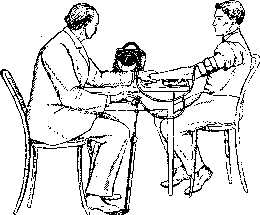
Measurement of blood pressure. (According to Recklinghausen.)
After removing the bandage, air is gradually let into the cuff and the pressure at which the bloodless finger turns red again from the influx of blood is noted on the manometer. Gartner's tonometer did not find wide application, since a more correct judgment about the general blood pressure and work of the heart is obtained from arteries located closer to the heart (shoulder) than from terminal ones (finger).
Related articles
Cite this page
“Sphygmomanometry.” Soviet Medical Encyclopedia. English translation of Bolshaya Meditsinskaya Entsiklopediya, 1st ed. (Moscow, 1928–1936), ed. N. A. Semashko. https://sovietmedicalencyclopedia.pages.dev/article/sphygmomanometry/