Oscillometers
Historical document, translated for reference. It reflects medical knowledge of the 1920s–30s and is not medical advice.
Summary
Oscillometers are devices for determining maximum and minimum blood pressure in humans by observing pulse oscillations. The method involves compressing an artery and observing the amplitude of pulse oscillations at different external pressures to determine blood pressure values.
Encyclopedia article (1928–1936)
OSCILLOMETERS, devices for determining the maximum and minimum blood pressure in humans by observing pulse oscillations (vibrations). The method is as follows: when compressing an artery, the pulse oscillations of the arterial wall become increasingly significant and reach a maximum when the external pressure on the wall equals the internal pressure (minimum blood pressure corresponding to diastole); under this condition of balanced pressures, the wall is unstretched at the moment of minimum blood pressure and therefore possesses maximum stretchability (like any other elastic membrane in an unstretched state). If the external pressure compressing the artery is increased, the pulse oscillations decrease again and disappear when the external pressure becomes equal to the maximum blood pressure. Thus, comparing the range (amplitude) of pulse oscillations at different external pressures makes it possible to determine the maximum and minimum blood pressure. This method was proposed by Marey (Marey; 1876), but the design of the modern O., which came into practice, belongs to Pachon (Pachon; 1909), who ingeniously solved the main task: to construct a device possessing very high, always constant sensitivity. O. consists of the following parts (see the figure): 1. A shoulder bandage B, in which increased pressure is created by a pump P, compressing the artery. 2. An aneroid manometric capsule C, enclosed in a hermetically sealed metal box E, and tubes a, b, f, connecting the shoulder bandage, the manometric capsule, and the internal space of box E. 3. A manometer M, indicating the pressure inside box E, and therefore inside the shoulder bandage. 4. Additional devices—a screw valve v, allowing gradual release of air from the entire system, and a disconnecting device s, by which when pressed, the internal space of box E and capsule C can be disconnected. The aneroid capsule reproduces the pressure oscillations of the air inside the shoulder bandage and transmits these oscillations to a hand moving along a dial.
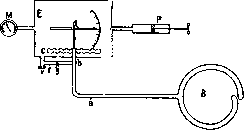
A significant feature of the O. design proposed by Pachon is that the increase in pressure created inside the shoulder bandage by the pump is transmitted not only to the inner but also to the outer surface of the aneroid capsule C through the connecting tube f. As a result, at any pressure, the capsule walls remain in an unstretched state, and their stretchability for each pulse pressure increase remains constant and at maximum. Moreover, the absence of initial stretching of the capsule allows it to be made of very thin metal and ensures very high sensitivity of the device.
The basic procedure for determining maximum and minimum blood pressure with the help of O. is as follows: air is pumped into the bandage by pump P to a value exceeding the maximum blood pressure. At this time, the O. hand remains completely at rest. Then, air is gradually released through the screw valve v until the O. hand first detects pulse oscillations, even if weak. To observe these oscillations, it is necessary each time to press the disconnecting device s, which stops the communication between the aneroid capsule C and box E and therefore causes the pulse pressure increase inside the bandage to be transmitted only to the inner surface of the capsule, but not to the outer. The pressure indicated by the manometer inside the bandage at the first appearance of hand oscillations indicates the maximum blood pressure. Air is released again until the oscillations of the O. hand reach maximum range (amplitude): the manometer at this time indicates the minimum blood pressure. The results of determining maximum blood pressure with the help of O. and by the usual Riva-Rocci method do not coincide: O. gives a higher figure. Pachon explained the reason for this difference: the disappearance of the pulse below the bandage observed by the Riva-Rocci method cannot serve as an exact criterion of maximum blood pressure, since at this time the pulse is still fully expressed in the area of the bandage and is clearly recorded by O. The disappearance of the pulse below the compressed vascular section occurs not as a result of cessation of blood flow, but due to the physical process of enhanced damping of the pulse wave in the area of the compressing bandage: damping under these conditions is enhanced because the elastic walls of the externally compressed artery, being less stretched than in the natural state, exhibit more significant pulse oscillations, which are accompanied by greater mechanical work. This work is where the kinetic energy of the blood pulse wave is expended. This expenditure of energy and damping of the pulse wave are further increased due to the increased friction of blood when passing through the narrowed channel inside the bandage (see also Blood pressure).
Yunev. Lit.—see lit. to article Oscillograph.
Related articles
Cite this page
“Oscillometers.” Soviet Medical Encyclopedia. English translation of Bolshaya Meditsinskaya Entsiklopediya, 1st ed. (Moscow, 1928–1936), ed. N. A. Semashko. https://sovietmedicalencyclopedia.pages.dev/article/oscillometers/