Drip Infusions
Historical document, translated for reference. It reflects medical knowledge of the 1920s–30s and is not medical advice.
Summary
This article from the 1928–1936 Soviet medical encyclopedia details the technique of drip infusions, covering both rectal and intravenous methods. It explains the physiological rationale, the necessary equipment, and the specific conditions for safe administration, including temperature control and bowel preparation.
Encyclopedia article (1928–1936)
Drip Infusions, the introduction of large quantities of various solutions into the rectum (drip enema, according to Murphy); in recent times, special apparatuses and cannulas have been proposed for intravenous drip infusions. Physiological solution and glucose are most often used for drip infusions. Various medicinal substances (adrenaline, digalen, etc.) are added to the solutions as needed. Drip infusions are indicated in cases where the patient cannot or should not drink (operations on the esophagus, stomach, in the oral cavity, frequent vomiting, etc.), when it is necessary to replenish the patient's body with fluid, and when it is necessary to eliminate toxins that have accumulated in the body. Drip infusions have relatively wide application in disorders of nutrition in young children. Some authors note that in cases of intestinal paralysis, drip infusions (enemas) induce peristalsis, and therefore recommend drip infusions for this purpose.-TECHNIQUE. To perform a drip infusion (enema), it is necessary to have a soft thin tip in the shape of a rubber catheter (No. 12-14), a rubber tube, a vessel for the solution, a clamp with a glass ball (counting ball); inside it there is a narrow tube through which the solution is released drop by drop. The rate of fluid release depends on the degree of pressure of the clamp on the rubber tube connecting the vessel to the ball. In cases where there is no counting ball, one can simply use one clamp, and before introducing the tube into the rectum, the rate of fluid intake is established by counting the drops coming out through the peripheral end of the tube. When applying drip infusions, three conditions must be observed: the first is that the fluid entering the rectum must be heated to 38-40°. This is achieved by placing the vessel with the solution in another filled with warm water. By occasionally adding hot water to the latter vessel, the temperature is regulated so that the thermometer in the first vessel with the solution shows from 37° to 40°. In addition to this, maintaining the temperature can also be done by covering the vessel with a woolen cap and placing the tube on a hot-water bottle. For this purpose, thermo-electric devices can also be used. Maintaining the required temperature is important for the absorption of the solution. Cold solutions are not absorbed, but on the contrary, irritate the rectum, and such an enema is not able to be retained by the patient.-The second condition is the emptying of the rectum immediately before the drip infusion. The intestine should not contain feces and gases. For this purpose, a cleansing enema is performed, and if it is contraindicated, the fecal masses are removed with a finger. The intestine is freed from gases by introducing a gas outlet tube. The presence of gases in the rectum can completely prevent the entry of fluid, since gases sometimes fill the tube.-The third condition is the careful regulation of the speed of fluid flow in accordance with the intestine's ability to retain the introduced fluid, which is determined by experience. The vessel with the solution must not be lower than 15-20 cm above the level of the patient's anus, thanks to which the fluid enters by gravity. If the vessel is placed at the same level, a Richardson balloon must be provided and pumped every 5-10 minutes. Due to the good absorbing capacity of the mucous membrane of the rectum, the solution can be introduced from 1/2 to 1 liter per hour, and this procedure can be repeated 2-4 times a day. These manipulations are usually well tolerated, but they should not be used for more than 2-3 days in a row, as irritation of the rectum may occur. Intravenous drip infusions are performed using various apparatuses. The simplest apparatus is the Tokarev apparatus. The apparatus consists of the following parts (see figure): 1. A glass graduated cylindrical irrigator with a capacity of 1 liter. The bottom of the irrigator is drawn out in the form of a tube. 2. A screw clamp and a tap, mounted on a rubber tube under the irrigator. 3. A glass "bulb-drip bottle with a float", located under the tap. 4. A thin rubber tube 115 cm long, leading from the "bulb" to the glass hot-water bottle. 5. A glass hot-water bottle with a capacity of 150 cm3 (a common chemical refrigerator), with four branches: a) the first lateral branch is connected to the leading rubber tube, which comes from the "bulb"; b) the second is connected to the discharging rubber tube, ending in a cannula; c) in the third, a thermometer (with divisions from 35° to 110°) is hermetically mounted with the aid of a rubber stopper or tube; d) the fourth is hermetically closed with a rubber stopper. 6. An electric or ordinary rubber hot-water bottle. 7. A rubber tube (75 cm long; interrupted by a glass tube along its length), leading from the 2nd branch of the hot-water bottle, ending in a silver, spear-shaped, curved cannula with a central and lateral opening.-Before use, the apparatus is filled with the introduced fluid (t° 40°). The tap is closed at this time. The irrigator is covered with a gauze stopper and suspended at a height of 1 m above the level of the patient's bed. Opening the tap, the rest of the apparatus must be raised to the upper level of the liquid. The "bulb" must be in a horizontal position until it is half full; the float rises at the same time. Then the entire rubber tube with all parts of the apparatus is slowly lowered so as to remove the air contained in it. If this is done carefully, all parts of the apparatus are gradually filled with liquid, which then begins to flow from the cannula. In the same cases where air bubbles remain or accumulate in vessel No. 5, they are easily removed by opening the 4th branch. By means of the screw clamp, while watching the "bulb", the number of drops to be introduced in 1 minute is regulated. After venesection, the cannula is introduced into the lumen of the vein and secured. The arm is fixed in a splint. The advantage of intravenous drip infusion lies in the fact that the fluid is introduced slowly, drop by drop, constantly, over 1-3 days or more, stimulating the vital centers with fluid rich in oxygen and nutrients, which is especially important for restoring the strength of patients in shock and collapse. This method is not a complete replacement for the ordinary rapid introduction into the vein of various nutritive and stimulating substances, which give a good but temporary effect, but is a further measure aimed at preserving and strengthening the result obtained. The apparatus is especially indicated for dehydrated cancer patients, in whom other measures fail to raise vital forces. Intravenous drip infusions are also indicated in peritonitis, sepsis, and other conditions where it is necessary to wash the body with large quantities of fluid. Physiological solution and glucose (41/2-51/2%) can be infused in quantities from 1/4 to 3 liters per day. The duration of infusion can vary from 1 to 4 days or more.
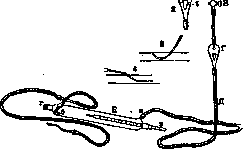
A-irrigator; B-screw clamp; C-tap; D-bulb; E-rubber tube goes to hot-water bottle; F-hot-water bottle with four branches: a-first lateral connected to leading rubber tube; b-second-connected to discharging tube, ending in cannula; c-third-with thermometer; d-fourth-closed with rubber stopper; 1-apparatus for infusion; 2-bulb with float (b) and tube ( ); 3-curved cannula with one opening; 4-spear-shaped cannula with central and lateral openings.
which then begins to flow from the cannula. In the same cases where air bubbles remain or accumulate in vessel No. 5, they are easily removed by opening the 4th branch. By means of the screw clamp, while watching the "bulb", the number of drops to be introduced in 1 minute is regulated. After venesection, the cannula is introduced into the lumen of the vein and secured. The arm is fixed in a splint. The advantage of intravenous drip infusion lies in the fact that the fluid is introduced slowly, drop by drop, constantly, over 1-3 days or more, stimulating the vital centers with fluid rich in oxygen and nutrients, which is especially important for restoring the strength of patients in shock and collapse. This method is not a complete replacement for the ordinary rapid introduction into the vein of various nutritive and stimulating substances, which give a good but temporary effect, but is a further measure aimed at preserving and strengthening the result obtained. The apparatus is especially indicated for dehydrated cancer patients, in whom other measures fail to raise vital forces. Intravenous drip infusions are also indicated in peritonitis, sepsis, and other conditions where it is necessary to wash the body with large quantities of fluid. Physiological solution and glucose (41/2-51/2%) can be infused in quantities from 1/4 to 3 liters per day. The duration of infusion can vary from 1 to 4 days or more.
Related articles
Mentioned in
Cite this page
“Drip Infusions.” Soviet Medical Encyclopedia. English translation of Bolshaya Meditsinskaya Entsiklopediya, 1st ed. (Moscow, 1928–1936), ed. N. A. Semashko. https://sovietmedicalencyclopedia.pages.dev/article/drip-infusions/