Syringes
Historical document, translated for reference. It reflects medical knowledge of the 1920s–30s and is not medical advice.
Summary
This article describes various types of syringes used in medical practice during the 1920s-1930s, including their construction, capacity, and specialized applications for injections, punctures, and aspiration procedures across different medical fields.
Encyclopedia article (1928–1936)
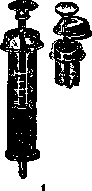
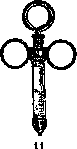
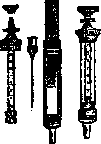
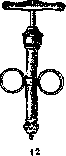
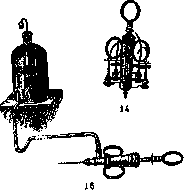
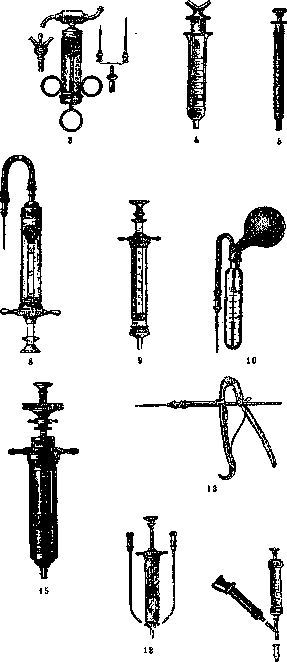
Syringes (from German Spritze) are used for introducing various therapeutic and anesthetic substances into the body, diagnostic punctures, aspiration of accumulated fluids, and in anatomical work. Syringes are made of metal, glass, and rubber. The capacity of syringes ranges from 1/2 to 350 cm3. The capacity of syringes used in anatomical work reaches 1,000 cm3. The most common types are the Record, Luer, and Pravaz syringes. The Record syringe (fig. 1) is made of metal and glass. The metal part is connected to the glass by a special metal alloy, forming a single piece. The glass cylinder is carefully polished and provided with precise graduations. The nickel piston is fitted very precisely, ensuring its smooth sliding and tight fit against the cylinder wall. The usual capacity of Record syringes ranges from 1 to 20 cm3, but for mercury-oil injections and other purposes, syringes with capacities of 1/4 and 1/2 cm3 with fine graduations are manufactured, ensuring accurate dosing (fig. 2). The universal Record syringe is adapted for injections, punctures, and aspiration (fig. 3). The Luer syringe differs by its very simple construction. It is entirely made of glass. A polished glass cylinder serves as the piston (fig. 4). These syringes are produced with capacities from 1 to 20 cm3. The Barthelemy syringe somewhat resembles the Luer syringe but differs in its smaller dimensions (fig. 5). This syringe is mainly used for mercury-oil injections. Due to its clearly visible graduations, it allows for precise dosing. The Lieberg syringe also has this property (fig. 6). The Pravaz syringe, in its construction, somewhat resembles the Record syringe, but its casing is made of metal or hard rubber, and the piston is made of rubber, leather, or asbestos. The capacity of this syringe can be changed as needed by moving the piston (screw) (fig. 7). The Roux (fig. 8) and Levyn (fig. 9) syringes have similar properties. Of the listed syringes, the Record and Luer types are most commonly used in daily practice. For introducing large quantities of liquid, the Gabrichevsky syringe (fig. 10), which is now obsolete, was used. Its capacity ranges from 5 to 100 cm3. For injecting thick substances, such as paraffin in the application of paraffin prostheses, Stein (fig. 11) and Onodi (fig. 12) syringes are used. Cannulas are attached to these syringes with a screw. The Broekaert syringe (fig. 13) deserves special attention, with which solid paraffin can be injected without applying great force and even with one hand.
E=-f
The casing of this syringe is made of metal or hard rubber, and the piston of rubber, leather, or asbestos. The capacity of this syringe can be changed as needed by moving the piston (screw) (fig. 7). Similar properties are possessed by the Roux (fig. 8) and Levyn (fig. 9) syringes. Of the listed syringes, the Record and Luer types are most commonly used in daily practice. For introducing large quantities of liquid, the Gabrichevsky syringe (fig. 10), which is now obsolete, was used. Its capacity ranges from 5 to 100 cm3. For injecting thick substances, such as paraffin in the application of paraffin prostheses, Stein (fig. 11) and Onodi (fig. 12) syringes are used. Cannulas are attached to these syringes with a screw. The Broekaert syringe (fig. 13) deserves special attention, with which solid paraffin can be injected without applying great force and even with one hand. For local anesthesia, Record and Luer syringes with a capacity of 5 to 10 cm3 are considered most common. Schleich proposed his syringe with an adjustable piston of asbestos or rubber for infiltrative anesthesia (fig. 14). The Braun syringe, proposed for the same purpose, allows for strong pressure through a screw included in the lock, facilitating infiltration of dense tissues (fig. 15). For easier production of local anesthesia, Schwabe designed his syringe (fig. 16), which connects through a special adapter to a vessel filled with anesthetic liquid. The syringe is equipped with two valves, one at the outlet allowing liquid movement only from the syringe, and the other on the side allowing liquid to enter the syringe. For spinal anesthesia, Record and Luer syringes are usually used. Pochhammer proposes performing spinal anesthesia with his syringe (fig. 17). It is performed as follows: after aspirating cerebrospinal fluid through the side adapter, the appropriate amount of anesthetic substance is introduced, then the liquid contained in a large syringe pushes and spreads the previously introduced liquid.
In otorhinolaryngology, for puncturing the maxillary cavity from the lower nasal passage, the Schmidt-Schotz syringe (fig. 18) is used. For introducing anesthetic substances into the submucosal layer of the nose, there is the Hering syringe (fig. 19) and the laryngeal syringe after Schmidt (fig. 20). For the same purpose, the Brunings syringe (fig. 21) was proposed. Anesthesia of the middle ear can be conveniently performed with the Neumann (fig. 22) and Hartmann (fig. 23) syringes. For nasal irrigation and insufflation, there are the Weber-Lie syringes (fig. 24), Fraenkel (fig. 25), and Silberstein (fig. 26). In urological practice, for washing the bladder, the Leiter syringe (fig. 27) is used. The casing of this syringe is made of hard rubber, the piston is rubber, and the syringe is easily disassembled. For the same purpose, as well as for washing the urethra, the Janet syringe (fig. 28) is used. There is a modification of this syringe, the Janet-Record (fig. 29). The capacity of these syringes ranges from 50 to 250 cm3. For douching and cauterizing the urethra, Pospelov proposed a syringe made of glass in a hard rubber casing (fig. 30). The Tarnovsky syringe with a soft rubber tip and a capacity of 8 cm3 (fig. 31) is distinguished by its particularly simple construction. For urethral anesthesia, Kollmann (fig. 32), Guyon (fig. 33), and Lanz (fig. 34) syringes were proposed. In gynecology, for uterine injections, aspirations, and irrigations, Braun (fig. 35), Olshausen (fig. 36), Record (fig. 37), Spiegelberg (fig. 38), and Courant (fig. 39) syringes are used. The latter author proposed a special cannula for his syringe, which ends with a notch facilitating the insertion of a tampon. On the side, there is an opening for liquid outflow. With this syringe, an inserted strip of gauze can be impregnated with a disinfectant solution in place. For diagnostic punctures from the vagina, the Record syringe (fig. 40) with a Flatau cannula is very convenient (see Cannula).
F. Ia. Ianshensky.

Related articles
Mentioned in
- Ampoule and Ampullitis
- Anatomical Instrumentarium
- Anelia Spritz
- Aspirators
- Autohemotherapy
- Autopsy Instruments
- Autoserotherapy
- Bartholin's Glands
- Bronchography
- Cannula
- Dacryocystitis
- Diday Irrigation
- Duodenal Tube (duodenal sounding, and duodenal)
- Energometry
- Fillings
- First Aid Kit
- Fluctuation
- Gabastou Method
- Ganglion
- Gerota Method
Cite this page
“Syringes.” Soviet Medical Encyclopedia. English translation of Bolshaya Meditsinskaya Entsiklopediya, 1st ed. (Moscow, 1928–1936), ed. N. A. Semashko. https://sovietmedicalencyclopedia.pages.dev/article/syringes/