First Aid Kit
Historical document, translated for reference. It reflects medical knowledge of the 1920s–30s and is not medical advice.
Summary
A first aid kit is a piece of equipment containing bandages and other supplies for providing initial medical assistance at the scene. In the Red Army, it was standardized with specific contents including bandages, tourniquets, scissors, and specialized tools for emergency care.
Encyclopedia article (1928–1936)
First Aid Kit, an item of equipment for a medic, containing bandaging material and other means for providing first aid at the scene. In the Red Army, the first aid kit is made of dense canvas. It can be worn over the shoulder (usually on the right side), for which it has a strap (or wide tape) consisting of 2 parts. When a medic needs to have their hands free and a hanging bag on the side should not restrict movement (e.g., when crawling, when carrying stretchers), the bag is worn on the shoulders like a backpack (see illustration). For this purpose, the back of the bag has 3 metal rings through which both parts of the shoulder strap or tape are threaded separately. The contents of the military first aid kit are standardized and determined by the table of property placed in it. Inside the first aid kit there are 2 compartments and a number of pockets (nests) for individual items. The large compartment is filled with bandaging material: individual or antiseptic first aid bandage packages, triangular bandages, safety pins. A skein of coarse thread and several needles for securing bandages and torn clothing rendered during aid are also placed here. For applying immobilizing bandages, splints are in the first aid kit: mesh, of the Filby type, or bast. To stop bleeding, a rubber tourniquet or special tape with a lock is in the first aid kit. For hand care, soap, a towel, and a grass brush for washing hands are carried in the first aid kit. Of individual items, scissors and a garden knife (with a curved blade) are mandatory accessories of the first aid kit for removing clothing before bandaging, for making splints from available materials, etc. For first aid to victims of persistent chemical warfare agents, a supply of tampons and a vial of decontaminating liquid are placed in the first aid kit. Bags with which medical instructors in military units are supplied are made according to the same type, but have a wider assortment of items contained in them. In addition to the items mentioned, a thermometer, a set of medical instructor's tools, a syringe, and some medications necessary in cases of emergency medical aid are placed in them: camphor oil and caffeine solution in ampoules, tincture of iodine, ammonia spirits, ether-valerian drops, as well as tablets with opium, codeine, aspirin, etc. If the medical instructor has an oxygen inhaler with them, then the tag from it, the oxygen cushion, and the corrugated tube can also be placed in the medical instructor's bag. First aid kits with which medics in Red Cross and Red Crescent teams are supplied are made according to the general army model, but their contents sometimes deviate from the inventory of items adopted in the Red Army.
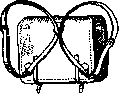
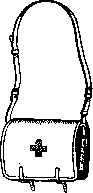
Red Army first aid kit.
For applying immobilizing bandages, splints are in the first aid kit: mesh, of the Filby type, or bast. To stop bleeding, a rubber tourniquet or special tape with a lock is in the first aid kit. For hand care, soap, a towel, and a grass brush for washing hands are carried in the first aid kit. Of individual items, scissors and a garden knife (with a curved blade) are mandatory accessories of the first aid kit for removing clothing before bandaging, for making splints from available materials, etc. For first aid to victims of persistent chemical warfare agents, a supply of tampons and a vial of decontaminating liquid are placed in the first aid kit. Bags with which medical instructors in military units are supplied are made according to the same type, but have a wider assortment of items contained in them. In addition to the items mentioned, a thermometer, a set of medical instructor's tools, a syringe, and some medications necessary in cases of emergency medical aid are placed in them: camphor oil and caffeine solution in ampoules, tincture of iodine, ammonia spirits, ether-valerian drops, as well as tablets with opium, codeine, aspirin, etc. If the medical instructor has an oxygen inhaler with them, then the tag from it, the oxygen cushion, and the corrugated tube can also be placed in the medical instructor's bag. First aid kits with which medics in Red Cross and Red Crescent teams are supplied are made according to the general army model, but their contents sometimes deviate from the inventory of items adopted in the Red Army.
Leonard's SANITARY TACTICS, the doctrine of the most effective use of the means of the sanitary service of the army in wartime. Since the task of the sanitary service in a combat situation is 'to be strongest at the right time and in the right place,' which is connected with the movement of sanitary means (personnel, sanitary property, separate sanitary institutions), S. t. is otherwise defined as the doctrine of sanitary maneuver. The most extensive and most fully developed chapter of S. t. is the doctrine of sanitary evacuation. At present the content of S. t. has been considerably expanded by information on sanitary reconnaissance and data on the maneuver of means of sanitary prevention (laboratories, sanitary checkpoints, vaccination detachments, etc.). S. t. as one of the military disciplines subject to study by the medical personnel was first named as such by the senior physician of the Finnish rifle battalion Valberg, who in 1889 published an article on the tactics of sanitary troops. In 1890 Valberg wrote a brochure 'Experience of a Brief Guide to the Tactics of Sanitary Troops,' first published in Swedish and only later in the Russian language (St. Petersburg, 1890). In the introduction to this work the author states that the sanitary troops, which until that time 'were in neglect and almost in humiliation,' must 'like all other troops in peacetime in the field learn what they will have to do in wartime.' Despite the fact that before this N. I. Pirogov wrote a great deal about the combat work of the sanitary service, emphasizing the exceptional importance of the ability to distribute sanitary means and manage the apparatus of the sanitary service ('in war administration first and foremost'), Valberg's call in tsarist Russia at the end of the 19th and beginning of the 20th century found no response, and his brochure for a long time was almost the only manual on sanitary tactics. The results of this could not but affect the sanitary consequences of the Russo-Japanese War of 1904-05, after which the first and last in the Russian language in prerevolutionary times sanitary-tactical dissertation by P. P. Potiralovsky appeared, for which the author was awarded the degree of Doctor of Medicine: 'The Battle of Mukden-Liaoyang in a sanitary-tactical aspect.' Revealing the root causes of the failure of the sanitary service in this war, Potiralovsky notes that 'we saw preparation mainly in the scientific education of sanitary personnel, but we had to come to the conclusion that for the successful use of sanitary institutions during war it is necessary to know how to direct the movement of the latter.' On the basis of an analysis of the experience of the Russo-Japanese War, Potiralovsky comes to the conclusion that 'sanitary tactics must be studied not only by field surgeons, but by all military physicians.' To substantially the same conclusions in 1908 comes Unterberger, pointing to the defects of the then military-medical education of physicians. Sanitary-tactical training of military physicians in the old army was introduced for the first time in 1907. From this time sanitary-tactical literature begins to appear (Gerikh, Zaglukhinsky, Potiralovsky, Pruss, Timofeyevsky, etc.). In the imperialist war the Russian military physicians for the most part did not know S. t., and the commanders had no idea of it. In the works of Burdenko, Oppel, Timofeyevsky and a number of other authors that appeared during and after the world war, one can find many specific figures and examples testifying to the consequences of the sanitary-tactical illiteracy of sanitary commanders in the world war. The percentage of returned to duty from hospitals after treatment in the Russian army was significantly lower compared with the armies of France, England, USA, Germany and other states participating in this war not because Russian physicians were medically insufficiently prepared or sanitary means were lacking, but mainly due to the unskillful application of the sanitary apparatus and its management. The Red Army in the first years of the civil war receives from the past medical personnel with 'extremely low theoretical qualification in S. tactics, but with some practical experience. New revolutionary methods of organization and work of the military-sanitary service in the active army and in the rear of the Soviet Republic, surrounded by an iron ring of fronts, arise. This experience to the present time has not yet been sufficiently taken into account and studied. Systematic sanitary-tactical training of medical personnel for the Red Army begins in the process of the civil war, improving to the present time. S. t. in 1922 is introduced as an independent subject for study by military physicians, and from 1924 it becomes an obligatory discipline, passed on medical faculties (in medical institutes) in the order of higher pre-conscription training; at the Military-Medical Academy of the Red Army from 1923 a separate course of S. t. is established, which is subsequently developed into a separate department. The dissemination of sanitary-tactical information is facilitated by the organization and work of the sanitary department of the Military-Scientific Society, which existed until 1928. Sanitary-tactical questions are widely covered in the periodical press (Military-Sanitary Collections 1924-28, the journal 'Military-Sanitary Affairs'). In the Red Army a number of official sanitary-tactical guides and instructions appear. In the training of the modern physician of the Red Army-sanitary commander-S. t. occupies a central place, combined with the entire system of constant improvement of his special medical qualification. Research work in the field of S. t. is proceeding in the direction of finding the best sanitary support for special types of troops. The sanitary means studied by S. t. are considered by it from the point of view of their technical properties and norms of operation. The methods of sanitary service ensuring the troops in a preventive aspect, such as: protective vaccinations, preventive quininization, sanitary processing, disinfection and decontamination measures, are characterized by the duration of action, time for production, expenditure of material resources, calculation of the output of medical personnel, productivity of equipment. Sanitary-preventive institutions are studied by S. t. in regard to their throughput, mobility, calculations of technical equipment, weight and volume tonnage, terms of deployment, folding, bringing into working readiness, etc. Treatment institutions are considered also from the point of view of their medical specialization, capacity (number of beds, calculation of patients and wounded admitted per unit of time in battle), norms of work of separate subdivisions (dressing room, operating room, diagnostic cabinets, etc.). Sanitary transport is characterized by technical properties-passability, speed of movement, turning angle, load capacity-and tactical calculations of operation-capacity for sitting and lying evacuees, daily output, etc. External conditions affecting the morbidity and combat casualty rate of the living force of troops, as well as determining the situation in which the activity of the sanitary service is deployed, are the subject of sanitary reconnaissance (see). The troops provided for in a sanitary respect are studied by S. t. in regard to the norms of their physiological load, useful work (e.g. time of daily march of infantry, cavalry unit, mechanized troops, flight work in aviation, distance covered by skiers, etc.), provision with everything vitally necessary (clothing, footwear, housing, food, sanitary-technical devices and installations), labor and living conditions, as well as morbidity (outpatient and hospital). Mainly on the basis of the experience of past wars, average figures of loss in troops from disease and battle casualties are established for sanitary-tactical calculations. These contingents are called sanitary losses and represent the object of medical-evacuation support of the troops. The norms of sanitary losses are only very approximate guidelines for the construction of plans for the sanitary support of troops (calculations of the need for resources and work of the sanitary apparatus), giving sharp deviations in the examples of individual specific episodes and requiring numerous corrections. The most widespread, empirically derived average calculation of combat losses is the Benesh calculation, establishing the combat loss for 3 days of battle of an infantry (rifle) division at 25% of the number of its active fighters, of which 1/5 (5%) falls to the share of the killed, and the remaining 4/5 (20%) constitute the contingent of sanitary losses. The corresponding figures for an infantry regiment already for 1 day of battle rise to 40%, for a corps for 4-5 days of battle they fall to 20%. Many authors (e.g. Ritchie) consider that an army as an operational connection of corps and separate divisions loses in a 7-10-day combat operation about 15% of its numerical strength. French and Polish instructions use an even rougher calculation, proposing the norm of combat sanitary losses for an infantry division in the first 2 days of battle at 600 men, in the following 2 days at 200. More stable are the average figures of loss from disease in wartime, taken at 3-3.5 per 1000 per day in relation to the total strength of the troops ('ration strength').
The distribution of military wounds by type of combat weapon indicates a decrease in the number of bullet wounds in the total mass of those wounded in battle (from 75-80% in the Russo-Japanese War to 9% in the American army in the world war), an increase in the number of artillery wounds (up to 55-60%), and the appearance in the composition of sanitary losses of a new category - those wounded by chemical agents (poisonous substances). For training purposes, most armies take the number of the latter contingents as equal to 1/3 of the total number of those wounded in battle. All these 'average figures' can claim some approximation to the expected actual reality in modern war only in calculations covering significant periods of time, a large number of battles, and various conditions of the combat situation. The range of deviations in specific cases increases with a decrease in their number battlefield
field hospitals
armies of opponents Figure 1. Diagram of the organization of treatment on site after a decisive battle in the era of single-point strategy (first half of 19th century). Depending on the effectiveness of treatment methods and the success of the organization of sanitary evacuation, the average length of stay in bed changes, taken as 2-3 weeks for the sick and for the wounded - in 1/2-2 months. The most stable remain the calculations for the localization of gunshot wounds due to the constant ratio of the projection of human organs, which gives grounds to accept damage to the organs of movement in 2/3 of traumatic injuries. In this connection, there is the evacuation calculation for the grouping of wounded in the forward area, according to which it is accepted that 1/3 consists of lightly wounded, walking, capable of foot evacuation, 1/3 - of wounded of medium severity with limited ability to move, requiring transport while sitting, sitting, and 1/3 - of heavily wounded, stretcher cases, completely unable to move independently and transported in a lying position. These ratios change over time from the moment of injury in the direction of a relative increase in the number of lying down /
and sitting, until in their condition there comes a change for the better. The evacuation-transport grouping of those wounded by chemical agents depends on the type of chemical agent that caused the injury. Those wounded by asphyxiating agents and chemical agents of the phosgene type require maximum rest in the first 24 hours after injury as a prophylaxis against pulmonary edema. The volume and nature of the tasks arising before the sanitary service in each individual battle (operation), determined by the calculation of sanitary-preventive work and the calculation of expected losses, the assessment of available sanitary means on the basis of their quantitative accounting and tactical-technical properties, the characterization of external conditions according to sanitary reconnaissance data - give the sanitary chief the opportunity to propose the most substantiated plan of action for the subordinate apparatus of the sanitary service. The goal of these actions in all cases is the sanitary provision of the greatest success for the troops operating in battle; therefore, the preliminary decision of the sanitary chief in its main outlines is approved by the command of military units or formations, and the plan itself is built on the basis of corresponding instructions from the headquarters, given to all 'services' (engineering, communications, supply, veterinary), including the sanitary one. Upon approval by the command of the plan for sanitary support of the battle (operation), the plan is implemented i ii.P Pruss.Russ.Jap. ]Amer.Engl.Fra|NC.Germ| 1870-711 1904-05 I
1914-18
I Figure 3. Comparative size of armies in the wars of the 19th and 20th centuries by the sanitary chief, who coordinates the details of execution with the headquarters of his military unit (formation). In urgent cases, sanitary chiefs are obliged to make independent decisions with subsequent reporting to the command. The methodology of operational and headquarters work of sanitary chiefs is also included as one of the sections of sanitary tactics. The sanitary maneuver in battle, pursuing the same goals that stand before the entire military unit (formation) as a whole, must reflect in its plan the main concept (decision) of the command. As a general rule, sanitary means are massed (accumulated) before battle in the direction of the main attack. During an advance, the bed (treatment) apparatus can be brought closer to the troops in order to reduce evacuation routes as much as possible and thereby increase the productivity of sanitary transport. During a retreat, the most cumbersome sanitary means are withdrawn to the rear in advance, and on the retreat paths, the most mobile means and as much sanitary transport as possible are held until the last moment. In a stable defense approaching the conditions of positional warfare, first aid is brought forward as much as possible, into specially constructed shelters for this purpose, and communication routes are adapted for the purposes of sanitary evacuation. In a meeting engagement, sanitary means are echeloned in the marching column so as to ensure the fastest deployment of sanitary institutions and the equipping of evacuation routes. But these are only very general rules, far from exhausting the details in establishing the order of work of the sanitary service. The latter is established in relation to the protection and preservation of the health of the troops by the plan of their sanitary-preventive support, and in relation to those removed from the ranks due to loss of health - by the evacuation plan or the plan of sanitary evacuation. Sanitary evacuation over the last century has undergone significant evolution. The operational (military) art of the Napoleonic era, characterized by Clausewitz as 'single-point strategy', came down to bringing as strong an army as possible to an enemy army of similar strength. The battle that arose at the place (point) of meeting usually decided the fate of the entire war, giving on such a field of decisive battle the largest number of combat losses for the entire war. The sanitary service under these conditions organized the treatment of the wounded 'on site', i.e., in the villages, settlements, and cities closest to the battlefield (fig. 1). But as soon as 50 years later military technology grew and the rifle began to shoot not at 200 m, but at 1,000-1,300 m, and the cannon not at 1 km, but at 3.5 km, tactics of battle and the art of commanding armies changed. Moltke in 1866 deployed against Austria not one, but as many as three armies, which was facilitated by the appearance of railroads leading to the borders of the state (Isserson). The 'strategy of a series of points' emerges. The on-site treatment system ceases to satisfy at this time and is supplemented by the dispersal of the wounded into populated points more distant from the battlefields (fig. 2). Sanitary transport is carried out along dirt and railway paths, for which a special sanitary transport is created. By the time of the outbreak of the world war, military technology developed so much that artillery began to hit covered targets at distances of 6-11 km or more. The range of the rifle increases to 3-4 km and its rate of fire; next to it begins to operate an automatic machine gun, giving up to 500 bullets per minute. Armies seek to disperse in different directions; the most dangerous blow becomes a blow to the flank. At the beginning of the world war, the so-called 'race to the sea' begins. The era of linear strategy of 1914-18 gives classic examples of wide fronts along the entire continent. At this time, on-site treatment becomes impossible, battles last for weeks, the size of the army increases (fig. 3), and the number of wounded reaches such proportions that dispersing them in the nearest rear alone is insufficient. The period of the evacuation system begins, when the basis for help to those wounded in battle and the sick is their removal to the deep rear and the systematic 'drainage' of the operating army to remove non-combat-ready contingents from its composition (fig. 4), but pre-\ front-line hospital bal*
front-line
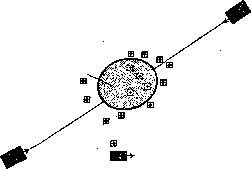
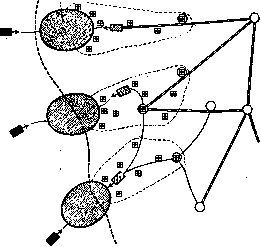
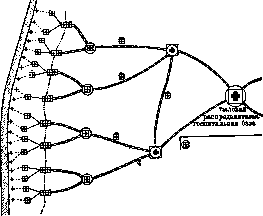
hospital base army hospital base. (field evacuation point) Hospital No. 3 of the 1st line. Hospital No. 2 of the 2nd line. intermediate hospital medical aid points. boundary of the troop district Figure 4. Diagram of sanitary evacuation in the era of linear strategy (at the beginning of the world war). On the left (shaded strip) - the combat zone on a continuous front line. Neglect of the basic principles of treatment - timeliness of medical care, its continuity, and rest for those in need - sharply negatively affects the results of treatment. As a result of the experience of the world war of 1914-1918, a new system of 'stage treatment' (Oppel), or 'echeloned treatment' (French authors), emerges, which seeks to combine the transportation of evacuees with the provision of medical aid at the stages of evacuation in the same sequence as is carried out in a stationary medical institution, where the wounded or patient undergoes the entire course of treatment until the moment of one or another outcome of their illness (fig. 5) (see Field Surgery).

Under the conditions of modern war, characterized by the possibility of damaging armies not only along the front but also in the depth of their deployment, the stage treatment system, with its continuous flow of evacuees to the rear, encounters great difficulties. A blow on the main direction from the depth of one's deployment into the depth of the enemy's troop deployment, the commitment of motor-mechanized units to break through the front line with a simultaneous air raid on the rear to defeat the enemy's reserves [------------], dressing room, operating room, reception ward, rest ward for those undergoing surgery,
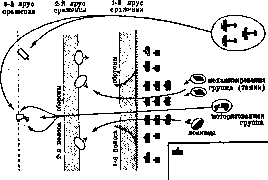
Figure 5. Plan of a hospital with a diagram of the stages of sanitary evacuation drawn into it (diagram of stage or echeloned treatment). (fig. 6) places the sanitary service of both the attacking and defending armies in conditions of a very complex combat situation and requires the equipment of new sanitary technology. In relation to sanitary transport, first place is taken by the high-cross-country sanitary vehicle (sanitary transporter) and the sanitary airplane, which frees it from dependence on non-rail (earth and highway) and rail (railway) routes. The motorization and mechanization of sanitary troops inevitably change their tactics, which in the first place must ensure the exploitation of all the advantages (speed of movement, range of action, mobility, etc.) of the latest technical means. Accordingly, sanitary tactics are significantly complicated. Reconnaissance, correct assessment of the situation, decisiveness and resourcefulness of the sanitary commander, his organizational skills, and precise calculation and coordination of the actions of the entire sanitary apparatus become the basic conditions for the success of combat sanitary work.
The plan for sanitary evacuation finds its expression in the form of a sanitary evacuation diagram and in the form of a planning table, where in the horizontal columns the troop units provided with sanitary support are indicated, and in the vertical column - the time and the expected place of development of their combat actions. Sanitary tactics, while remaining a medical discipline in its content, in the methods of its study is increasingly approaching the military sciences. Hence the requirements for the organization of sanitary-tactical training, which should: a) be conducted with contingents having medical education and who have passed a preliminary course in military disciplines (organization of troops, their tactics, familiarity with the basic combat regulations), b) be practical, i.e., conducted not only by the book and in the classroom, but carried out mainly in the field by solving typical sanitary-tactical problems and military-sanitary games, first on a map without real means, and as operational skills are acquired (organization of reconnaissance, assessment of the situation, decision-making, planning, maintaining communications, working with a map, etc.) - with field sanitary equipment and with sanitary troops.
In full, the verification of sanitary-tactical training can be achieved in combined arms exercises, in which the sanitary service participates.
Related articles
Mentioned in
Cite this page
“First Aid Kit.” Soviet Medical Encyclopedia. English translation of Bolshaya Meditsinskaya Entsiklopediya, 1st ed. (Moscow, 1928–1936), ed. N. A. Semashko. https://sovietmedicalencyclopedia.pages.dev/article/first-aid-kit/