Stretcher
Historical document, translated for reference. It reflects medical knowledge of the 1920s–30s and is not medical advice.
Summary
This article describes various types of stretchers used for transporting patients and wounded individuals in different environments, including manual, animal-drawn, ski, wheel, and specialized military stretchers. It details construction methods, historical developments, and standardization efforts for medical transport equipment.
Encyclopedia article (1928–1936)
STRETCHER, a device for transporting patients and wounded in a lying position. Depending on whether transportation is carried out by hand, pack animals, sleds, or wheeled stands, manual, pack-animal, ski, wheel, and other types of stretchers are distinguished (Fig. 1-5). The basic and essential property of all stretchers is the ability to carry them by hand and to ensure rest for the patient. Transport requires 2-4 people supporting the stretcher on their hands or shoulders, usually with the help of straps. Instead of human bearers, for transport on pack animals, the principle of which is that the head and back of the bearer are simultaneously loaded, and the wounded person is on the stretcher in a semi-recumbent or sitting position. During wartime in battle on fortified positions with numerous deep narrow trenches and a whole network of branching communication passages at sharp angles, conditions are created that also greatly hinder work with ordinary stretchers. Constructed during the imperialist war on the western front, special trench stretchers either resembled mountain models or represented various improvisations. From greatcoats and tent canvas, poles, blocks, belts, and ropes, hammocks or short stretchers were made. In general, the making of improvised stretchers from available material has been widely and diversely practiced since ancient times for first aid in emergency cases. A special variety of such improvised stretchers are drag sleds. In swampy forests, this is the simplest, sometimes only possible means of transport. Two young trees are felled, laid parallel to each other at a certain distance, secured in this position by spacers, and branches are laid on top. The remaining branches on the underside spring when the victim laid on such a frame is dragged along the ground. On soft ground, the same purpose is served by mounting stretchers on runners. Loads not carried by hand in alpine mountains are transported in winter and summer on special sleds, which can also be easily adapted for transporting the wounded. In flat terrain in winter with abundant snow cover, the need for ski stretchers is unquestionable. B. K. Leonar distinguishes four categories of sled-ski combinations with ordinary stretchers and singles out as a separate group the transformation of skis for walking into a means for transporting and carrying the wounded. To the latter group belong the Tatarinov and Tsygankov ski-stretchers: the runners are secured by two cross extensions, on which the stretcher canvas is installed with ski poles instead of poles.-Along ordinary roads, stretcher transport is significantly facilitated and accelerated by wheeled attachments to manual stretchers. The number of wheels varies from 1 to 4. Accordingly, the attachment together with the stretcher resembles a wheelbarrow, a two-wheeled cart, or a Chinese 'rickshaw', a three- or four-wheeled vehicle.-The last category of special stretchers, not mentioned above, are marine stretchers (see Maritime Sanitary Service). Some similarity to the conditions of maritime sanitary transport is found in the situation in mountain industry. For hauling along drifts in mines and for bringing the victim to the surface of the earth ('issuing to the mountain'), stretchers-shin and stretchers-hammocks are also successfully used. Similar stretchers best meet the technical conditions for loading, unloading, and transportation during the evacuation of patients and wounded by airplane. The importance of stretchers as the basic sanitary-transport device appears especially clearly during wartime. The desire to make military stretchers portable forces manufacturers to make them folding or collapsible. The most convenient type of collapsible stretchers are those divisible into two identical halves, each of which can be used as a trench stretcher for carrying the wounded in a sitting position. Since transferring the wounded from one stretcher to another is usually painful and harmful to the wounded, the idea arose to create a single standard-size model of stretchers suitable for placing in any type of sanitary transport (vehicle, automobile, railway car, etc.). The need for a very large number of stretchers adaptable not only to diverse external conditions but also to various therapeutic and prophylactic tasks further urgently raises the question of a standard model. The International Committee of the Red Cross in Geneva at the 1925 conference decided to create a permanent technical commission for the standardization of sanitary supply items. First priority was given to solving the stretcher question. At present, agreement has been reached on the dimensions and general properties of such unit stretchers. In 1927, the commission established the following dimensions obligatory for all countries: maximum length of poles 230 cm; maximum width of stretcher (at the level of cross braces) 59 cm; distance between outer edges of poles not more than 55 cm; maximum height with raised headrest 40 cm, without headrest 20 cm; distance along the poles between the closest points of support for setting or hanging the stretcher 119 cm; length of support belt in head and foot parts of each pole 10 cm; length of free ends of pole on each side 45.5 cm; maximum weight 12 kg. As for general properties, it was considered desirable that stretchers, while maintaining national characteristics, satisfy the following design requirements: 1) transverse divisibility of the stretcher into 2 strictly identical halves; 2) interchangeability of both halves of each pole and their fastening into one long pole by a simple and strong mechanism; 3) complete removability of each half-canvas; 4) absence of small parts, bolts, chains, etc.; 5) portability of each half of the stretcher on shoulder straps; 6) suitability of half-stretchers for work in trenches.-The field stretchers model 1927 adopted for supply in the RKKA have wooden poles 221.5 cm long; metal cross braces 55 cm wide, folding on hinges toward the handles; low loop-shaped metal legs; non-removable canvas nailed to the outer edges of the poles and protected from sagging downward by 2 cross strips. For greater strength when setting or hanging, the poles are shod with an iron ferrule in the central parts of the handles near the attachment of the canvas. Weight of stretcher about 9.5 kg, height of litter above ground level 16 cm. The headrest is improvised, straps for bearers, belts for fixing unconscious wounded, and blankets for preserving heat are prepared separately as needed. American military-sanitary stretchers have great similarity with the described stretchers.-From a medical point of view, field stretchchers must be an unchanging until the place of hospitalization sanitary-transport device ensuring rest for the wounded without tension of the muscles of the trunk or limbs and without restriction of breathing and blood circulation, while protecting the patient from sun, rain, and ground cold, and finally allowing carrying by hand and transporting on wheeled and other means of transport without transferring.
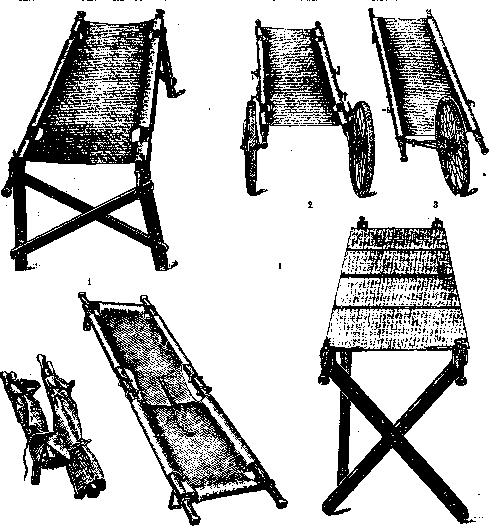
Figure 1. Ordinary stretchers. Figure 2 and 3. Stretcher-carts on two and one wheel. Figure 4. Folding stretchers. Figure 5. Stretcher-table.
For longer distances, pack animals are used, preferably mules or camels, with 1-2 stretchers mounted or suspended on special saddles. In mountains, on narrow trails with sharp turns, descents, and ascents, it is impossible for 2 bearers with long straight stretchers to pass. Therefore, in alpine countries, life experience has developed a whole series of chair-like mountain stretchers. During the imperialist war on the western front, special trench stretchers were constructed that either resembled mountain models or represented various improvisations. From greatcoats and tent canvas, poles, blocks, belts, and ropes, hammocks or short stretchers were made. In general, the making of improvised stretchers from available material has been widely and diversely practiced since ancient times for first aid in emergency cases. A special variety of such improvised stretchers are drag sleds. In swampy forests, this is the simplest, sometimes only possible means of transport. Two young trees are felled, laid parallel to each other at a certain distance, secured in this position by spacers, and branches are laid on top. The remaining branches on the underside spring when the victim laid on such a frame is dragged along the ground. On soft ground, the same purpose is served by mounting stretchers on runners. Loads not carried by hand in alpine mountains are transported in winter and summer on special sleds, which can also be easily adapted for transporting the wounded. In flat terrain in winter with abundant snow cover, the need for ski stretchers is unquestionable. B. K. Leonar distinguishes four categories of sled-ski combinations with ordinary stretchers and singles out as a separate group the transformation of skis for walking into a means for transporting and carrying the wounded. To the latter group belong the Tatarinov and Tsygankov ski-stretchers: the runners are secured by two cross extensions, on which the stretcher canvas is installed with ski poles instead of poles.-Along ordinary roads, stretcher transport is significantly facilitated and accelerated by wheeled attachments to manual stretchers. The number of wheels varies from 1 to 4. Accordingly, the attachment together with the stretcher resembles a wheelbarrow, a two-wheeled cart, or a Chinese 'rickshaw', a three- or four-wheeled vehicle.-The last category of special stretchers, not mentioned above, are marine stretchers (see Maritime Sanitary Service). Some similarity to the conditions of maritime sanitary transport is found in the situation in mountain industry. For hauling along drifts in mines and for bringing the victim to the surface of the earth ('issuing to the mountain'), stretchers-shin and stretchers-hammocks are also successfully used. Similar stretchers best meet the technical conditions for loading, unloading, and transportation during the evacuation of patients and wounded by airplane. The importance of stretchers as the basic sanitary-transport device appears especially clearly during wartime. The desire to make military stretchers portable forces manufacturers to make them folding or collapsible. The most convenient type of collapsible stretchers are those divisible into two identical halves, each of which can be used as a trench stretcher for carrying the wounded in a sitting position. Since transferring the wounded from one stretcher to another is usually painful and harmful to the wounded, the idea arose to create a single standard-size model of stretchers suitable for placing in any type of sanitary transport (vehicle, automobile, railway car, etc.). The need for a very large number of stretchers adaptable not only to diverse external conditions but also to various therapeutic and prophylactic tasks further urgently raises the question of a standard model. The International Committee of the Red Cross in Geneva at the 1925 conference decided to create a permanent technical commission for the standardization of sanitary supply items. First priority was given to solving the stretcher question. At present, agreement has been reached on the dimensions and general properties of such unit stretchers. In 1927, the commission established the following dimensions obligatory for all countries: maximum length of poles 230 cm; maximum width of stretcher (at the level of cross braces) 59 cm; distance between outer edges of poles not more than 55 cm; maximum height with raised headrest 40 cm, without headrest 20 cm; distance along the poles between the closest points of support for setting or hanging the stretcher 119 cm; length of support belt in head and foot parts of each pole 10 cm; length of free ends of pole on each side 45.5 cm; maximum weight 12 kg. As for general properties, it was considered desirable that stretchers, while maintaining national characteristics, satisfy the following design requirements: 1) transverse divisibility of the stretcher into 2 strictly identical halves; 2) interchangeability of both halves of each pole and their fastening into one long pole by a simple and strong mechanism; 3) complete removability of each half-canvas; 4) absence of small parts, bolts, chains, etc.; 5) portability of each half of the stretcher on shoulder straps; 6) suitability of half-stretchers for work in trenches.-The field stretchers model 1927 adopted for supply in the RKKA have wooden poles 221.5 cm long; metal cross braces 55 cm wide, folding on hinges toward the handles; low loop-shaped metal legs; non-removable canvas nailed to the outer edges of the poles and protected from sagging downward by 2 cross strips. For greater strength when setting or hanging, the poles are shod with an iron ferrule in the central parts of the handles near the attachment of the canvas. Weight of stretcher about 9.5 kg, height of litter above ground level 16 cm. The headrest is improvised, straps for bearers, belts for fixing unconscious wounded, and blankets for preserving heat are prepared separately as needed. American military-sanitary stretchers have great similarity with the described stretchers.-From a medical point of view, field stretchers must be an unchanging until the place of hospitalization sanitary-transport device ensuring rest for the wounded without tension of the muscles of the trunk or limbs and without restriction of breathing and blood circulation, while protecting the patient from sun, rain, and ground cold, and finally allowing carrying by hand and transporting on wheeled and other means of transport without transferring.
D. Octah-Sinen. I NOSEBLEEDS, cu.Epistaxis. «15 61в
Related articles
Mentioned in
Cite this page
“Stretcher.” Soviet Medical Encyclopedia. English translation of Bolshaya Meditsinskaya Entsiklopediya, 1st ed. (Moscow, 1928–1936), ed. N. A. Semashko. https://sovietmedicalencyclopedia.pages.dev/article/stretcher/