Dressing Squad
Historical document, translated for reference. It reflects medical knowledge of the 1920s–30s and is not medical advice.
Summary
A dressing squad was a mobile medical unit in the Soviet military that provided first aid to wounded soldiers. These units evolved from earlier field hospitals and were later replaced by more mechanized medical battalions as warfare technology advanced.
Encyclopedia article (1928–1936)
DRESSING SQUAD, a mobile sanitary (medical) institution whose purpose is to provide medical aid to the wounded. To operate at the site, the dressing squad deploys a dressing station, or medical aid point. As a military-sanitary institution, dressing squads were introduced into the old Russian army in 1915 to replace divisional infirmaries. Before this and in previous wars, dressing squads were formed and sent to the front by public organizations (Red Cross, Zemstvo Union, Union of Cities, etc.). The dressing squad transports all its property in wagons; in addition, the dressing squad's convoy includes sanitary transport for the evacuation of the wounded; this ensures the mobility of such an organization. The property of the dressing squad includes everything necessary for setting up medical aid points both in populated areas and outside them (see). The personnel of the dressing squad consists of doctors (2-4, one of whom is a qualified surgeon), administrative staff, middle medical personnel, and orderlies. The number of the latter during the world war reached 200 in each divisional dressing squad, and they formed a company of stretcher-bearers intended for carrying the severely wounded from the battlefield. However, the practice of the imperialist war of 1914-18 showed that under modern combat conditions, the dressing squad's company of orderlies cannot be used to carry the battle casualties; stretcher-bearers arriving from the rear are delayed, have difficulty in unfamiliar terrain, and when attempting to work under enemy fire themselves suffer heavy losses. In the Red Army, divisional dressing squads do not have companies of orderlies. Divisional dressing squads are headed by a chief doctor and a military commissar, subordinate to the divisional doctor. The convoy of such a squad consists of over 80 wagons and forms a marching column about 600 meters long. Divisional dressing squads are part of rifle and cavalry divisions. In battle, they deploy one (main) or two (main and auxiliary) medical aid points at a distance of 6-10 km from the contact line with the enemy. The sanitary transport of divisional dressing squads operates from forward medical aid points to the main (or auxiliary) point on the principle of "evacuation to itself." A distinctive feature in the work of divisional dressing squads was the unevenness of their workload. Between battles, the activity of the dressing squad is negligible and does not justify maintaining the personnel and convoy. However, during major battles, the dressing squad, unable to cope with the work falling to it, passes several hundred wounded in a short time. The motorization and mechanization of the army raise the question of using automotive transport for dressing squads and of creating such motor vehicles on which equipment and individual installations would be located in a ready, working condition: X-ray vehicle, office with power plant, sterilization vehicle, pharmacy vehicle, vehicle with water heater, etc. To some extent, such motorized dressing squads already existed during the world war of 1914-18 in the French and American armies. The advantages of such squads are shorter column length, less personnel, greater mobility, and shorter deployment times. Changes in the technical equipment of dressing squads change not only their organization but also their tactics of work. Motorized dressing squads can advance closer to the front, have more sophisticated medical equipment, i.e., they solve the task of bringing qualified medical aid closer to the soldier. The ability to quickly transfer motorized dressing squads over distances many times greater than the daily marching norms of horses allows such squads to be used to serve various sectors of the front, not just the division to which the dressing squad is attached, which achieves more effective work of the organization. In the richest armies (USA), dressing squads have been reorganized into sanitary (collective) battalions of the medical regiment. In the French army, dressing squads (ambulances) perform the functions of medical aid points with a special focus on serving the wounded, sick, victims of chemical agents, etc. Supplementing the equipment of the ambulance with hospital equipment (section d'hospitalisation) allows such a dressing squad to be used as a field infirmary with care for those in need of medical aid in the manner of a stationary treatment institution. The introduction into warfare of chemical agents of destruction and in particular persistent chemical agents, the effects of which especially require the organization of washing of the affected as early as possible after exposure, required the inclusion of a washing (shower) installation in the composition of the dressing squad. The latter must be technically constructed so as to ensure constant readiness for washing (sanitary processing) of several dozen people simultaneously. This forces having in the composition of the dressing squad or an institution corresponding to it in the system of troop sanitary service one or several vehicles of mainly mechanical traction (auto-showers) on which are mounted a water heater, shower device, devices for water supply and a tank for storing the latter in a heated state of 34-38°. The most difficult problem in this case is the question of the premises in which the washing must be carried out. In view of the urgency of washing in case of chemical agent exposure, which loses its effectiveness as the time elapsed since the chemical agent came into contact with the skin increases, washing installations have to be deployed in the immediate vicinity of the site of exposure, using for this purpose temporary, portable, but quickly erected heated premises. For this purpose, insulated tents, plywood cabins or wagons whose bodies can be unfolded into a tent can be used. Since one washing does not solve the problem of decontamination processing of those affected by chemical agents, and it is also necessary to change clothes, decontaminate carried weapons and equipment, as well as gear and convoy, the squad must have a reserve of uniforms and corresponding decontamination equipment. All this changes so much the material support, maintenance and volume of work of the dressing squad that the very meaning of the name "dressing squad" is lost. The existence of dressing squads in their pure form at the present time, in connection with changes in military technology and types of combat injuries, has completely lost its meaning.
B. Leonardev. DISTILLATION serves for obtaining liquids in a pure state. The simplest example is the distillation of water (obtaining distilled water). Water is placed in a flask equipped with a delivery tube, the delivery tube is connected to a condenser. When the water is heated to boiling, its vapors enter the condenser, condense in it, and the water flows into the receiver. To determine the boiling point of the liquid, a thermometer is inserted into the flask. To obtain large quantities of distilled water, a metal cube embedded in a furnace and covered with a lid (helmet) with a spiral delivery tube (coil) immersed in a tank with cold water is used; the water vapors are cooled in the coil, and the water flows into the receiver. Another type of distillation is used to separate a mixture of liquids (fractional or fractional distillation). A mixture can be separated by distillation only if the boiling points of the components of the mixture differ significantly. With a difference in boiling points of 5-10°, mixtures are practically inseparable, just as in the case when the distilled liquids form a so-called azeotropic mixture that does not break down upon distillation into its components, even if they have different boiling points. Fractional distillation is performed with a dephlegmator or with a fractional column filled with glass beads or glass rings. The vapors of the liquid from the flask enter the dephlegmator or column, the high-boiling parts are cooled and flow back into the flask, the low-boiling parts exit through the side tube of the dephlegmator to the condenser. A thermometer is inserted into the upper part of the dephlegmator. Distillation is performed as follows: suppose there is a mixture of two liquids with boiling points of 90° and 150°: fractions are distilled from 90° to 110°, from 110° to 130° and from 130° to 150°; then the first fraction is again distilled to 110°, the second fraction is added, distilled to 110°, the receiver is changed and distilled to 130°, the third fraction is added, distilled to 130°, then, after changing the receiver, the residue is distilled. Since a single fractional distillation usually does not sufficiently separate the mixture, fractional distillation is repeated several more times, mixing instead fractions with the same boiling point. In this way, the mixture can be separated into its components, after which the main mass of the distillate will be in the first and third fractions; a small amount of mixture is obtained in the middle fraction. To separate a substance insoluble in water or to separate substances volatile with steam from non-volatile ones, steam distillation is used (see figure). In this distillation, the distillation flask, connected to the condenser, is placed obliquely; through a stopper with a delivery tube
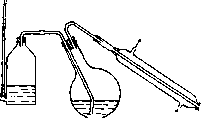
a second tube is inserted into the tube, extending almost to the bottom of the flask and connected to a steam generator; steam enters the flask, which has been preheated, carries volatile substances with it, and passes along with them into the condenser. If the substance has low vapor pressure, superheated steam is used for distillation, which is achieved by placing a copper spiral tube between the steam generator and the distillation flask, heated by a burner; the temperature of the steam exiting the spiral is determined by a thermometer placed between the spiral and the flask; the contents of the distillation flask are heated 20-30° above the steam temperature (on an oil bath).-High-boiling liquids that decompose at their boiling point are distilled under reduced pressure in a vacuum (see Vacuum apparatus). In factories, large metal stills are used for fractional distillation, and instead of laboratory dephlegmators, very large column apparatus are used, inside which a large number of plates are inserted. In the chemical processing of wood, coal, petroleum, so-called dry distillation is used. In dry distillation, the substance decomposes to form a mixture of products that are separated by fractionation. Among the products of distillation of petroleum, coal, wood are gaseous (illuminating gas), liquid (for example, wood alcohol, acetic acid from wood, gasoline, kerosene from petroleum) and solid (for example, paraffin). In laboratory conditions, retorts are used for dry distillation; factory installations vary depending on the purpose and raw material (gas plant from petroleum, from coal, etc.).
Related articles
Cite this page
“Dressing Squad.” Soviet Medical Encyclopedia. English translation of Bolshaya Meditsinskaya Entsiklopediya, 1st ed. (Moscow, 1928–1936), ed. N. A. Semashko. https://sovietmedicalencyclopedia.pages.dev/article/dressing-squad/