Military Medical Service
Historical document, translated for reference. It reflects medical knowledge of the 1920s–30s and is not medical advice.
Summary
This article outlines the historical development of military medical services from ancient times through the Middle Ages. It emphasizes how the organization of medical care in armies has always been fundamentally tied to the socio-economic and political conditions of the era.
Encyclopedia article (1928–1936)
MILITARY MEDICAL SERVICE.
Military medical service is a term defining the system of healthcare in the armed forces and its practical implementation. The ideological principles, forms of organization, and the degree of development of military medical service are in the closest dependence on the social and state conditions of the corresponding epoch, the economic and cultural state, and the system of organization of the armed forces. I. History of military medical service. Healthcare for troops has always reflected those real relationships of forces that, in a given historical situation, existed between the mass that constituted the troops and the class that held political and economic power in its hands. Among various peoples in different epochs, sometimes separated by hundreds of years, given the presence of analogous social, political, economic, and cultural prerequisites, one can establish a significant similarity in the organization and state of military medical service. The prehistoric tribal period of human society, just like the wild tribes of our modern era, corresponded to the absence of combat differentiation of the armed forces. The entire physically fit population of the clan or tribe rose for war. For these armed forces, judging by the most ancient monuments of writing and art, certain sanitary-hygienic requirements and norms were nevertheless considered mandatory even in very ancient times, but no special organization was established for the implementation and supervision of their fulfillment. Preventive and curative measures against diseases among primitive peoples were based, for the most part, on the understanding of the sick person as possessed by an evil or good spirit, and therefore consisted of means of a religious nature (incantations, amulets, talismans, etc.). Somewhat more rationally, although also far from perfect, assistance was carried out for all kinds of injuries, including military ones, but even here it did not go beyond self-help and mutual aid. In the Sanskrit poem Ramayana, which dates back several millennia, one can find a description of the removal of the wounded from the battlefield to special tents, where bleeding was stopped and wounds were smeared with pain-relieving healing agents. On the basis of existing monuments, it can be considered that there were no professional doctors in ancient Greek troops either, but every warrior had to possess the art of providing assistance for wounds. This art was valued very highly, and individuals who excelled in it were often at the same time combat leaders, as, for example, Podalirius and Machaon, the "wise children" of Asclepius (Homer). Among other peoples, such as the Egyptians, medical practice was concentrated in the hands of ministers of the religious cult. In Herodotus, there are indications that the armies of the pharaohs were accompanied by priests who also possessed the medical art. Bas-reliefs found during excavations of Thebes depict dressing stations that were deployed in Egyptian troops during battles, to which the wounded were carried. The stations were provided with surgical instruments and could perform amputations of limbs (E. Knorr). In the early historical epoch, in the armies of the most culturally and state-organized peoples, deeper rudiments of military-sanitary organization and more rational methods of medical and sanitary support for troops appear. Doctors appear in the troops in significant numbers. The position of a skillful doctor is very high: "An experienced doctor is more precious than many other men," says the Greek poet. The armies of Alexander the Great were already provided with doctors. With the end of the war, the sick and wounded of his armies were handed over to the care of relatives and private families. From the instruction of Cyrus to his son Cambyses, cited by Xenophon, one can establish the presence of doctors in the Persian army as well and a correct understanding of a number of the most important hygienic requirements: "My son," Cyrus taught, "after all, doctors begin to treat only when someone falls ill; it is more fitting for you to take care of health: you must observe so that the army does not suffer need from the very beginning; if you are sure that you will remain in one and the same place for some time, then first of all you must keep in mind the arrangement of a hygienic camp. You will succeed in this if only you think seriously about it. Furthermore, it is not enough to pay attention to the terrain, but one must also think about how the warrior should observe himself in order to be healthy." "For the care of the health of my warriors, there are people in my army who are skilled in medicine" (Fröhlich, Lakhtin). In the Bible and the Talmud of the Jews, there is also a large number of instructions on the regulation of a whole range of healthcare issues in the troops. Among the Romans, scientific medicine began to develop only from the 3rd century B.C., and under Greek influence, the cult of Aesculapius (Asclepius) was introduced in Italy. In the 1st century, doctors appeared, at first only during campaigns, and with the introduction of a standing army under Emperor Augustus, a more stable military-sanitary service was organized. In the land and naval forces, medici vulnerarii were introduced at the rate of one for every 250–300 warriors; there is also an indication of the establishment of the position of medicus castrensis (garrison doctor). In the time of Caesar, the wounded and sick from active units were evacuated to Rome or the nearest Roman settlements, while in the subsequent period, under Tiberius, military medical institutions appeared in the camps (valetudinaria), with a defined staff of doctors, intermediate medical (capsarii, discentes capsarii), and junior sanitary (qui aegris praesto sunt) personnel. In the valetudinaria, a dietary system of nutrition was introduced, and treatment with warm baths, etc., was organized. Roman doctors enjoyed officer (equites) status (Bayrashevsky). In the field of sanitary support for Roman troops of the first centuries A.D., the requirements were also quite high (see Military hygiene). The decline of morals in Roman society that occurred in subsequent centuries, in connection with the accumulation of great wealth in the hands of the Romans, the evasion of the Romans from military service, and the use of a system of mercenary troops, lowered the direct interest of state bodies in the matter of troop healthcare, which resulted in a sharp deterioration of military medical service. Phenomena of the same kind can be observed among other peoples in whose social and state life structure one can note a class or caste principle. If the military profession was a privilege of the ruling classes of the population, then the development of military medical service and the presence of a significant number of doctors in the troops were noted; if, however, the military burden was the lot of the poorest population, slaves, and conquered tribes, then the military medical service was in decline. Middle Ages. The invasion of barbarians into Europe, the fall of ancient culture, and continuous wars—all this, having sharply changed the state and social order, the economic and cultural level of European peoples, to a significant extent reflected on the organization of the armed forces, their tactics, and ultimately on the attitude toward the sick and wounded warrior and the state of military medical service. The strengthening of royal power in the Middle Ages led to the formation of standing, initially mercenary troops, usually recruited from a demoralized contingent, which did not inspire respect either from the employers or from the civilian population, and therefore were not an object of in-depth medical-sanitary service. (In our days, a similar situation can be observed in the mercenary troops of Chinese imperialists, where a military-sanitary organization practically does not exist. In the so-called foreign legions—mercenary colonial troops of bourgeois states—one observes to a certain extent the same phenomenon.) A certain hint of a more organized service is encountered in the army of Louis the Pious (9th century), where there were special sanitary teams with cohorts for removing the wounded from the battlefield and caring for them. In the army of Maximilian I (beginning of the 16th century), for every 200 men, a medic with an assistant was assigned (Lakhtin). The extreme weakness of the military-sanitary organization, and more often its complete absence, in medieval European armies doomed the wounded and sick to self-help and mutual aid and created favorable ground for the activities of charlatans who followed the troops. "They provided assistance to the sick and wounded, but, mainly, they traded in various secret remedies, exploiting the helpless sick with this" (Lakhtin). Some medical assistance was provided to the troops by monks, especially during the period of the Crusades, but their activity in this direction was sharply disrupted by the decree of the Council of Mainz (1247), which proclaimed "Ecclesia abhorret a sanguine." To this, it must be added that the sharp impoverishment of Europe, the influence of Christianity with its preaching of asceticism, and the associated decline of sanitary-cultural life created unusually favorable conditions for the development of all kinds of diseases in the troops, both wound-related and epidemic. The appearance of standing regular troops, and even more so the invention of gunpowder, fundamentally changed troop life. The use of firearms increased the number of traumatic injuries, made wars more bloody, and therefore the need for a military-sanitary organization became more palpable.
The growth of the economic importance of cities in the second half of the feudal period and the need to protect cities from the arbitrariness of feudal lords and the outrages of mercenary bands led to the formation of a militia or levy, first from the urban and then from the rural population. At the same time, in other countries, such as Sweden, a system of national-settlement troops was established, resembling the pre-revolutionary Russian Cossack troops (endowing troops with land while granting tax exemptions). In the countries of Western Europe, the principle of organizing national troops took on the character of recruitment, i.e., hiring for money, in view of the difficulty in providing land. Subsequently, the need to increase the size of standing armies, due to growing economic and political contradictions, led to a transition to a system of universal military conscription. This evolution in the organization of armed forces was also reflected in the Military Medical Service: the participation of broad masses of the population in the troops increased public attention to issues of protecting the health of the troops and prompted governments, for the purpose of the greatest combat exploitation of the troops, to pay attention to their medical and sanitary maintenance. The first rudiments of the military medical service in European troops date back to the 15th century, when Spain and France, and later the Roman Empire, established standing armies. Spain, which had inherited certain material and cultural values from the Moors, including their medical schools and hospitals, already in the 16th century had the opportunity to provide each regiment with a physician and a surgeon (which France could not yet achieve even during the period of the Second Empire). To the same time belongs the organization in the Spanish army of military medical institutions, which served as a model for other European armies for two hundred to three hundred years. The scarcity of medical schools and the depletion of the state treasury in France and the Roman Empire led to the fact that only in the 17th century did a military medical organization take shape in the armies of these countries, with a chief physician (usually the king's personal physician) at the head, with regimental hospitals in the troops, and with naval surgeons in the fleet. The maintenance of the hospitals was carried out at the expense of company resources. Management lay with the senior officers. The embezzlement by the managing officers and physicians brought these hospitals into a state of decay. Passionate apostles of fundamental reforms in the Military Medical Service in the 17th century were the physician Fort in France, who published the work 'Military Medicine' in 1681, and I. A. Gehema in Brandenburg, who wrote the book 'The Sick Soldier' in 1689. Fort proceeded from the premise that a military physician should be primarily a hygienist who would have the right to point out to the combat command all the shortcomings of the sanitary situation threatening the health of the unit and to recommend ways to eliminate them (Brice et Bottet). In 1689, a regulation was issued in France that remained in effect until the end of the 18th century and standardized the rights and duties of medical personnel in the French fleet. In the history of the Military Medical Service in England, the first mentions of military surgeons date back to the end of the 17th century. In the mass, English surgeons were distinguished by great ignorance: 'a soldier who had served for some time with a surgeon as a batman and had learned to apply a plaster and cut corns became a surgeon's assistant, and subsequently could become his deputy' (Bayrashevsky). Far from all regiments had infirmaries, and the sick were placed in private houses, often without care. The existing infirmaries were poorly furnished. Physicians were disenfranchised and poorly paid. Officers enjoyed the right to impose even corporal punishment on physicians. The field sanitary service was also unorganized: the wounded remained on the field until the end of the battles, and only after that were comrades allowed to carry them out. Sanitary transport and stretchers in limited quantities appeared only in the era of the Napoleonic Wars. The 18th century is marked in the history of the Military Medical Service by reforms that primarily concerned military medical education. By the end of the 17th century, the conviction was created of the need to have personnel for the army knowledgeable in both surgery and internal medicine. In 1775, the Imperial Joseph Medical-Surgical Academy was established in Austria, and in 1795, a secondary medical-surgical school (Pepiniere) was established in Prussia, which did not grant the right to civilian medical practice. Somewhat later (in the 19th century), reform was also carried out in France, where the conviction long persisted of the need for the army to have only surgeons. The material and legal status of physicians in Western European armies improved significantly; they received officer rank or the title of sanitary officers (France, 1791); a tendency emerged to establish the positions of sanitary chiefs to control hospital service in a division or territorial district (divisional staff surgeon in France; staff surgeon in Austria); at the head of the medical section of individual armies were placed general physicians or general surgeons. In 1772, a central administration was organized in France in the form of a Sanitary Commission headed by a general physician-inspector, later reorganized into a Hospital Directorate and again reorganized into a Central Sanitary Council. Unlike the French tendency toward creating a collegial administration of the Military Medical Service, in Austria and Prussia, the organization followed the principle of unity of command: the medical section in the Austrian army was headed by a protomedicus, and in the Prussian army by a general surgeon. They were in direct subordination to the Minister of War and, on matters within their jurisdiction, enjoyed the right of personal report to the sovereign. Military medical institutions received more stable forms: in France, in 1788, regimental hospitals were established to replace garrison ones; in Austria, in 1781, the first garrison hospitals appeared; from 1725, garrison hospitals were established in Prussia. The heads of the hospitals were combat officers, while physicians were in charge only of the medical section. The provisioning of the sick was improved by the introduction of 'rations,' and the maintenance of the sick was carried out at the expense of deductions from soldiers' salaries and subsidies from the treasury. In France, the leasing of the maintenance of the sick to private individuals was also used. The ideas of the French Revolution had a very favorable influence on the medical care of sick soldiers in the French army during the republican wars: 'in the name of the principle of brotherhood and equality, the soldier was granted the right to the same medical care that officers enjoyed' (Lakhtin). The general sanitary state of European armies in the 18th and early 19th centuries remained very grave. It is sufficient to point out that out of 4.5 million soldiers who participated in France in the Napoleonic Wars (1792-1815), 150,000 fell on the battlefields, and 2.5 million died in hospitals. According to Kolb, European wars from 1733 to 1865 claimed about 8,000,000 human lives, of which 1.5 million perished from wounds, and 6.5 million from diseases. In the 19th century, the successful development of the natural sciences, the achievements of bacteriology and hygiene, and the growth of industrial technology brought about a colossal revolution in the organization of the Military Medical Service in European and other major armies. This was also facilitated by the introduction of compulsory military service (in the 1870s) in place of mercenary troops, as the attitude of the civilian population toward the army changed significantly, as did the relationships within the army itself between its rank-and-file and officer corps. The introduction of universal military service after the abolition of serfdom was also associated with a reduction in the term of service, and consequently, with a faster turnover of the soldier mass and larger numerical contingents that had to be trained and educated in a short time. Hence arose the necessity, both in the interests of the cause of training and educating the soldier, and under the pressure of public opinion, to improve sanitary and living conditions in the troops. The organs of the military medical service increasingly took on the functions of initiative and control over the working and living conditions of the troops. More systematic practical development was given to measures for the prevention of infectious diseases (for example, compulsory smallpox vaccination was introduced in the troops, as well as the isolation of infectious patients and the disinfection of their premises and belongings, periodic physical examinations, etc.). Sanitary functions began to predominate over curative ones, and in most European armies, medical organs were renamed sanitary ones. Surgery took its place in medical education and practice alongside other medical disciplines. A special caste of surgeons as such died out. From 1824, Austria, and from 1848, Prussia, began graduating full-fledged physicians from their military medical schools. The basis of the reform of military medical education in Western European countries was the special requirements of the military medical service, and courses in military and military-sanitary sciences were introduced. To this end, the Prussian Medico-Surgical Institute (1825) and the French School of Military Sanitary Service (1857) were organized in such a way that they provided instruction only in military and military-sanitary sciences, while students completed general medical sciences at local universities. The legal status of medical personnel progressed steadily as the scientific authority and the functions of the military medical service expanded. The evolution of the social status of military physicians was completed in Europe with the establishment of a special military medical (Austria, 1870) or sanitary (France, 1852) corps.
Prussia, 1866) corps, with the granting to physicians of the rights of non-combatant officers (non-combattants) in France, and "sanitary officers" of the same class of military ranks as combatant officers (Personen des Soldatenstandes) in Prussia. From 1873 in Prussia, from 1888 in France, and from 1889 in Austria, compulsory military service was introduced for physicians (half the term in the ranks, half as an assistant physician). The material status of military medical personnel was equalized with that of the combatant personnel. Intermediate medical personnel in Western European armies, of the type of the Russian pre-revolutionary company medical assistants, were trained in special schools (France in 1824, Prussia in 1891). To unify the leadership of the Military Medical Service within the divisions, the positions of divisional physicians were established (in Austria in 1883, in Prussia in 1896). The central governing bodies became medical departments headed by a chief physician (in Austria and Prussia from the 1850s, in France from 1889). Throughout the 19th century, one can note the development of military legislation toward expanding the rights and responsibilities of military medical service bodies and their influence on troop life and labor. The establishment in 1876 of a commission under the Bavarian Ministry of War, chaired by Voit, laid the foundation in all Western European armies for broad medical participation in the development of hygienic norms for troop provisioning. The reform in medical care was expressed in the establishment of infirmaries attached to units (the last of all in Prussia—in 1885). The system of large hospitals was recognized as impractical, and their number was reduced, while the remaining large hospitals were given the character of scientific centers. France disbanded regimental hospitals, establishing "military wards" in civilian medical institutions (1870); Austria retained regimental hospitals, placing them in a position independent of the regiments. Chief physicians of military medical institutions received administrative and economic rights in the institutions they managed (Austria 1870, Prussia 1872, France 1888–1889). The re-equipping of medical institutions on the principles of asepsis, the installation of X-ray rooms, laboratories, and dental offices at the most significant hospitals strengthened the reform of medical care. Austria took the initiative in creating sanatorium (health resort) stations. The degree of sanitary well-being of European armies in peacetime at the end of the 19th century is indicated by the following data (according to A. Maurvaud): Table 1. Number of admissions to hospitals and infirmaries per 1,000 personnel. French internal 1888: 6.1 (deaths), 27.1 (illness). German 1883: 3.9 (deaths), 32.9 (illness). Austrian 1887: 6.9 (deaths), 21.9 (illness). Italian 1887: 8.7 (deaths), 36.7 (illness). English internal 1884–85: 5.2 (deaths), 25.2 (illness). Belgian 1880–1888: 3.9 (deaths), 20.9 (illness). Russian 1880–84: 8.9 (deaths), 31.3 (illness), 40.2 (total). Spanish 1886: 13.5 (deaths), 30.8 (illness), 44.3 (total). English fleet 1884 (according to Fröhlich): 9.0 (deaths). The degree of sanitary well-being of European armies in wartime in the second half of the 19th century is illustrated by Table 2 (according to Moqaspe). The most destructive diseases for the army were: typhus, scurvy, typhoid fever, and dysentery. II. Experience and influence of the imperialist war on the Military Medical Service. The extraordinary development in the first quarter of the 20th century of capitalism and imperialist contradictions among individual states, the rapid progress of science and industrial technology, which increased the destructive power of armies and navies, the development of the chemical industry, aeronautics, and mechanical transport, and the strengthening of the system of universal military service—these are the basic prerequisites that conditioned the colossal scale of the imperialist war (1914–18) and made possible the mobilization of up to 40 million people. The concentration of a large number of troops in limited spaces, the great destructive power of weapons, and consequently, the mass nature of casualties, in the presence of increased cultural demands of the population and the need for maximum combat exploitation of the army's manpower, dictated the necessity of ensuring sanitary well-being in the troops and a well-organized medical-evacuation service. In accordance with this, the influence of the military medical service naturally grew in resolving issues of protecting the health of the troops. Significant progress in the Military Medical Service was achieved during the war itself, when the insufficiency of all previously made calculations was revealed. Sanitary-preventive measures received a grandiose scale and new forms. To ensure the hygiene of trench life, water pipelines hundreds of km long were sometimes constructed, deep-bore wells were drilled, drainage works were carried out on areas of tens of thousands of km, special furnaces were built for burning excrement and waste, and entire underground towns were constructed, excellently equipped in sanitary-technical respects. Preventive vaccinations against infectious diseases (smallpox, typhoid fever, cholera, and paratyphoid) covered tens of millions of people, preventive quinine treatment was applied to hundreds of thousands; the preventive administration of anti-tetanus serum was carried out for all suspicious and contaminated wounds. For field armies and for servicing military lines of communication, sanitary-inspection points (see Baths, Isolation-inspection points) were erected for washing soldiers and disinfecting their clothing, with a daily throughput capacity of 10,000 people or more. Difficulties with the nutrition (see) of many millions of soldiers in large armies were overcome not only in quantitative but also in qualitative terms, and cases of scurvy (see), with the exception of the Russian and Turkish armies, were insignificant. Military housing conditions were softened by the introduction into practice of a large number of temporary and portable barracks (see), many of which sufficiently satisfied basic hygienic requirements. Of essential importance for the health of the troops was the application of methods of psychophysiology and psychotechnics in manning armies and selection by branch of service. Particularly significant results were obtained in the field of aviation (see Aviation hygiene). The American army carried out a psychotechnical examination of 700,000 people, using its results for manning military schools. The use of chemical weapons (see Combat poisonous substances) led to the invention and mass use of various kinds of protective means and devices (see Gas masks, Gas shelters, etc.). A significant number of sick and those injured by enemy weapons required the creation of a powerful medical-evacuation apparatus and a huge quantity of sanitary-transport means—ground, railway, water, and air, adapted to the diverse conditions of individual fronts (see Sanitary transport). Methods of medical activity proved necessary to coordinate with the operational situation and conditions of evacuation. The influence of the military medical service, by virtue of all these conditions and requirements, increased significantly both in the field of sanitary-preventive preparation for combat operations and operational leadership of evacuation activities (see Sanitary reconnaissance, etc.), and in the matter of exercising sanitary supervision over the labor and life of troops and the treatment of the sick and those injured in battles. A tendency emerged to build the apparatus of the military medical service on the basis of centralized leadership of the Military Medical Service in the army, with the transfer of this leadership to military medical specialists and with the establishment of dual subordination (in the order of general service—to the command, in special service—to the senior sanitary chief). Indicative examples of successes in the military medical service can serve as the following: in the French army from 1914 to 1918, only 56 cases of smallpox were registered (of which 12 were in European troops); typhoid fever, which in 1914 gave up to 12,000 cases monthly, decreased in 1918 to 35; malaria morbidity from 60,000 cases in 1917 was reduced in 1918 to 8,000; the sick constituted only 13% of total losses. In the German army, morbidity from typhoid fever fell from 6.2% in 1914 to 0.8% in 1918; cholera—from 0.42% in 1914 to 0.03% in 1918. In the English army, the average annual morbidity for the campaign was expressed as 256‰; the ratio of the number of sick to the number of wounded on the French front was 1.8:1, etc. III. Modern organization of the Military Medical Service abroad.
In the post-war period, the reforms of the Military Medical Service were most closely linked with general military reforms, which pursued the goal of accelerating mobilization, covering pre-conscription ages and the reserve with military training, and the militarization of the civilian population, science, technology, and industry. In connection with this, great attention was paid to the military training of the military medical personnel of the cadre and reserve, to the development of preventive measures in the troops, to the study of the psychophysiology of military labor, predominantly flight-related, and to the sanitary issues of chemical warfare. The Military Medical Service was granted extensive administrative and economic rights. The military medical experience of the World War was formalized in the relevant regulations and other legislative provisions governing troop life and activity, with the Military Medical Service being granted broader rights regarding sanitary supervision and medical control. However, in the works of the largest foreign specialists in military medical affairs (Joubert, Freland, Ritchie, and others), one can detect an admission that the progress of the Military Medical Service in large world armies is delayed by the lack of organizational unification of military and civilian healthcare and by the still too great dependence of military medical bodies on the command and general supply bodies in the field of specialized military medical activity. But the main reason lies, of course, in the capitalist class organization of foreign armies, and the points mentioned above are merely its consequence. The provided diagrams (see separate tables III-V) introduce the organization of the Military Medical Service in some foreign armies. IV. History of the Military Medical Service in Russia. Military Medical Service in Russian troops. In the early periods of Russian history, there was no military medical organization in the Russian troops. In the 14th century, Ivan the Terrible sent his court foreign doctors with the troops during individual campaigns, but in limited numbers and only to provide assistance to high-ranking commanders. In the 17th century, under Boris Godunov, a detachment of medics was equipped to fight dysentery in the troops near Kromy. The first indications of established military medical personnel in the troops date back to 1620, when a 'regimental doctor' is already mentioned, apparently from among the 'self-taught masters.' In the middle of the 17th century, it became a rule to oblige all foreign doctors hired for Russian service to take youths from the Streltsy children for training. Thanks to this, by the end of the 17th century, all regiments were provided with Russian doctors. 'With the help of barbers, the doctors treated sick soldiers in quartering apartments, receiving medicines and instruments from the state pharmacy.' The central administration of both military and civilian medicine in Russia was concentrated in the Apothecary Chancery, renamed under Peter I to the Medical Chancery, and under Catherine II to the Medical Collegium. In the 18th century, in connection with the establishment of a standing army by Peter I and numerous wars, the state of military medical education improved significantly, outpacing Western European practice due to the opening of general hospitals (the first in Moscow in 1706) and medical schools attached to them, later reorganized into Medico-Surgical Academies (see). By decree of Peter I, the position of general doctor was established in the army, subordinate to the army commander and obligated to observe the treatment of sick soldiers in regimental hospitals, consult with doctors, and monitor the timely supply of hospitals by the treasury with medical provisions. It was the duty of regimental commanders to make deductions from the salaries of officers and soldiers to cover hospital expenses. Regimental doctors, who held the rank of non-commissioned officer, in addition to performing medical duties, had to 'shave the regimental staff and teach one soldier from each company how to shave and apply plasters' (Alelekov). During the 18th century, significant improvements were made to the Military Medical Service in Russia. In large garrisons, military hospitals were organized, military pharmacies and pharmaceutical depots were opened (1796), a state factory for surgical instruments was equipped, and a general regulation on 'military hospital service' (1735) was issued, which established the subordination of the hospital in all respects to the chief doctor; medical positions were equated to officer ranks ('sub-lieutenant,' 'captain,' etc.), and feldsher schools were established (1741). By the end of the 18th century, the staffing tables required having 1 senior and 1 junior doctor per regiment and 1 feldsher per battalion. By this time, the Russian army had 233 senior and 253 junior doctors and 410 feldshers in the troops. The functions of the military medical service, however, were predominantly reduced to purely therapeutic activity, because, on the one hand, medical science gave doctors little knowledge in the field of the etiology of diseases and their prevention, and on the other hand, the general social and political conditions of Russian reality did not favor the implementation of broad health-improving measures in the troops. Throughout the 19th century, the Military Medical Service in the Russian army developed in the same directions as in Western European armies. Often, the leaders of the Military Medical Service in Russia were foreign doctors invited on a contractual basis, such as, for example, Baron Wylie (1765-1854). The Military Medical Academy (see Military Medical Academy) ensured the replenishment of the army with doctors, feldsher schools were expanded, and the training of company feldshers was introduced (1809). Large losses from diseases and wound infections in the Crimean War attracted broad public attention in Europe and Russia to the Military Medical Service, which conditioned subsequent major reforms. The character of the reforms in the Russian army was influenced by N. I. Pirogov.
MILITARY MEDICAL SERVICE. I
Regimental Commander
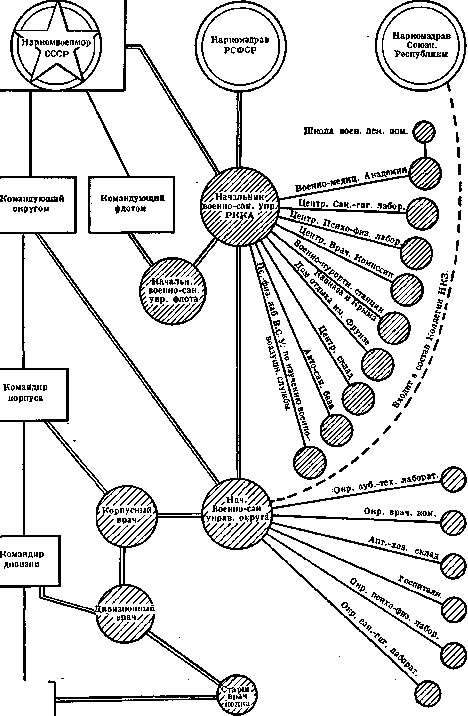
Diagram of the organization of the military medical service of the Red Army (in peacetime).
MILITARY MEDICAL SERVICE. II Emperor Supreme Commander-in-Chief
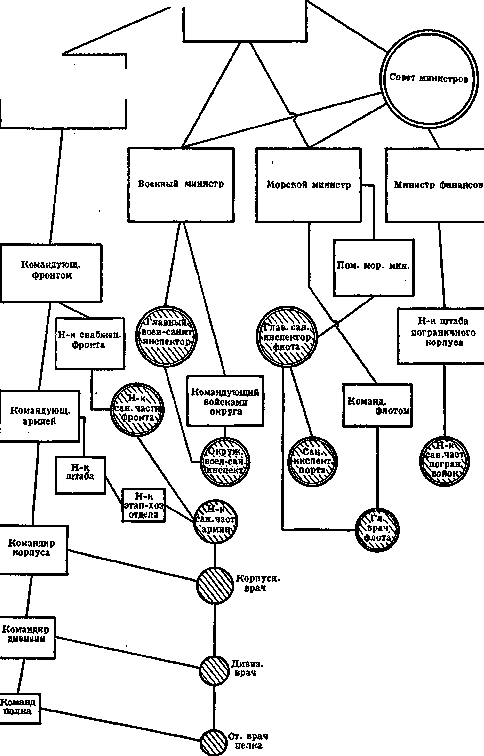
Diagram of the organization of the military medical service during the World War in Russia (1914-1917).
MILITARY MEDICAL SERVICE. III
Chief of Staff Division Commander
Service Company
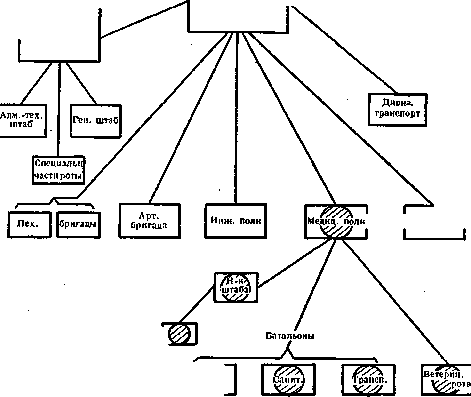
Hospital. Diagram of the organization of the military medical service of an infantry division (wartime) in the U.S.A.

Aviation Group

Headquarters
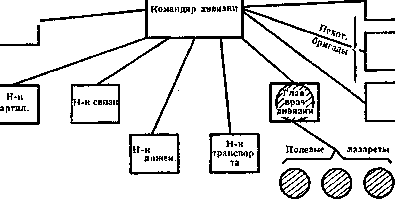
Diagram of the organization of an infantry division of the British Army (wartime).
MILITARY MEDICAL SERVICE. IV
Front Commander Army Commander Headquarters Headquarters Battalion Auto-medical detachment Medical group of the division Senior non-commissioned officer
1 scooter rider
2 WAGONERS
Junior doctor
3 musicians 1st class stretcher-bearer 16 STRETCHER-BEARERS Regimental WAGONER Scooter rider Diagram of the organization of the military medical service (wartime) in France.
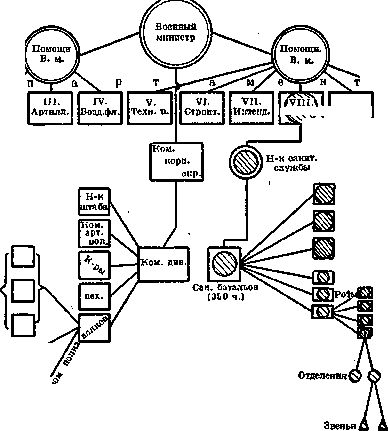
etc.
Military industry
Detachment, battalion commander Sanitary-technical workshop Cadre reserve
Squads. Scheme of organization of military sanitary service (in peacetime) in Poland. based on personal experience in the Crimean campaign, wrote the "Fundamentals of field surgery" and outlined the principles of organization of aid to the wounded. However, the ideas of N. I. Pirogov could not under the conditions of serfdom in Russia receive full implementation. Of the most significant innovations of the 19th and early 20th centuries, we can note: the publication of the regulation "on district military-medical inspectors and district inspectors of hospitals (1864); the establishment (in 1867) of the Main Military-Hospital Committee (with the mandatory participation of the Chief of the General Staff, the Quartermaster General, the Chief Engineer), reorganized in 1888 into the Main Military-Sanitary Committee, with an expansion of its rights in the field of mobilization; the establishment of the Main Military-Medical Administration and the position of Chief Military-Medical Inspector (1869); the publication of regulations on divisional (1871) and corps physicians (1874) and regulations on army stretcher-bearers (1874); the establishment of local infirmaries (1885); the establishment of positions of hospital commanders from the combat personnel (1885), which again worsened the state of hospital affairs; the establishment of a factory for medical supplies in St. Petersburg (1896); the separation of a veterinary department within the Main Military-Medical Administration and the establishment of the position of Chief Military-Veterinary Inspector (1902), the reorganization of the Main Military-Medical Administration into the Main Military-Sanitary Administration and the Chief Military-Medical Inspector into the Chief Military-Sanitary Inspector with the abolition of the Main Military-Sanitary Committee and the transfer of all matters under its jurisdiction to the Main Military-Sanitary Administration (1909). However, the state of military healthcare remained unsatisfactory. A characteristic indicator of the attitude toward M.-s. d. can serve as the attitude toward the military-medical personnel of the army, who are the carriers of healthcare ideas in the troops. According to the observations of Dr. Howard, sent by the government of the Russian Empire as an observer to the Russian army in the 1904-05 campaign, "officers treated physicians as belonging to a different stratum of society, refusing to see them as equals, brothers in uniform, and not accepting them as equals in their gatherings." According to the testimony of the Chief Sanitary Inspector Evdokimov, during the period of the Japanese War, "the physician of a military unit was only an observer, without sufficient authority, over the sanitary-hygienic conditions of the lower ranks." In the World War, the Russian military-sanitary service entered also insufficiently prepared organizationally, which affected the state of the entire military-sanitary affair (see separate table II). Individual branches of m.-sanitary affairs were under the jurisdiction of various ministries (M.-s. d. of land armies - in the Ministry of War, naval - in the Ministry of the Navy, border troops - in the Ministry of Finance). The commanders of sanitary units of the front were not subordinate to the Chief Military-Sanitary Inspector, who headed the military-sanitary service of the land armies. Sanitary-evacuation affairs were under the jurisdiction of the General Staff. Positions of commanders of sanitary units of fronts and armies, as well as evacuation points, were predominantly filled by combat commanders. In the area of supply, the military-sanitary service was highly dependent on the quartermaster service. Sanitary commanders, who headed army and front military-sanitary organs, were assigned a secondary place in headquarters. According to the law, "direct supervision by the commander of the sanitary departments of the army" over the activities of corps physicians was permitted only in exceptional cases, with the permission of the army commander. To unify all sanitary and evacuation activities in the country, Prince Oldenburg was appointed during the war, unprepared to lead healthcare in the country and army either by his education or previous activities. The consequence of organizational unpreparedness and extreme imprudence in areas affecting the most essential interests of M.-s. d., but not within the sphere of influence of the military-sanitary service, were major defects in the medical-sanitary and evacuation support of the army, which caused distrust in Russian society and required its active participation in the form of organizing zemstvo and city-wide unions. Only about 20% of all evacuation beds belonged to the military-sanitary department, while the rest were deployed by public organizations. The percentage of disability in the Russian army was very high, and of the hospitalized sick and wounded, only about 46% returned to the troops in general, which may not seem surprising, since "the vast majority of the wounded arrived (in the deep rear) in such a condition that one could only marvel at the vitality of the human organism" (Terebinsky). The development of preventive measures lagged behind foreign armies or was implemented on a more modest scale. Even purely therapeutic measures sometimes reflected the ignorant hand of military despotism: there is a known case when the commander of one of the front headquarters, writing a resolution "I see no benefit from salvarsan," delayed the use of this drug on that front for almost a whole year. At the XIV Congress of Russian Surgeons at the end of the war (1916), N. A. Veliaminov characterized the state of M.-s. d. as follows: "Among the shortcomings of the existing system, which forms the basis of the organization of medical-sanitary service on the front, including both the military-sanitary department and private organizations, two major defects can be pointed out: a) the absence on the front of a competent central body directing the entire medical-sanitary service in the armies and uniting the activities of various departments and organizations involved in sanitary affairs; b) the complete lack of independence of the entire medical corporation in the special matter which it serves." 44 3 19.4, dysentery-16 5, cholera-7.9, typhus-6 4. smallpox-0.7. Of the total number of wounded admitted to treatment facilities, according to various data, the percentage returning to the troops can be considered equal to 40-42. V. Principles and organization of M.-e. d. in the Red Army. "The character of the organization of healthcare in the Red Army is in direct dependence on the general attitude of the Soviet state toward that basic mass of population from which the troops are recruited. In all countries, the most numerous class is the working population, which also provides the main contingent for the troops, but the assessment of this living force in capitalist states and in the Soviet state differs significantly. The capitalist system evaluates the working population as a commodity with a certain market value, as a living machine. The soldier is a means and instrument for achieving certain goals contrary to his class interests - serves as an object of attention and care no more than as much as necessary for this instrument" (3. P. Solovyev). The fighter of the Red Army is a full-fledged member and citizen of the socialist state and as such is an object of maximum attention and care regarding his sanitary, cultural, 128.7, typhoid fever-25, relapsing fever- ('intellectual and physical condition T a b l. 3..3 a b o l e v a e i o st in the Russian army in the imperialist and development. This premise war from August 1, 1914 to September 1, 1917 (according logically obliges K establishment ___________________of Dr. Avramov *).______^j______^^^^^ of such a healthcare system in the country that would be essentially unified for the entire working population of the socialist state, i.e., unified Soviet. medicine. Only under this system does healthcare for various age groups (childhood, adolescence, pre-conscription age, military contingents, army reserve, etc.) receive the necessary organizational unity and planned progressive development. Civil healthcare agencies, improving health and replacing military personnel and even officials in positions requiring from those occupying them special knowledge and training. And this in all departments and organizations. No special matter, in any department, can function normally and correctly, as long as specialists serving it are not masters of this matter, and in this case - until military physicians, in addition to the duties and responsibilities imposed on them, are given rights thanks to which they will become equal members of the military family." The Russian army, deprived of independence in its strategic and operational plans by the allies, of course, could not coordinate its operational actions with its sanitary-hygienic condition and sanitary-epidemic conditions of its rear. Major operations were developed without proper preparation in terms of sanitary prevention, without proper provision of sanitary-evacuation means, as a result of which the Russian army suffered heavy losses compared to hostile and allied armies (see tables 3 and 4), despite the presence of large material supplies and high general medical qualification of physicians-. The largest number of diseases per 1,000 of the average strength were: scurvy- Became ill and recovered Absolute numbers Officers Became ill .
Recovered and returned to the front... Soldier Per 1,000 of the average listed strength Officers 1,051.3 861, Soldiers 1,308.7 811.7 Per 100 sick Officers Soldiers * Dr. Avramov believes that the absolute figures he cites are 10% lower than the actual figures due to the loss of purely statistical material during retreats and demobilization.' \ Table 4. Combat losses (officers and soldiers) of the Russian army (according to Dr. Avramova*). Killed Wounded and concussed. Died ...in units ... ... : ... . Remained in units . Sent to medical institutions . . . 3,748,669 18,371 319,445 Missing without a trace (captured) ... ... ... . Suffered from Cv W. Died Remained Sent to medical institutions .!. . 16,658 42,160 General remark regarding their.-ta-she^that^ts^pA tabjishsh.'Z'.". daily replenishment; military health care, carrying out its direct objectives of ensuring the combat capability of troops, at the same time contributes to strengthening the health of the creative productive forces of the country, which are 'demobilized,' and even measures of health care Among the broad layers of: adult civilian population at the same time ensure "proper reserves for the army. Application of K' organizations of armed forces: principles of the territorial system and methods of pre-conscription preparation: causes^' 'even greater necessity' as the unity of Soviet medicine. Active participation of the broad masses of the population in the general socialist construction has as a consequence the development of Red Army initiative in the field of health care, on the basis of widely organized sanitary education. The scheme provided [see separate table I (pp. 421 - 422)] gives an idea of the organizational structure of the military sanitary apparatus.- The organization of the military sanitary service is based on the principles: 1) unified leadership of health care; 2) dual subordination of military sanitary organs (along the command line - in the general military service order and to the senior military sanitary chief - along the special service line); 3) ensuring initiative and responsible executive work in the presence of centralized leadership; 4) maximum use of civilian apparatus. Health care activities for troops are carried out in the direction of preventive medicine, applying the principles of prevention to treatment activities. Practical measures for health care are built on the basis of active and responsible participation of command and political personnel in health care, which is provided for in the statutes of the Red Army. All health care work of the Red Army (including the naval and air forces), troops of the United State Political Administration and convoy service is under the jurisdiction of the Military Sanitary Administration of the Red Army (VSU RKKA). It is entrusted with: a) leadership of the medical examination of citizens called up for military service and servicemen serving in the ranks of the Red Army; development of issues of fitness for military service, selection and distribution of persons called to the ranks of the Red Army among various branches of arms, depending on their psycho-physiological condition; b) sanitary supervision of the condition of Red Army troops and the conditions of their labor and life; development of issues of improving the labor and living conditions of Red Army troops; c) leadership of general and specialized stationary and outpatient treatment of Red Army servicemen; d) implementation of special sanitary-prophylactic measures aimed at preventing diseases among the personnel of the Red Army; e) medical supervision of physical training of Red Army servicemen and pre-conscription age persons; f) supervision of the medical-sanitary provision of the variable composition of territorial troops during the intervals between assemblies and pre-conscription persons during training assemblies; g) development of staffing tables, schedules, norms and all kinds of organizational and mobilization issues for the military-sanitary service; participation in the development by People's Commissariats of Health of the union republics of measures for the mobilization preparation of civilian health care agencies; h) procurement, accounting and distribution of medical, sanitary-hyg. and sanitary-technical property for units, institutions and establishments of the Red Army>; i) accounting for the personnel of the military-san. service and mbd,ь щ^^ва-.щщощ: Red Army; k) leadership of the special training of medical personnel of the Red Army, of the rank-and-file of the sanitary service of the Red Army and contingents of medical reserve personnel of the Red Army; l) organization of scientific research work on issues of medical-sanitary service of the Red Army; collection, through special surveys and current reporting, and development of statistical materials on issues of physical development and health of the conscription contingent '. personnel of the Red Army; m) leadership of sanitary-educational work in the Red Army. This Administration is under the People's Commissariat of Health of the RSFSR and receives directives from it concerning the proper organization of medical-sanitary work in the Red Army, as well as coordination of this work with the activities of civilian health care agencies, with the latter being coordinated in turn by the People's Commissariat of Health of the RSFSR with the People's Commissariats of Health of other union republics. The People's Commissar for ! Military and Naval Affairs gives VSU RKKA ; tasks for the military-sanitary provision of the Red Army, for the mobilization preparation of the military-sanitary service, for the location of sanitary institutions and establishments, for the timing of their formation and other military-operational issues. The head of VSU RKKA is appointed by the Council of People's Commissars of the USSR on the proposal of the NKM USSR and the People's Commissariat of Health of the RSFSR, after coordinating the candidate with the People's Commissariats of Health of the union republics. VSU RKKA has an independent budget in the all-union budget, and the head of this Administration enjoys the right of a first-degree credit manager. In the direct jurisdiction of VSU RKKA are: a) The Military Medical Academy; b) laboratories: Central Sanitary-Hygienic, Central Psychophysiological (see Military Hygiene) and Central Laboratory for the Study of Psychophysiology of Military Aviation Activities (see Aviation Hygiene); c) Central Pharmaceutical-Economic Warehouse and motor base; d) Military resort stations of the Caucasus and Crimea. Attached to VSU RKKA is the Central Medical Commission - the highest body for resolving disputed issues arising in the activities of district, hospital, garrison and draft commissions related to the medical examination of servicemen and military reservists. In military districts, leadership of health care work rests with district military sanitary administrations, in fleets - with VSU of the respective fleets. The heads of these administrations are subordinate in the general service order to the commander of the district troops, and in the special service order - to the head of VSU RKKA. The heads of VSU of districts located on the territory of Union republics are members of the Boards of the People's Commissariats of Health of the respective republics, which ensures coordination of local work of military and civilian health care agencies. Attached to VSU of districts are: a) district sanitary-hyg. and district psychophysiological laboratories, b) district medical commission, c) district dental technical laboratory, d) district pharmaceutical-economic warehouse. In the direct subordination of the heads of VSU of districts are all hospitals (see !) of the district and through district, divisional and garrison physicians, the entire sanitary service of troops and military educational institutions, through sanitary inspectors of border troops - the sanitary service of border troops.
In the fleet, through flagship physicians and senior sanitary officers of coastal defense, the sanitary service of the fleet and this defense, and directly the naval hospitals. At each commander of a separate unit or formation in the army, air and naval fleets, there is a physician (at the commander of a regiment - senior regiment physician; at the commander of a division - division physician, etc.), who is the head of the military sanitary service of the given unit or formation. In garrisons where several military units and institutions are located, garrison physicians are appointed to coordinate military sanitary activities. The duties of a unit physician consist of: 1) continuous medical supervision of the personnel through: periodic medical examinations; presenting to the command one's views on issues of hygienic regime in the unit, both in terms of daily routine and regarding the load of fighters with drill and other activities; observing drill training and physical culture activities; scientific organization of verification by psychophysiological methods of achievements in physical development and education of fighters; 2) sanitary supervision of the living conditions of the personnel, study and observation from a sanitary-hygienic perspective of the condition of the area where the unit is located, residential premises, technical and economic institutions and installations serving the unit (kitchens, armories, warehouses, water supply, sanitation installations, etc.); 3) general supervision of the proper and timely provision of the personnel with their due rations; 4) anti-epidemic measures; 5) providing medical assistance - outpatient, inpatient (in the reception ward, unit infirmary or by referral to a military hospital or civilian medical institutions); 6) guidance on sanitary-educational work and the cultivation of sanitary-hygienic skills among the unit personnel; 7) organization of training of subordinate medical and sanitary personnel for work in wartime conditions; 8) ensuring the unit with all due medical, sanitary-technical and sanitary-economic property; 9) guidance on the proper conduct of sanitary-statistical work in the unit. All work related to the activities of civilian health authorities is coordinated with them. To implement qualified medical supervision and guidance over the physical training of troops, there is an institute of physician-instructors for physical training of troops in provincial and territorial districts. They are also responsible for general guidance and instruction to civilian health authorities on the organization of medical-sanitary service for pre-conscription training of citizens undergoing military service in territorial order during methodological training camps1. - Xl' ' ''' The entire personnel of the military sanitary service is divided into military personnel and civilian employees; military personnel - into commanding and rank-and-file. The commanding staff - into command, political, medical and administrative, with division into service categories. Disciplinary and administrative-economic rights are connected with the position held. As a general rule, the commanding medical staff enjoys the rights of a commander in relation to directly subordinate personnel and the rights of a senior officer in relation to all rank-and-file. The medical staff of the Red Army enjoys all rights granted by the law on benefits for the commanding staff of the Red Army and the pension statute. According to positions held, the commanding staff is divided into junior, middle, senior and high. Junior commanding staff is filled from rank-and-file who have received appropriate training. Middle, senior and high - from military personnel who have received secondary or higher military or special education. The sanitary rank-and-file (sanitaries) undergo training in troops and hospitals. Disinfectors and sanitary instructors - at special courses at large military hospitals. Medical assistants are recruited from those who have completed the school of military medical assistants at the Military Medical Academy and civilian technical schools. Pharmacists and dentists - from persons who have completed corresponding civilian educational institutions. Physicians - from persons who have graduated from the Military Medical Academy or civilian higher medical educational institutions. To ensure proper training of the medical reserve, pre-conscription training has been introduced in higher educational institutions and secondary technical schools, and medical reserve training camps have been established. To improve the qualifications of the medical staff of the Red Army, attachments to the Military Medical Academy for advanced training (for 1 and 2 years), business trips to special military sanitary and civilian courses, sanitary-tactical exercises, field exercises, and military games have been established. Attachments to the V.-m. Academy for advanced training and for pharmacists have been established. In the general system of measures for healthcare of the Red Army, the methods and order of its staffing, the forms and degree of participation of military and civilian health authorities in this process occupy a prominent place. Shortened terms of service, establishment of pre-conscription training and application of the principles of the territorial system have a beneficial effect on healthcare. In the process of conscription, health authorities take an active part, working in conscription commissions as full members (and not as experts, as was the case in the pre-revolutionary period). Military sanitary control applies to all activities of conscription authorities in terms of medical examination. The conscription process is used by health authorities to study the physical condition and morbidity of the entire conscription contingent, for which a special card is compiled for each conscript. Selection by branches of troops, staffing of military educational institutions is carried out with medical participation and to a large extent with the application of psychophysiological and psychotechnical research methods, which, along with healthcare interests, ensures the best training results. Sanitary supervision aims to timely eliminate harmful factors in the living and working conditions of the Red Army soldier and to find measures to create conditions most favorable for the success of military training and strengthening of health. Sanitary supervision is carried out by the Red Army both in the form of participation of the military sanitary service in the development of sanitary-hygienic standards for various types of Red Army rations and labor, and also in the order of direct supervision over the implementation of these standards and rules in the working and living conditions of the troops (nutrition, housing, clothing, physical activities - educational and sports, personal hygiene, etc.). Medical supervision has the task of timely detection of any unfavorable changes in the health status of the Red Army soldier. One of the practically important forms of medical supervision is mandatory comprehensive periodic personal examinations, accompanied by medical examination of the most important organs, anthropometric measurements and recording of the data obtained in the personal sanitary-statistical card of the Red Army soldier. Medical examinations facilitate early recognition of diseases, establishment of their etiology and, consequently, timely adoption of preventive and therapeutic measures. Along with preventive measures carried out in the process of sanitary supervision and medical supervision, extraordinary preventive measures exist in the Red Army, which should include protective vaccinations against infectious diseases (cholera, intestinal infections), sanitary treatment (washing in a bath with disinfection of clothing, haircutting, etc.), carried out for special indications (see Baths), and not in the order of regular hygienic service, preventive quininization (see Malaria), etc. The therapeutic activity carried out by unit physicians (outpatient clinics, reception wards and unit infirmaries), garrison outpatient clinics, hospitals with their polyclinic departments and military resort stations, is based on the task of combining medical assistance to the sick with the study and improvement of troop labor and living conditions. Among therapeutic and therapeutic-prophylactic methods, the use of therapeutic natural agents (physiotherapy, climatotherapy, balneology, dietetics, etc.) has been widely developed in the Red Army. In the field of dentistry (see Odontology), along with conservative treatment methods, preventive sanitation has been widely developed. The introduction into practice of the personal sanitary-statistical card of the Red Army soldier made it possible to connect the physician's observations obtained in the course of medical supervision and in the process of treatment, as well as to connect the individual treatment institutions through which the sick Red Army soldier passes, and thereby ensure the most rational choice of treatment methods, as well as ensure the preventive nature of therapeutic activity. Sanitary education is placed by the Red Army as the basis of Red Army initiative in healthcare. 'The results of this initiative stand in direct dependence on the sanitary-cultural level of the Red Army mass. Correct guidance of Red Army initiative can be ensured only by the extensive organization of sanitary education' (3. P. Solovyov).
The task of sanitary education in the RKKA is set as follows: a) to involve the entire military unit and the army as a whole in work to protect their own health ('to create the basic condition for the combat capability of the army's living force - its human resources'); b) to instill skills of self-help and mutual aid in case of injury and poisoning by chemical agents in battle, which directly contributes to the combat capability of the RKKA; c) to educate the Red Army soldier as a conductor of culture after demobilization. Sanitary-educational activities in the RKKA are closely linked with the general cultural and political work and are conducted in the form of school and extracurricular activities. Hygiene and the basics of Military Sanitary Affairs have been introduced into the curriculum of all military educational institutions, including academies. The physical training of troops has the task of harmonious physical development of the fighter in connection with special military-applied requirements, and therefore is organized as mass work and regulated by military-sanitary authorities. Military-sanitary statistics and reporting are one of the methods for studying the sanitary condition of the RKKA and the conditions on which it depends, in order to timely and rationally implement healthcare measures for the troops. On the basis of these requirements, the forms of military-sanitary statistics have been constructed and the procedure and deadlines for the preparation and processing of corresponding materials have been established. In the area of material supply, carried out by the military-sanitary service, Table 5. Losses of the RKKA in the civil war 1918-21. Years Fell ill Including of whom died Wounded and concussed Killed on fronts in the rear Total number of whom died 1918 1919 1920 1921 87,929 1,078,735 3,928,894 1,821,335 174,293 75,578 12,101 200,124 318,807 3,731 2,338 7,407 3,351 The main types are: monetary, medical, sanitary-economic and sanitary-technical. In order to provide troops and institutions with medical and sanitary equipment of such type, quality and quantity as required by medical practice, in connection with modern scientific achievements, and as permitted by the production capabilities of our country, all schedules and catalogs underwent a major revision with the participation of the Military Medical Academy and a number of specialists (1924). In the area of preparing the USSR for defense, the activities of military-sanitary authorities have long gone beyond the narrow Table 5a. Infectious diseases in the RKKA. Years Fell ill per 1,000 personnel Typhus Recurrent typhus Typhoid fever Dysentery Malaria 1919 1920 1921 1922 1923 19 24 1925 1926 1927 130.7 115.9 23.3 29.3 1.86 0.70 0.22 0.16 0.12 73.8 177.9 71.6 72.7 3.36 0.46 0.14 0.09 0.08 11.6 11.0 6.8 2.7 1.15 0.96 0.92 0.70 0.52 6.9 5.7 1.0 0.8 0.9 0.5 0.57 17.14 18.09 106.47 142.01 104.25 59.58 51.4 38.0 0.13 0.07 4.9 0.53 20.8 departmental framework and serves as the framework around which the work of sanitary defense of the country by civilian health authorities and public organizations is developed. Throughout the first decade alone, the Soviet system of military healthcare and the organization of military-sanitary service have fully justified themselves. During the years of the civil war, under conditions of blockade and heavy epidemics that spread to the army, Soviet healthcare was able to take on the leadership of sanitary evacuation and deploy a powerful evacuation apparatus - up to 500,000 beds, having received only 50,000 from the pre-revolutionary army (all the rest was lost, falling into the hands of the enemy on the fronts, or was lost during demobilization), to carry out, on the basis of the development of preventive measures, a successful fight against epidemics of parasitic typhus, intestinal diseases, malaria and others, and, as can be seen from tables 5, 5a, 6, 7 and 8, to raise the general level of sanitary-hygienic condition of the RKKA. During the period of peaceful construction, with the transition from the fight against epidemics to the creation of Table 6. Syphilis in different armies. Years Army Fell ill with syphilis per 1,000 personnel Polish 12.45 American 11.70 Pre-revolutionary Russian 12.80 19 24-25 Red army 10.44 1925-26 » » 8.77 1926-27 » » 8.ог Table 7. Labor losses (per serviceman). Years Outpatient visits Days of exemption in the order of outpatient help Days of illness spent in a treatment institution Days in connection with treatment and sick leave. 1925-26 1926-27 3.50 3.03 3.30 2.65 2.16 9.70 6.62 5.69 8.65 8.01 Table 8. Mortality (per 1,000 personnel died from diseases). Years Personnel Commanding rank Rank and file 1913 1924-25 1925-26 1926-27 4.93 1.81 1.66 1.19 3.02 2.59 2.13 1.21 healthy and rational military labor and living conditions, the successes of Soviet healthcare, despite the insufficiency of material resources, ensured greater sanitary well-being of the army than was observed in the pre-revolutionary army, as indicated by the tables above. In the pre-revolutionary Russian army in 1913, there were 23.2 cases of gonorrhea per 1,000 personnel, while in the Red army in 1926-27 - 17.82.
Related articles
Mentioned in
Cite this page
“Military Medical Service.” Soviet Medical Encyclopedia. English translation of Bolshaya Meditsinskaya Entsiklopediya, 1st ed. (Moscow, 1928–1936), ed. N. A. Semashko. https://sovietmedicalencyclopedia.pages.dev/article/military-sanitary-affairs/