Field Sanitation
Historical document, translated for reference. It reflects medical knowledge of the 1920s–30s and is not medical advice.
Summary
Field sanitation is a branch of military hygiene focused on preventive measures to improve conditions for troops in the field, protecting soldier health and combat effectiveness. It addresses troop placement, water supply, waste disposal, and the construction of defensive and non-defensive structures in various combat scenarios.
Encyclopedia article (1928–1936)
FIELD SANITATION, an applied branch of military hygiene, encompassing a system of preventive measures to improve and sanitize conditions for troops in the field for the purpose of protecting the soldier's health and increasing his combat effectiveness. F.S. historically developed in parallel with military hygiene, and as is usually the case, practice (sanitation) often far outpaced theory (hygiene). The main questions addressed by F.S. are the conditions for locating military units during both combat operations and rest—in so-called defensive and non-defensive structures and buildings. The main objects of F.S. are troop placement, water supply and sanitation in field conditions. In the context of combat operations, the main requirements and considerations are of a tactical nature, determining the character of defensive structures, their location, etc. This circumstance, as well as the need for careful camouflage of all structures, makes it difficult to apply standard hygienic norms in these conditions, forcing a reduction of hygienic requirements to the minimum permissible limits. Regarding non-defensive buildings, which serve mainly for the rest of military units, it is possible to impose stricter requirements on their construction and equipment, establishing even if reduced, yet firm hygienic norms (see Dugout, Barracks, Tent). When using populated areas for rest and temporary billeting, it is also necessary to observe a number of sanitary requirements. When allowing for a short-term location of troops in populated areas, a reduction of living space to minimum limits (but not less than 2 m2 of floor area per person) is permitted, but the main attention in this method of placement should be paid to the sanitary condition of the living quarters themselves, and as a mandatory requirement, the absence of infectious diseases among those living in these premises. When camping in bivouac order, the main attention when choosing a location is paid to the sanitary condition of the area and the availability of good quality water in sufficient quantity for drinking and domestic needs (see Bivouac). Defensive structures: trenches, shelters—depending on the nature of military operations (maneuver, positional warfare) and the type of battle (defense on previously fortified positions, offensive, etc.)—are constructed with varying degrees of strength and equipment, starting from simple individual trenches (cells) for shooting while lying down, ending with concrete shelters well equipped from a sanitary standpoint. During combat operations, the simplest earth structures camouflaged from the enemy—trenches (fig. 1)—find the widest application, providing convenience for shooting and protection from enemy fire. For better preservation of the trench, the steepness of the trench is usually reinforced with revetment—from poles, wattle, brushwood, boards, etc. To protect trenches from dampness and mud, measures are taken to drain water into nearby lowlands or specially constructed absorption wells.
Figure 1. View of a section of a simple trench with arrows: B—parapet; R—firing step in the trench; T—traverse at the rear.
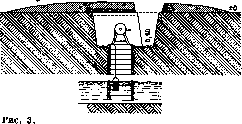
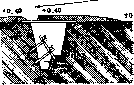
In more advanced trenches, for better protection of the soldier from rifle fire, shrapnel bullets, and small fragments, loopholes, visors, and canopies or special niches and parapet shelters (fig. 2) are constructed. For the rest of soldiers and at the same time protection from artillery fire, shelters of varying strength are constructed, which as a rule are also equipped from a chemical warfare protection standpoint (see Gas Shelters). In F.S., under combat conditions, ensuring that active troops have a supply of good quality water is of great importance. In this regard, previously prepared water supply maps of various areas, indicating water sources, their quality and flow rate, are of great value. The practical resolution of field water supply issues depends primarily on the nature of combat operations. Depending on the degree of maneuverability, water supply for active troops is carried out in different ways, starting from water transport (in barrels, tanks) and ending with the construction of pipelines. The latter method, for example, was widely used during the imperialist war, when a pipeline network with water distribution points was set up in the trenches themselves. When constructing shaft or Norton wells in trenches (figs. 3 and 4), the latter are made in sheltered places away from latrines and contaminated areas. At the same time, it is necessary to consider the direction of groundwater, especially if dirty water from trenches is discharged into absorption wells. If there are springs near the trenches, they can also serve as a water supply source after primitive capture. In many cases, it is necessary to provide for purification (disinfection) of water. The question of water supply in shelters is resolved in much the same way as in trenches, although water consumption here will be significantly greater, since in addition to drinking needs, water is needed for washing (showering). In the absence of water on site or its unusability, water is brought to the point of consumption by transport in barrels, tanks, or on advanced positions by special water carriers. For storing water reserves (in shelters, trenches), various types of impregnated (treated, for example, with alumina and ozokerite salts) fabric reservoirs can be used with great convenience. On the march, water supply is most often carried out by using local water sources with preliminary sanitary inspection and in many cases with disinfection (see Water supply—water supply in military field conditions).
Figure 1. Shelter under the parapet (in the Polish army).
Fire from the enemy + ".40 +0,40"
Installation of a shaft well in trenches.
Fire from the enemy
Figure 4. Installation of a Norton well in trenches.
The question of water supply in shelters is resolved in much the same way as in trenches, only water consumption here will be significantly greater, since in addition to drinking needs, water is needed for washing (showering). In the absence of water on site or its unusability, water is brought to the point of consumption by transport in barrels, tanks, or on advanced positions by special water carriers. For storing water reserves (in shelters, trenches), various types of impregnated (treated, for example, with alumina and ozokerite salts) fabric reservoirs can be used with great convenience. On the march, water supply is most often carried out by using local water sources with preliminary sanitary inspection and in many cases with disinfection (see Water supply—water supply in military field conditions).
Figure 5. Latrine in trenches.
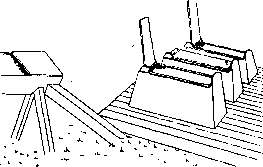
Figure 6. Portable latrines of German type.
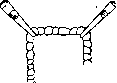
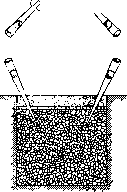
No less important and no less complex issues of F.S. are the removal of excrement and waste. The typical solution here is to construct latrines near trenches or shelters, connected to them by communication trenches. The location and design of latrines must guarantee protection of water sources from contamination. Latrines should be constructed in impermeable soil; otherwise, their bottom and walls are lined with fatty clay. When the cesspool is filled, it is backfilled. To combat odor and flies, excrement is covered with earth and sprinkled with a 10% solution of chloride of lime or 20% lime milk. The construction of a latrine in trenches is shown in fig. 5. For protection from shrapnel bullets and fragments, the latrine is provided with a canopy. From a sanitary point of view, the portable latrines used by the Germans during the world war were very appropriate (fig. 6). By tightly covering the cesspools, they well protected against odor and flies. For collecting urine, a specially designed urinal for trenches (fig. 7) can be recommended, consisting of a 1 m3 pit filled with crushed stone, pebbles, and sand. Urine entering the urinal through corner receivers (metal or ceramic funnels) quickly undergoes mineralization. For drainage
Figure.
7. Construction of a trench urinal.



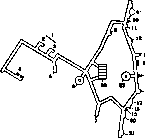
For used water in shelters (after showers), absorption wells (vertical drainage) are usually arranged. Garbage and food waste are removed from trenches into special pits, where they should be regularly covered with a layer of earth. In more stationary conditions, particularly in positional warfare, it is advisable to use garbage incineration. Figure 8 gives a general idea of the types of trenches and, in particular, the relative location of various devices in them: shelters, wells, latrines, communication trenches, etc. The improvement of battlefields is of great importance in field sanitation: the timely and proper burial of killed soldiers and the removal of animal carcasses. The arrangement of common (mass) graves* should be carried out with observance of the basic requirements regarding air, water, and soil purity, taking into account the possibility of rapid decomposition and mineralization. To meet these requirements, the soil (dry, loose, preferably sandy), a low groundwater level, and avoiding the accumulation of a large number of bodies in one grave are important. In one common grave, it is recommended to bury no more than 20 people, arranging the grave itself as a trench 2 m wide and up to 20 m long; the bodies should be laid in a single row, separating them from each other as much as possible with a layer of earth and tree branches. The depth of the grave should be at least 1.5-2 m, the bottom of the grave should be at least 0.5 m above the groundwater level. Bodies of those who died from infectious diseases should, if possible, be burned; if burial is necessary, the bodies are covered with chlorinated or quicklime for disinfection. The cleanup of battlefields should be carried out by specially appointed and trained teams under the supervision of military sanitary authorities. Similar to the rules mentioned above, cemeteries for animal carcasses are arranged, with a corresponding increase in the area allocated per corpse.
Related articles
Cite this page
“Field Sanitation.” Soviet Medical Encyclopedia. English translation of Bolshaya Meditsinskaya Entsiklopediya, 1st ed. (Moscow, 1928–1936), ed. N. A. Semashko. https://sovietmedicalencyclopedia.pages.dev/article/field-sanitation/