Tent
Historical document, translated for reference. It reflects medical knowledge of the 1920s–30s and is not medical advice.
Summary
The article describes various types of temporary shelters used primarily in military contexts, including their construction, materials, and applications. It details different tent designs for various seasons and purposes, with emphasis on their use in field conditions, medical settings, and military encampments.
Encyclopedia article (1928–1936)
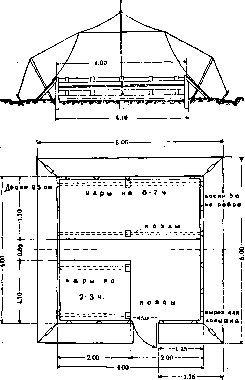
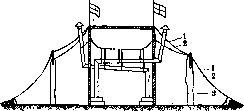
Tent, one of the simplest types of temporary shelter, serving as protection from atmospheric influences, constructed from various types of fabric. Tents are used for the short-term accommodation of workers, in expeditionary and tourist practice, and mainly in the army, where they are used both in peacetime and wartime for accommodating soldiers during field exercises, in camps, as well as in front-line conditions, for the temporary accommodation of patients and wounded, for setting up dressing stations, field bakeries, etc. All types of tents consist of fabric panels (made of dense cotton or linen fabric) and usually wooden reinforcing parts (poles, stakes, pegs). The method of setting up, dimensions, and construction of tents vary depending on their purpose. The tent adopted by the Red Army for marching consists of separate, interconnected tent panels and is reinforced with poles and pegs (the simplest type of marching tent; Fig. 1); Figure 1. Marching tent. Such a tent can only be used in warm weather for short-term accommodation, as it does not provide reliable protection from bad weather and especially cold, is inconvenient to use (low), and is not sufficiently resistant to wind. For cold weather, the so-called П.-ю p т a (Fig. 2), made from 12 separate marching tent panels and heated by a stove, is more suitable; such a tent is designed for 12 people. 'a б г0 Figure 2. Tent-yurt. A camp tent (Fig. 3) accommodates 8-10 people, with a usable area of about 16 m2 with a height in the middle part of 2.7 m. To increase volume and convenience of arrangement, the camp tent has a special base-nest with wooden, adobe, and other walls about 1 m high. The walls of the nest are made sloping on the outside (better drainage of rainwater and better preservation of the fabric). Tents are equipped with beds or platforms. The floor is in the form of a wooden raised platform by 10-15 cm. The installation and reinforcement of the tent are visible in the figure. To prevent water from flowing around the tent, a ditch is made. The place for setting up the tent must meet a number of sanitary requirements, and first of all, it must be dry, with a low groundwater level. Due to certain shortcomings [poor protection from atmospheric influences, significant air pollution with the floors down, especially in bad weather (for more detailed data, see Camp), insufficient lighting], tents are inferior in sanitary-hygienic terms to other types of temporary shelters, for example, barracks. When using tents in winter, certain measures are taken to insulate them, in particular, equipping the tent with an additional inner wool lining. For heating, simple-type stoves are installed, which, as shown by testing one type of winter camp tent, make it possible to easily maintain the required temperature (+16° at an outside temperature of -15°). Due to their relative lightness, mobility, and speed of installation, tents find fairly wide application in the practice of military-sanitary service. Until recently, tents of the German type, known to us under the name "Hessian" (Fig. 4), were quite widespread. This tent consists of two covers, of which the outer one is distinguished by special density and impermeability to water. In cold weather, the tent is insulated by a second inner wall made of thick camel wool and the installation of 1-2 stoves; the tent is equipped with 12 windows; the floor of the tent is covered with waterproof canvas. The size of the Hessian tent—about 100 m2—allows 20 or more people to be accommodated in it. In addition
Figure 3. Camp tent.
there is a hospital tent of a more modern design (assembled, made of separate parts) with approximately the same area as the Hessian, and a small tent with a usable area of about 13 m2, intended mainly for setting up a dressing station. Both
Figure 4. Cross-section of a Hessian tent: 1 and 2—outer and inner shells; 3—stakes.
types of tents have double covering, windows, a fabric floor covering; for cold weather, they are equipped with a warm wool lining and adapted for the installation of stoves. Sufficient heating of these latter tents makes them suitable for accommodating patients and wounded at any time of year.

Related articles
Mentioned in
Cite this page
“Tent.” Soviet Medical Encyclopedia. English translation of Bolshaya Meditsinskaya Entsiklopediya, 1st ed. (Moscow, 1928–1936), ed. N. A. Semashko. https://sovietmedicalencyclopedia.pages.dev/article/tent/