Market
Historical document, translated for reference. It reflects medical knowledge of the 1920s–30s and is not medical advice.
Summary
This article describes the historical development of markets, focusing on their sanitary arrangements and evolution from ancient times to Soviet-era collective farm markets. It details how markets have transformed from open-air spaces to specialized facilities with sanitary considerations.
Encyclopedia article (1928–1936)
Market, a place of open or closed type where retail trade in various goods is conducted, predominantly agricultural products. Unlike markets (see), where trade takes place only on certain days of the decade or month, so-called market days, at Markets trade is conducted daily, for which the latter have special equipment and facilities. The arrangement of Markets specifically for trade in agricultural products dates back to ancient times. In ancient Rome, great attention was paid to Markets from a sanitary standpoint, and there were special Markets for trading in individual food products: vegetable Market, meat Market, fish Market, etc. In ancient Rome and ancient Greece, to protect visitors from the weather, covered galleries were arranged around the Markets, which thus served as a kind of prototype for the covered Markets that were later established. As early as the 16th century, the Saint-Germain Market in Paris, for the purpose of protecting visitors and the products themselves from rain, sun rays, etc., was covered with a gallery. Later, under Napoleon I, this gallery was demolished to build a new extensive covered Market on this site. After this, several covered Markets arose in Paris. In England, where much attention is paid to sanitary improvements, even in small cities there have long been equipped covered Markets. In Germany, covered Markets began to be built at the end of the 19th century (in Berlin, Stuttgart, Dresden, Leipzig, Munich, Cologne and other cities). The main purpose of these Markets was, for the most part, wholesale trade in food products. Under the capitalist system, these Markets pursue the goal of supplying consumers with food products in proper sanitary conditions to a lesser extent than ensuring the interests of large capitalist purchasers who supply food products to large cities. Since the main subject of trade in these Markets is perishable products (meat, fish, vegetables), the main concern in arranging Markets is to prevent spoilage of these products. Most of these Markets adjoin railway lines, and thus products arriving by rail are unloaded directly from cars into the storage facilities of the Market. For storing perishable products, Markets are equipped with refrigerators and ice cellars. Retail Markets are given much less attention. For example, in the same Germany, there are relatively few covered Markets for retail trade, and in most cities, retail market trade is conducted on open squares. In tsarist Russia, little attention was paid to the sanitary improvement of Markets. Covered Markets were counted in the single digits and existed only in a few cities: in Saratov, Kiev, Petersburg, Rostov n/D. But even in the capitals, these covered Markets were in a very unsanitary condition and could not ensure the population with quality products. In the USSR, Markets now receive considerable attention. They now also acquire special significance as a place for collective farm trade. The Council of People's Commissars of the USSR and the Central Committee of the All-Union Communist Party (Bolsheviks) in their resolution of June 6, 1932, 'On the plan for grain procurement from the 1932 harvest and the development of collective farm trade in grain' deemed it advisable, after the completion of the grain procurement plan and the formation of seed funds, 'to give collective farms and collective farmers the full opportunity to sell their surplus grain freely at their discretion both at markets and bazaars, and in their collective farm shops, obliging local authorities to provide full assistance to these collective farms and collective farmers and to take measures to eliminate private traders and resellers-speculators who try to profit from collective farm trade'. A similar resolution on collective farm trade in meat was issued by the Council of People's Commissars of the USSR and the Central Committee of the All-Union Communist Party (Bolsheviks) in their resolution of May 10, 1932, 'On the plan for livestock procurement and on the meat trade of collective farms, collective farmers, and individual working peasants', where it was also recognized 'advisable to give collective farms, collective farmers, and individual peasants who conscientiously fulfill the centralized livestock procurement plan the full opportunity to sell cattle, pigs, sheep, poultry of all kinds, and meat products of their farms freely at markets, bazaars, and through collective farm shops'. By these resolutions of the Party and government, collective farm trade is given the significance of the most important factor in improving the nutrition of the population on the one hand, and raising the well-being of collective farmers and working peasants on the other. By resolution of the Central Executive Committee and the Council of People's Commissars of the USSR of May 20, 1932, trade by collective farmers and working peasants is granted significant benefits: all kinds of taxes and fees are abolished, rental fees for premises, stalls, etc. are maximally reduced. This same resolution also provides for the collection of one-time fees for maintaining the cleanliness of trading places and for cleaning market squares. The importance now attached to collective farm trade requires special attention to Markets also from the point of view of their sanitary improvement. The arrangement of modern collective farm Markets makes them completely different from old Markets. They are now designed not only for cultural trade but also for cultural service for collective farmers and working peasants arriving with their products. This approach to the organization of Markets has not only great cultural but also purely sanitary significance. Collective farm Markets are usually arranged of open and closed types. An example of the first type is, for instance, the collective farm Market in Leninskaya Sloboda (Moscow). It is divided into three parts: 1) a square with two rows of stalls and two rows formed between them; 2) a special place for trade from carts, equipped with a special system of tethering posts, allowing for the rapid evacuation of carts from the Market territory without interfering with trade; 3) cultural and sanitary institutions serving collective farmers; here there is
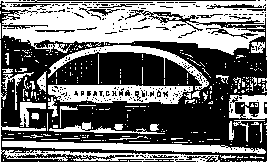
FIG. 1.
a kindergarten for children of collective farmers coming to the Market, a cultural tea house with greened, raised verandas; there is also a stage for agitprop performances and concerts. For storing products remaining after trade, a warehouse-refrigerator is equipped. The Market has a blacksmith shop and a watering trough for horses.-An example of a collective farm Market of the closed type is the recently opened in Moscow Arbat Market (figs. 1 and 2), which fully creates opportunities for cultural trade in proper sanitary conditions. The central place is occupied here by rows of food stalls. In addition to stalls, there are tables for trade by collective farmers and working peasants arriving with small batches of goods. A special part of the Market, separate from trade in food products, is occupied by stalls with goods of wide consumption. The food stalls are arranged very appropriately from a sanitary point of view: in front of the counters there is a depression creating a kind of 'pocket' for the buyer, leading him out of the general flow of visitors. The back part of the stall
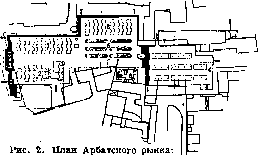
1-vegetable stalls; 2-milk stalls
tents; 3-meat and fish tents; 4-general consumer goods; 5-sale of products from tables; 6-tea room and snack bar; 7-service premises. It is glazed. This facilitates supervision of cleanliness, as this way the usual 'dark side' of the tent is eliminated. The Market is well lit from above; it is painted in light colors. The Market is served by permanent sanitary and veterinary supervision, for which there is a sanitary station, a milk control laboratory, and a veterinary station--for meat inspection. For the service of collective farmers, there is a medical station, tea room, snack bar, and barber shop. For rest, benches are placed along the walls in special niches. There are drinking fountains, heated toilets, and washbasins. The Market is sewered. According to the organization and maintenance of collective farm Markets, there are special rules of the People's Commissariat of Communal Affairs of April 4, 1932, and the People's Commissariat of Health of the RSFSR of May 19, 1932 ('On the Health Front', official supplement, No. 16-17, 1932), which establish the minimum sanitary requirements mandatory for collective farm markets. The latter must be clearly divided into: a) the section where trade from tents takes place, b) the section for trade from carts, c) the section for trade from hand, d) the section where cultural and domestic service enterprises are concentrated (canteens, barber shops, medical and veterinary stations, etc.).-The section where trade is conducted from carts must be separated from other sections by a driveway at least 6 m wide. Places where trade is conducted from hand must be equipped with tables 90 cm high and 75 cm wide; inside the table, at a height of 20 cm from the ground, there must be shelves for storing the merchant collective farmer's stock of goods. Between tables there must be a passage at least 3 m wide and a space for standing merchants 1-1.5 m wide. Rows of tents, carts, and hand traders must be arranged according to the principle of specialization (row of vegetable tents, row of meat tents, etc.), with the trade in food products being allocated to special sections. Food products to protect from flies, dust, and other contamination must be covered with light fabric or other materials. Markets must be provided with warehouses and ice cellars (or even better refrigerators) for storing stocks of products brought by collective farmers and working peasants. Market areas must be paved or asphalted. In rural areas and in small populated places where there are no pavements, in extreme cases the area must be leveled and well compacted. Areas must have drains for water. On market areas, public flushing toilets and urinals must be arranged, located at least 20 m from places where food products are sold, equipped with substances that repel flies (tar, kerosene, etc.). For solid waste, portable containers with lids (wooden or metal) with a capacity of no more than 100 l must be installed for the convenience of moving from place to place. For manure, special manure boxes must be provided. All kinds of waste and garbage, as well as manure, must be removed from the market area daily and immediately after the cessation of trade, followed by disinfection of garbage cans and other places for storing waste (with chloride of lime). Cleaning of market areas must be carried out daily before and after trade. Market areas must be supplied with water and special facilities for watering animals. The choice of a site for the market area is of extremely important sanitary significance. The latter must be located at a distance of at least 300 m from dumping grounds, and from premises where there are industrial enterprises in which production is associated with the development of dust and pollution of the area (rag warehouses, burlap warehouses, tanbark warehouses, hair warehouses, leather establishments, livestock and horse yards, slaughterhouses, etc.),-at a distance of at least 70 m. The main driveway must be no less than 6 m wide, and passages 3-4 m.-Collective farm Markets must be under constant sanitary supervision. In large cities, there are usually special sanitary doctors or their assistants attached for the permanent sanitary service of Markets. For quality control of milk, milk control stations must be available. In addition to sanitary supervision, Markets must also be provided with veterinary supervision to control the quality of meat, for which meat control stations must be available, where all imported meat must be inspected and branded. For the sanitary doctor, as well as for the milk control station and meat control point, special premises must be provided on the Market. E. Barkhan.
Related articles
Cite this page
“Market.” Soviet Medical Encyclopedia. English translation of Bolshaya Meditsinskaya Entsiklopediya, 1st ed. (Moscow, 1928–1936), ed. N. A. Semashko. https://sovietmedicalencyclopedia.pages.dev/article/market/