ORLOV
Historical document, translated for reference. It reflects medical knowledge of the 1920s–30s and is not medical advice.
Summary
Sergei Sergeevich Orlov (1864-1927) was a professor of experimental hygiene at Moscow State University. His scientific works focused on the methodology of sanitary-hygienic research of food products and everyday items, and he studied the effects of sewerage on soil and groundwater purification processes.
Encyclopedia article (1928–1936)
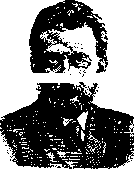
ORLOV Sergei Sergeevich (1864-1927), professor of experimental hygiene at Moscow State University. After graduating from the medical faculty of Moscow University in 1888, he worked for 2 years as a sanitary statistician in the Moscow provincial zemstvo. In 1890, at the invitation of F. F. Erisman, he went abroad, where he studied the methodology of sanitary-hygienic research in Zurich and Munich. In 1891, O. took the position of laboratory assistant at the hygiene institute of Moscow University and simultaneously
worked at the Moscow city sanitary stationg organized at the same hygiene institute. In 1910, O. was elected professor to the department of hygiene at Moscow University, which he held until his retirement in 1924. From 1924 to 1927, O. worked as a consultant and deputy director at the San.-hyg.
^tt^fe.4 № institute of the People's Commissariat of Health of the RSFSR. O. actively participated in the work of the Scientific Medical Council of the People's Commissariat of Health and was one of the most active members in developing current problems in the field of public nutrition. O's scientific works (more than 30) relate mainly to issues of the methodology of sanitary-hygienic research of food products and items of common use [these works were published in the reports of the Moscow sanitary station (1894-1905), edited by Erisman, Bubnov, and Orlov himself]. All these works are of an experimental nature and provide scientific illumination of the practical suitability of one or another analytical method. O's dissertation, "Ground waters of Moscow and its cemeteries" (M., 1905), addresses the question of the influence of sewerage on the processes of self-purification of urban soil and groundwater and contains valuable material for subsequent researchers of the same question. ORNITHODORUS,a genus of ticks of the family Argasidae of the superfamily Ixodoidea. The body is thick without a sharp boundary on the sides between the dorsal and ventral sides. They inhabit hot and warm countries. In the USSR, they are found in the Caucasus (up to Makhachkala) and in Central Asia (up to the southern part of Kazakhstan). O. moubata
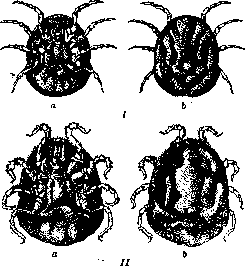
Figure 1. Ornithodorus moubata: I-male; II-female; a-from the ventral side; b-from above. (fig. 1) (tropical Africa) lives in the huts of natives and on caravan paths, during the day burying itself in dust or hiding in the cracks of buildings. It attacks mammals, birds, and humans and sucks their blood. In humans, it is a carrier of African relapsing fever (Treponema Duttoni). O. Savignyi is rarer in Africa and India. In the USSR, O. papillipes (fig. 2); ♀ 7.8-8.2 × 4.3-5 mm, ♂ somewhat smaller. Dark gray in color, with a shagreen-structured chitin. O. lahorensis (fig. 3) is much larger: the size of its body in ♀ up to 11 × 6.2 mm. The chitin cover has a star-like structure. O. papillipes lives in livestock premises, yurts, houses in the burrows of wild boars. It attacks hosts at night. It sucks blood for a long time (up to 40 minutes). The blood-sucking procedure
Figure 2.
Figure 3.
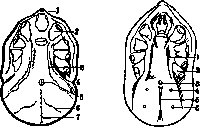
Figure 2. Ornithodorus papillipes-female from the ventral side: 1-rostrum; 2-coxa; 3-coxal fold; 4-lateral body emargination; 5-anus; 6-postanal groove; 7-anomarginal groove. Figure 3. Ornithodorus lahorensis-female from the ventral side: 1-coxal fold; 2-coxa; 3-anus; 4 and 5-disks corresponding to the sites of muscle attachment; 6-anomarginal groove. for humans is painless. On the skin at the site of the puncture, a hemorrhagic papula quickly develops-a characteristic sign of the bite of O. papillipes. It does not winter on animals, as it is quite resistant to cold. It is a carrier of the causative agent of Central Asian tick-borne relapsing fever-Spirochaeta sogdiana (Latyshev, Moskvin, Nicolle, Anderson). Infection occurs through the saliva of the tick when it sucks human blood (Moskvin, Pavlovsky). O. lahorensis in the nymph stage winters on host animals-camels, sheep, cows, and other animals. In the spring, it drops off them and molts into imago. They live in cracks in the walls of livestock premises. The development cycle of O. lahorensis-egg, larva, nymph I, nymph II, imago. O. lahorensis is attributed with the ability to spread Persian relapsing fever; Pavlovsky's experiments led to negative conclusions, as it was not possible to obtain infection with relapsing fever in guinea pigs by feeding them nymphs or adult ticks. From other Ornithodorus in the USSR and the adjacent Persian strip are known: O. Kholodkovskyi (Central Asia), O. canestrinii (Tehran, Tash-Burun), O. taleje (Armenia), O. talajevar. coniceps (Aral Sea?). In addition, there are new species living on various wild animals (described by Pavlovsky). Questions of prevention of tick-borne recurrens in the USSR are resolved along the line of protecting humans from the bite of O. papillipes (mosquito nets on beds, avoid staying overnight in adobe buildings of native type, put the legs of the bed in tin cans with water and kerosene; see also Relapsing fever). Among measures to combat the tick itself, chloropicrin is mentioned (Latyshev and Troitsky), the dose of which in a concentration of 1:100,000 (10 cm& per 1 m3 of room) kills ticks.
Related articles
Mentioned in
Cite this page
“ORLOV.” Soviet Medical Encyclopedia. English translation of Bolshaya Meditsinskaya Entsiklopediya, 1st ed. (Moscow, 1928–1936), ed. N. A. Semashko. https://sovietmedicalencyclopedia.pages.dev/article/orlov/