Kettle
Historical document, translated for reference. It reflects medical knowledge of the 1920s–30s and is not medical advice.
Summary
This article from the 1928–1936 Soviet medical encyclopedia details the use of boiling water for disinfection, describing various types of kettles and their operation.
Encyclopedia article (1928–1936)
KETTLE, boiling. Boiling is applied for the purpose of disinfecting drinking water, since in boiling water (at 100°) all vegetative and some spore-bearing forms of pathogenic microorganisms die within a few minutes. This measure has special significance during epidemics of intestinal diseases: cholera, typhoid fever, dysentery, as well as when using drinking water of doubtful sanitary quality. Disinfection of water by boiling takes place both in peacetime and in wartime conditions, for supplying individual concentrations, groups, and masses of the population, namely: in factories, plants, railway stations, places of public catering, dormitories, barracks, educational institutions, orphanages, medical-sanitary institutions, in marches, camps, work teams, in work outside populated places (field, earthworks, etc.), expeditions, sanitary trains, steamships, etc. Boiling of water is carried out in special devices, kettles of various types: stationary, portable, and mobile. According to the nature of action, kettles are of periodic and continuous action (the latter are preferable). Materials for the manufacture of kettles can be: tin, tinned or galvanized iron, copper, and aluminum. When choosing a material, questions of a technical and economic nature play a role (strength, lightness, cheapness of manufacture and operation); sanitary requirements here reduce to the fact that the iron and copper on the surfaces in contact with water must be covered with tin; in the case of aluminum this is not required. Of stationary kettles, the simplest and most primitive is the well-known cube, built into a special hearth. Its main disadvantages are as follows: interruption of action, uneconomical consumption of fuel, and inaccessibility of internal parts for cleaning and repair (necessity of disassembling the hearth). The type of stationary kettle with continuous action is the so-called tavern kettle (Fig. 1), consisting of separate sections (batteries) with a productivity of 350–600 liters per hour and also built into the hearth. Feeding of the kettle is carried out continuously and automatically, as the boiling water is drawn off; boiled water is obtained with proper drawing, corresponding to the productivity of the kettle. Cleaning of the kettle from scale can be carried out without disassembling the hearth through special hatches. Continuity of action and the possibility of cleaning without disassembling the hearth are advantages of this device. When steam is available, kettles with a coil are installed (in factories, steamships).kettle

Portable kettles are subject to the following requirements: in design they must be simple, easily repairable in case of damage or formation of scale, must be compact, not too heavy, economical in fuel, reliable in boiling, and inexpensive. The simplest portable kettle is the samovar made of tin or galvanized iron. Of other systems of portable kettles, the systems of Orlov, Boryu, Bessonov, Seppe-Petukhov ('Titan') and others are best known. They are built with a productivity of 600–1,000 and more liters per hour. In kettles of these systems, in order to increase the heating surface, the furnace, smoke flues, and tank have a complex design (Fig. 2 and 3). Water supply is continuous, automatic by means of a ball valve or float as the water is consumed. Water from the apparatus is obtained upon bringing it to a state of boiling, which is achieved by the device of a special 'consumption box', the edges of which are about 5 cm above the level of water in the kettle, into which the bubbling streams and drops of boiling water are thrown. Portable mobile kettles on wheels are also arranged (Boryu system). The disadvantages of the aforementioned portable kettles include the complexity of their design, insufficient dimensions of the parts of the tank in which the water is boiled, as a result of which there is rapid, dependent on the high content of salts in the water, formation of scale, sometimes closing the entire lumen of the tube or elbow, and the possibility of unboiled water getting into the box from which it is taken. Therefore, the operation of kettles must be under constant supervision of sanitary control. Control over boiling can be carried out by an installed thermometer (ordinary or maximum), or by sowing the water obtained from the apparatus to determine the number of microorganisms, or finally by chemical analysis of the water (raw and boiled) by determining carbonate hardness, dissolved free CO2, dissolved oxygen (O2) and concentration of hydrogen ions (pH). Upon boiling, water undergoes changes in its chemical composition depending on its origin and composition: 1) carbonate (removable) hardness decreases; 2) the amount of dissolved (free) CO2 decreases (by 60–90%); the same decrease in CO2 occurs in raw water during long storage or frequent pouring; 3) the content of dissolved O2 also decreases, but then, depending on the duration of storage and frequency of pouring, it increases again, not reaching the amount of O2 of raw water in the case of surface water bodies (rivers, lakes) and exceeds it in the case of ground water (Markaryants); 4) the concentration of hydrogen ions (pH) increases due to the evaporation of free CO2; the same is observed in raw water during its prolonged storage and pouring.
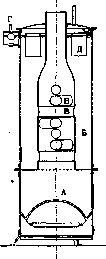
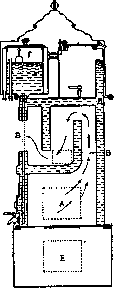
Fig. 2.
Fig. 3. Fig. 2. Continuous-action kettle: A-furnace; B-tank for preparing boiling water; C-pipes of the tank passing through the furnace; D-ball valve for maintaining the water level; E-tank for boiled water. Fig. 3. Boryu sterilizer: A-furnace; B-outer casing; C-smoke flue; D-preparation box; E-boiling kettle; F-underfire. During its prolonged storage and pouring. - A simple way to distinguish boiled water from raw (Semikoz-Markaryants method) is as follows: ordinary test tubes are filled with 0.5–1 g of NaCl and the water under study is added. In the case of raw water, a cloud of tiny air bubbles rises from the bottom of the test tube, floating to the surface and settling on the walls of the test tube. Boiled water that has stood for 4–6 hours does not give air bubbles. Boiled water that has stood up to 16 hours gives significantly fewer air bubbles than the control raw water. A conclusion should be drawn cautiously, since there is no single simple and accurate method for distinguishing boiled water from raw water. Boiled water, due to the loss of dissolved gases in it (O2, CO2), loses its pleasant, refreshing taste and sometimes acquires an unpleasant metallic taste from the vessel in which boiling takes place, and thus is disadvantageously different from raw water. In addition, boiled water is capable of faster putrefaction. Otherwise, its physiological role in human nutrition is equivalent to raw water. With these disadvantages of boiled water, one has to reconcile, considering the high degree of detoxification of it by boiling from pathogenic microorganisms. - An important sanitary moment in supplying masses of the population with boiled water is the question of its storage. The latter must be arranged so that the boiled water is cooled and guaranteed against subsequent contamination. Water storage must be carried out in closed, inaccessible to the consumer vessels with a tap (barrels, tanks, etc.); it is better if the latter are connected directly to the kettle by a tube and do not require manual pouring to fill them. - Boiling is also used in cooking food for the purpose of preliminary preparation for better assimilation by the organism, as well as for disinfection purposes (see), especially with the addition of certain chemical agents (soda, soap) increasing the disinfecting capacity of boiling. Disinfection by boiling is carried out in special devices - buchilniks (see). In addition, boiling is applied in sterilizing canned goods and for disinfecting meat in certain contagious animal diseases (tapeworm, etc.) with the aim of making it suitable for food.
Related articles
Mentioned in
Cite this page
“Kettle.” Soviet Medical Encyclopedia. English translation of Bolshaya Meditsinskaya Entsiklopediya, 1st ed. (Moscow, 1928–1936), ed. N. A. Semashko. https://sovietmedicalencyclopedia.pages.dev/article/kettle/