PAVEMENT
Historical document, translated for reference. It reflects medical knowledge of the 1920s–30s and is not medical advice.
Summary
This article describes the technical, economic, and sanitary requirements for urban pavements in the 1930s Soviet Union, comparing different types of road surfaces including shosse, granite cobblestone, wooden block, and asphalt pavements.
Encyclopedia article (1928–1936)
PAVEMENT, upper covering of durable materials for roadways, streets, squares, courtyards, etc. Pavement is installed mainly to facilitate transportation; it is absolutely necessary with any developed traffic. Especially heightened requirements are now placed on pavement in connection with the development of automobile traffic. The main technical requirements for pavements are: 1) to be convenient for driving, 2) not to cause damage and rapid wear of vehicles, 3) not to wear out quickly and not to require frequent repairs. Every type of pavement must also satisfy economic requirements, i.e., not cause large expenses in operation, and correspond to the type of traffic (horse-drawn, auto-, mainly freight, passenger, mixed). In addition to technical and economic requirements, pavement must also satisfy sanitary requirements. 1. Pavement should protect the soil from contamination by animal excretions, dirty water, waste, etc., i.e., the paving material should ensure the impermeability of the pavement. 2. The pavement should serve as the PAVEMENT
beginning of structures for draining surface water, which is necessary both for protecting the soil from contamination and for combating soil waterlogging; therefore, the pavement must have a correct and uniform slope both transversely and longitudinally, ensuring water drainage. The size of slopes varies depending on the terrain, as well as on the paving material; asphalt pavements allow the smallest slopes, while pavements with rough surfaces (cobblestone) allow the largest; accepted slopes for transverse profiles are 1-4°, for longitudinal profiles are 1-10°, although larger slopes are also encountered as exceptions. 3. The surface of the pavement should not produce large amounts of dust, for which it should be smooth, consist of materials that are not easily worn, and ensure convenient and rapid street cleaning. 4. The pavement should not produce noise when driving over it. All these technical, economic, and sanitary requirements can be met by various types of pavements, the choice of which depends on a number of local conditions: purpose of the roadway (transit highway with heavy freight traffic, residential street, auto- and horse-drawn traffic), availability of financial and technical resources in the city, proximity of local building materials, etc. Cities of Western Europe and America have long since embarked on the path of covering roadways with improved types of pavements, with stone cobblestone, all kinds of asphalt, and also concrete (for intercity automobile traffic) being most widespread abroad. Paving with clinker bricks is also gaining a foothold. Cities of the USSR are extremely backward in regard to their roadways. A significant part of urban roadways in the USSR usually remains completely without any covering, and the most common method of paving is cobblestone, which very poorly satisfies the above-mentioned basic requirements. According to data from the NKVD in the RSFSR by early 1925, 11.7% of all cities had no pavements at all, and in the rest only 21% of street area was paved. Types of pavement. Shosse. The simplest type of road paving is the construction of shosse. The construction consists of the following: first, a foundation of sand is laid with a thickness of 15-20 cm, on top of the foundation crushed stone is poured with a layer also about 20 cm thick, the spaces between the crushed stone are filled with fines - screenings from sifting crushed stone or fragments from stone crushing. On top, the shosse is covered with sand and rolled with a roller while being moistened with water. Its disadvantages are: 1) lack of durability, since individual crushed stones are not tightly connected to each other, during movement their connections are disrupted, from the movement of wheels friction occurs between parts, crushed stones can be torn to the surface by horse hooves; 2) dust formed from the wearing of the surface; 3) the presence of so-called "berms", i.e., the uncovered side parts of the roadway, which are necessary to give support and stability to the pavement. Shosse is unacceptable due to these disadvantages for paving city streets, as well as roads with predominant automobile traffic. - Gudronirovannoye shosse. To improve the quality of shosse, its surface is subjected to gudronirovaniye, i.e., it is covered with a layer of gudron (from French goudron - resin) or natural or petroleum bitumen. They distinguish between surface gudronirovaniye, in which a ready shosse is covered on top with hot resin, and deep gudronirovaniye, in which a mixture of crushed stone and resin is prepared in special apparatuses (kettles) and this mixture is distributed over the road surface. The latter method gives the best results. Gudronirovaniye gives strength to the shosse surface and prevents dust formation. With proper maintenance, gudronirovannoye shosse is acceptable for residential streets with average traffic, as well as for suburban, mainly automobile traffic. - Stone pavements. The worst type is the simple cobblestone pavement (fig. 1), made from large stones - cobblestones, laid on a sand foundation. The joints between cobblestones are filled with crushed stone, fines, and sand. The disadvantages of cobblestone pavement are the lack of durability of the foundation, unevenness of the surface, permeability to liquids, abundance of dust, noise. All these disadvantages are eliminated when constructing a pavement from granite cobblestone, which has a regular shape, due to which the stones fit tightly against each other. Cobblestone (fig. 2, 5, 6 and 7) is large (12x25x15 cm), medium - "bruckenstein" and small - "kleinpfleister" (cubes 6-8 cm in size). Cobblestone must be laid on a solid concrete foundation, since a soft sand foundation quickly causes disruption of the pavement surface and the phenomenon of so-called "cobblestone wear", in which the edges of the stones become rounded and the joints between them increase. The joints between stones should be filled with asphalt, gudron, or cemented to create an impermeable pavement. In the USSR there are huge deposits of stone on Lake Onega, so-called diabase, which serves as an excellent material for cobblestone. - Wooden cobblestone - end-grain pavement, made from pine blocks on a concrete foundation with joints filled with gudron, also has its advantages, including noiselessness (fig. 3). But it is expensive, less durable, and requires very careful maintenance. Asphalt pavements. Among various improved pavements, those made of asphalt (fig. 4) best satisfy sanitary and technical requirements. Asphalt (see) - a natural mixture of bitumen with limestones. It is used in the form of tamped, cast, and synthetic asphalt. For all types of asphalt pavements, a concrete foundation is necessary. Tamped asphalt is used in the form of powder, which is heated, distributed over a concrete foundation, after which it is tamped and rolled. Cast asphalt - a mixture of bitumen with mineral rock, sand, mel-
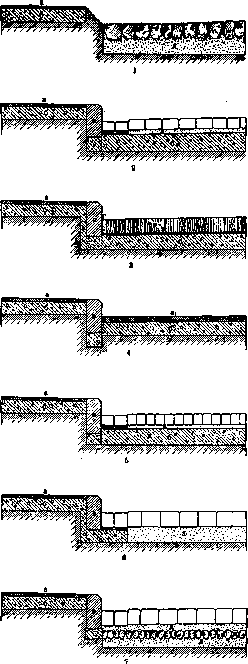
Types of pavement coverings. 1. Transverse profile of cobblestone pavement. 2. Transverse profile of "bruckenstein" pavement with cement-filled joints. 3. Transverse profile of end-grain pavement with cement-filled joints. 4. Transverse profile of asphalt pavement. 5. Transverse profile of "kleinpfleister" pavement with sand-filled joints. 6 and 7. Transverse profile of cobblestone pavement on sand foundation and on cobblestone foundation, a-asphalt sidewalk; b-concrete foundation of sidewalk; v-curb stone; g-sand joint; d-sand foundation of pavement; e-cement cushion; f-cobblestone foundation under pavement.
with gravel—in a molten state is distributed over a concrete base. The disadvantages of asphalt pavements—their slipperiness for horses during frosts and their ability to soften in summer due to high temperature—forced a transition to so-called synthetic asphalt, i.e., the manufacture of artificial mixtures of asphalt and sand, asphalt and crushed stone (asphalt concrete), etc. With skillful selection of material in the necessary proportions, very good results can be achieved. From a sanitary standpoint, asphalt pavement provides the best roads: absence of dust, smoothness, impermeability, noiselessness. In practice, not only natural bitumen from ore is used, but also artificial bitumen, obtained during the processing of petroleum. Recently, pavements made of clinker, manufactured from clay that melts at a very high temperature, have begun to gain popularity. Bricks made from such clay are distinguished by their durability and are a good material for paving. Furthermore, technology provides many other materials that are used for paving: various types of artificial stone 'vulcanol', slag from incinerators (in the form of slag concrete or slag asphalt), and a number of others. All these materials, before finding wide application, must be tested both in technical and sanitary respects. Data on the service life of various pavements, i.e., the time after which repaving is required, are as follows: cobblestone pavement—3–7 years, wood block pavement—7–10 years, cast asphalt—up to 25 years, Kleinpflaster—40 years, granite paving stones—50 years. In the total sum of expenses for urban improvement, paving constitutes a very large and often dominant part. At the same time, in the general system of measures for the sanitation of cities, paving plays a very significant role. Expenses for paving are primarily determined by the size of the surfaces subject to paving. Previous city plans of the USSR usually suffered from exaggerated sizes of the street network in terms of density, length, and width. These shortcomings of old planning create exaggerated surfaces requiring paving, and often lead to expenses that are unbearable for municipal services. Striving for economy, cities often choose less perfect and cheaper types of paving, which invariably turn out to be very expensive to operate. The sanitary significance of paving is thereby lost, intra-city transport suffers losses, repairs are frequent, and maintaining such pavements in good condition proves impossible. Both in technical and sanitary respects, it is rational to use part of the street area for lawns and plantings, leaving only the intervals of truly necessary width for roadways. In accordance with this, paving should be carried out according to properly developed projects (general planning, selection of types, routing, longitudinal and transverse profiles, slopes, intersection layout, etc.). The proper organization of urban paving requires 1) a reduction in the excessive density, length, and width of streets and roadways;


2) proper technical design of streets and the paving itself; 3) the use of durable foundations; 4) the use of a more perfect type of paving. All these requirements lie in the plane of both the economy and the hygiene of cities.
Related articles
Mentioned in
Cite this page
“PAVEMENT.” Soviet Medical Encyclopedia. English translation of Bolshaya Meditsinskaya Entsiklopediya, 1st ed. (Moscow, 1928–1936), ed. N. A. Semashko. https://sovietmedicalencyclopedia.pages.dev/article/pavement/