Extraction
Historical document, translated for reference. It reflects medical knowledge of the 1920s–30s and is not medical advice.
Summary
Extraction is the process of removing a substance from a mixture using a liquid solvent. This method is widely used in pharmaceutical preparation and various fields of chemistry and technology.
Encyclopedia article (1928–1936)
Extraction, the removal of a substance with the help of a liquid solvent from a mixture of substances. Leaching (Auslaugen), the preparation of extracts, tinctures, macerates, infusions, digests, and decoctions—all these are particular types of extraction. Solid mixtures of substances, various plant materials, animal organs (fresh or dried), or solutions can be subjected to extraction. Extraction can be performed at ordinary temperature, with heating, or with boiling. The solution obtained as a result of extraction and separated by some method from the undissolved substance is called an extract. Extraction is widely used in the preparation of medicinal substances and in all fields of chemistry and technology. In the laboratory, extraction of solid substances is carried out in all sorts of vessels: beakers, flasks, bottles with stoppers. Extracts from organs (it is preferable that the organs be previously crushed) are often prepared in mortars by grinding with sand or in kettles. Extraction apparatuses are also used (see below). Decantation, filtration, or pressing on presses are used to separate the extract from the residue. In pharmacies, pharmaceutical extracts are prepared in special apparatuses (see Infusum, Infusion apparatus). In technology, to avoid having to evaporate the solution strongly later, consuming much fuel for this, they try to prepare as concentrated an extract as possible with a small amount of solvent. For this purpose, the principle of countercurrent is used, implemented in special installations. They consist of a system of iron (or other) cylindrical kettles (in sugar beet production—diffusers), into which the material to be extracted is loaded and through which the extracting liquid (often water) flows. The liquid passes from one kettle to another with such a calculation that on its path it encounters increasingly fresh portions of material and gradually becomes saturated with soluble substances to the maximum. On pharmaceutical factories, enormous extraction apparatuses are used to obtain various preparations (see Extracts). When extracting a substance present in a solution, the following should be kept in mind: 1) only liquids that do not mix with the solvent can be used for extraction; for example, in the case of an aqueous solution, ether or chloroform can be used, but not alcohol; 2) in extraction, the distribution law applies, according to which in the case of a system of two immiscible solvents, the dissolved substance is distributed between them such that its concentrations in the solvents are in a certain and constant ratio (distribution coefficient), specific to these solvents and the substance and independent of the absolute concentrations of the substance. The distribution coefficient basically determines the speed and completeness of extraction. The simplest way to extract from a solution is to shake it with the appropriate solvent in separatory or dropping funnels. After shaking, the solutions are allowed to stand and separate, and then the lower layer is first poured from the funnel spout, and then the upper layer through the upper opening. This process is called "shaking" or "agitation" (Ausschiittelung). Multiple shaking each time with a small amount of extracting liquid extracts the substance much more completely than a single shaking with the total amount of solvent used in the first case. Knowing the distribution coefficient, it is easy to calculate the amount of remaining unextracted substance after the nth extraction using the formula: ""= a K^T^J where v is the volume of the main solution, va is the volume of added solvent, a is the amount of substance in the main solution, k is the distribution coefficient, x is the amount of substance remaining in the main solution. Saturation of the aqueous solution with common salt before extraction reduces the solubility of substances in water and thus promotes better extraction. In the case of poorly soluble substances or an unfavorable distribution coefficient for extraction, when therefore multiple shaking would be needed for practically complete extraction, small automatically working extraction apparatuses are used in laboratories. There are many models of these latter, but their basic design principle is the same and consists of the following: the solvent (extracting liquid) evaporates in a special vessel, enters a condenser, flows from there to the mixture to be extracted, passes through it, extracting parts of the extractable substance, and with it flows back to the vessel from which the initial evaporation took place. The cycle continuously repeats and gradually the extractable substance accumulates in the flask, carried by the same portion of the circulating solvent.
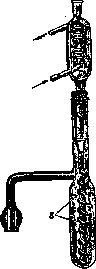
Figure 1.
Figure 2. The most common extraction apparatus for solid substances is the Soxhlet apparatus, used in all sanitary-hygienic, food, and chemical laboratories for the extraction of fats and other lipoids. Figure 1 shows a setup of two Soxhlet apparatuses for two simultaneous determinations. Since extraction is mostly performed with ether, the heating of the bath under the flasks is done not over a naked flame, but on electric devices or a water bath. Ether enters through tube a into the bulb condenser, from there to the crushed substance, placed in a special paper cartridge (can be made from several layers of filter paper; it is important that there be no holes) in the cylindrical part of the apparatus b (the edge of the cartridge should be above the siphon bend). Here the ether accumulates, impregnating the substance, until its level exceeds the siphon bend; when this happens, all the empties through the siphon back into the flask (the powder is retained by the cartridge). From the flask, the ether again enters the condenser, etc. Of the models used for extracting liquids, the Kutscner apparatus (Kutscner) (Fig. 2) is very convenient. In it, the extracting liquid (lighter than water), mostly ether, boils in flask a, drips from the condenser into the funnel, and, due to the pressure of the accumulated column of ether, passes through tube to the bottom, and then rises through the solution being extracted. At this, the drops, describing circles along the glass channel b, open
- from below, pass a long path in the solution, extracting the substance. Thus, ether accumulates in a layer on the solution l/ and flows back into the flask. Other apparatuses are also used, where ether simply rises in bubbles through the liquid being extracted, but then to intensify the extraction, the liquid is thoroughly mixed with an automatic stirrer. If a liquid heavier than water is used for extraction, which therefore will not rise to the surface (e.g., chloroform), somewhat different apparatuses must be used, e.g., the one shown in Fig. 3. In this apparatus, chloroform is first poured into the bottom of the extraction chamber; it enters the space between two tubes: one rising from the bottom, the other descending and surrounding the first. Then the liquid to be extracted is poured in from above, and chloroform into the flask, which is heated. Chloroform drips from holes in the spiral from above, passes through the liquid, accumulates at the bottom, gradually rises in the space between the tubes, and begins to overflow through the edge of the first tube.-Finally, if a substance that easily decomposes is subjected to extraction, it is sometimes necessary to cool it during the process. In this case, the extraction chamber can be moved away from the flask and placed in a vessel with ice, as, for example, is done in the apparatus proposed by Pinkus and shown in Fig. 4. Sometimes, mainly in geology and technology, the word "extraction" is replaced by "leaching"; for example, in geology, leaching of rocks implies the process of washing out easily soluble chlorides, sulfates, and to some extent carbonates from them by underground waters, as a result of which underground cavities may form. Leaching of soil can also occur under the influence of irrigation waters. In sugar beet production, leaching of beet shavings implies the process of extracting them with warm water; in soda production, leaching of the melt of sodium sulfate with lime and coal is performed with water to obtain soda.
Related articles
Mentioned in
Cite this page
“Extraction.” Soviet Medical Encyclopedia. English translation of Bolshaya Meditsinskaya Entsiklopediya, 1st ed. (Moscow, 1928–1936), ed. N. A. Semashko. https://sovietmedicalencyclopedia.pages.dev/article/extraction/