Infusion Apparatus
Historical document, translated for reference. It reflects medical knowledge of the 1920s–30s and is not medical advice.
Summary
The Infusion Apparatus is a device for preparing infusions, consisting of a water (steam) bath and an infundirka. It is used in pharmacies to extract medicinal substances while preserving volatile components.
Encyclopedia article (1928–1936)
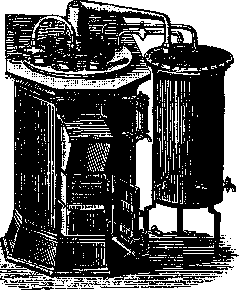
INFUSION APPARATUS, an apparatus for preparing infusions, consisting of a water (steam) bath and the so-called infundirka (fig. 1). Pharmacy infundirkas are usually made of tin or porcelain; porcelain infundirkas must be used for extractions from materials containing free acids or tannins. In order that the essential oils may not evaporate as much as possible during the infusion process (see Infusum), the infundirka must be covered with a tight-fitting lid. In pharmacies, the distillation apparatus is commonly used as a water bath, for which holes or depressions called nests are made in the lid of the still (fig. 3), into which the infundirkas are placed. With the nest system, the water of the distillation flask remains uncontaminated. Special water baths with a small amount of water are shown in fig. 2. The water evaporating in these baths during boiling condenses and flows back into the reservoir, which has the shape of a ring; therefore, the water level in the bath remains almost constant. For heating infundirkas,
Fig. 2.
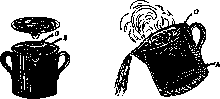
laboratory-type water baths can also be used. A rather simple infusion apparatus is also a double-walled vessel (fig. 4) with a heavy lid and an opening (O) at the edge. Water is poured into the interspace (A) to 3/4 full, and the required amount of distilled water is placed in the inner vessel (B). The entire vessel is placed directly on the fire, and the interspace serves as a water bath. The material to be extracted is placed in the inner vessel when the water in it has been heated to the boiling point.
Fig. 3.
essential I oils as much as possible !do not evaporate during the infusion process (see Infusum), the infundirka must be covered with a tight-fitting lid. In pharmacies, the distillation apparatus is commonly used as a water bath, for which holes or depressions called nests are made in the lid of the still (fig. 3), into which the infundirkas are placed. With the nest system, the water of the distillation flask remains uncontaminated. Special water baths with a small amount of water are shown in fig. 2. The water evaporating in these baths during boiling condenses and flows back into the reservoir, which has the shape of a ring; therefore, the water level in the bath remains almost constant. For heating infundirkas,
Figure 4.
laboratory-type water baths can also be used. A rather simple infusion apparatus is also a double-walled vessel (fig. 4) with a heavy lid and an opening (O) at the edge. Water is poured into the interspace (A) to 3/4 full, and the required amount of distilled water is placed in the inner vessel (B). The entire vessel is placed directly on the fire, and the interspace serves as a water bath. The material to be extracted is placed in the inner vessel when the water in it has been heated to the boiling point.
Fig. 3.
laboratory-type water baths can also be used. A rather simple infusion apparatus is also a double-walled vessel (fig. 4) with a heavy lid and an opening (O) at the edge. Water is poured into the interspace (A) to 3/4 full, and the required amount of distilled water is placed in the inner vessel (B). The entire vessel is placed directly on the fire, and the interspace serves as a water bath. The material to be extracted is placed in the inner vessel when the water in it has been heated to the boiling point.


Related articles
Mentioned in
Cite this page
“Infusion Apparatus.” Soviet Medical Encyclopedia. English translation of Bolshaya Meditsinskaya Entsiklopediya, 1st ed. (Moscow, 1928–1936), ed. N. A. Semashko. https://sovietmedicalencyclopedia.pages.dev/article/infusion-apparatus/