Tableware
Historical document, translated for reference. It reflects medical knowledge of the 1920s–30s and is not medical advice.
Summary
This article discusses tableware used for collecting, storing, transporting, preparing and serving food and other products. It covers historical development, materials, production statistics, and sanitary requirements for different types of tableware in the Soviet Union.
Encyclopedia article (1928–1936)
TABLEWARE, utensils used for collecting, storing, transporting, preparing and serving both ready-made food and other products of food and non-food character. Tableware has the greatest sanitary significance in the food industry, in public catering establishments, and in domestic household use. In prehistoric times, the prototype of modern tableware was animal skins, which were used as vessels for storing water or for cooking food by placing hot stones in the skins with water. In the Neolithic era (New Stone Age), pottery production arose and developed. Ancient clay vessels were made from coarse clay with an admixture of small stones and usually had the shape of half an eggshell, then vessels with flat bottoms appeared; over time, vessels began to differ in artistic completeness: punctures, protrusions, colored painting, handles, variety of forms :-cups, bowls, jugs, etc. In the age of metals (bronze and iron), tableware became even more diverse and was already made from different metals or alloys of them. At present, the production of tableware in the USSR is very widespread, and along with the presence of large factories, there is also artisanal production. To characterize the need for tableware, the following figures can be given. According to Vsekopit, the demand for metal and wooden tableware for 1932 is expressed (selectively): aluminum bowls-446,648 pieces, wooden spoons-80 million, enameled cups-2,485,290 pieces, enameled bowls-4,400,000 pieces, metal table spoons-5,437,680 pieces, metal tea spoons-5,197,190 pieces, metal serving spoons-160,318 pieces, tinned cast iron pots of various sizes-22,800 pieces, tinned iron pots-71,993 pieces, kettles-10,000 pieces, meat grinders-12,731 pieces, thermoses-28,420 pieces, etc. According to an approximate calculation by the Institute of General Nutrition (Moscow), when public catering covers 25 million people according to the resolution of the CC VKP(b) of 19/VIII 31 within 2-3 years 1) with an assortment per person: deep plate, small plate, appetizer saucer, glass, two tea spoons, table spoon, fork, knife, glass or saucer for sweets, 2) additionally for four people: water pitcher, bread plate, salt shaker, mustard pot with spoon, pepper pot, 3) provided that the duration of the meal is 20 minutes, cleanup after the meal-10 minutes, washing, drying and preparing tableware for the second shift of diners-30 minutes (i.e., counting 2 sets per person per shift)-the following amount of tableware will be required (Table 1). Table 1. Required amount of tableware for public catering establishments with coverage of 25 million diners. San.-hygienic requirements for tableware: 1) Tableware should have few depressions, ribs, decorations, be as smooth as possible on the outside and especially on the inside, so that it can be easily cleaned and washed; 2) the material from which the tableware is made should not dissolve in food and should not have a harmful effect on human health or spoil the taste and appearance of food; 3) the contents of the tableware should not be absorbed into the walls of the tableware. Batches of tableware arriving from factories should be examined in special laboratories to determine their sanitary suitability. Materials for tableware and utensils can be a) metals: silver, gold, aluminum, lead, iron, copper, nickel, tin, zinc and various alloys, b) minerals: clay, faience, porcelain, stone, glass, marble, c) wood, d) rubber, e) paper, f) bone, g) leather, h) hair, i) fabrics. Some of these metals can be poisonous to humans (lead, copper, zinc) and spoil the taste and color of dishes (for example, iron tableware); some materials due to their porosity absorb the contents into their walls (for example, faience, porous stone, bone, wood, leather, etc.), as a result of which maintaining the cleanliness of tableware becomes impossible. If the tableware material does not meet the listed requirements, but is covered on top with a harmless insulating layer, then such tableware is permissible from a sanitary-hygienic point of view. Thus, sanitary-hygienic requirements should be applied not only to the main mass of the material, but also to the covering layer, which includes: glaze, tinning, enamel, coloring. When evaluating tableware hygienically, one should also take into account the fact that the contact of food with the walls of tableware can last for different times; the shorter this time, the less the tableware material affects its contents. For example, one cannot allow zinc tableware due to its toxicity for preparing or storing food, but at the same time, there are no objections to galvanized dishwashing sinks. Table 2 shows from which materials tableware and utensils are made, with indication of under what conditions and in what products a given material can be used. Analyzing Table 2, the following conclusions can be drawn: 1. Tableware and utensils made of noble metals, aluminum, tinned iron, tinned copper, nickel, from various alloys, silver-plated or nickel-plated, glazed porcelain, glazed faience and colorless glass are widely used and are permitted from a sanitary-hygienic point of view in the most diverse products. 2. Lead, stone, rubber, gutta-percha and leather tableware and utensils are not permitted under any conditions and in any products. 3. All other materials have only limited application: iron-only for products where the contact of iron with the product or dish lasts for a very short time (scoops, shovels) or does not affect the quality of the product (baking sheet); any enameled tableware is permitted only for storing cold dishes, foodstuffs and products to avoid cracking and chipping of enamel; the scope of wooden items is limited only to spoons, rolling pins, bread cutting boards, etc., where without. Table 2. Permissibility of use of tableware and utensils depending on the material.
Enamel-coated cast iron Plates, saucepans, bowls, pots, thermoses, spoons, frying pans Various items Only disposable napkins Glasses for drinking water, fruit and berry waters for single use Paraffin and parchment must meet standard requirements (OST No. 3 526) Sifts for straining Due to fragility, short lifespan and very poor quality of glaze, not permitted in public dining rooms; permitted in household use Not permitted (toxicity of impurities or inability to maintain cleanliness) Rolling pins, pushers, bread cutting boards, graters, barrels, chests, kitchen sieves, spoons for mashing, spoons for eating Only eating spoons permitted Not permitted, except for baking sheets (spoilage of taste, color, etc.) Milk cans, tanks and water containers, molds, graters, tea strainers, butter jars, cutters for dough and roots, whisks, sieves, funnels for coffee makers, meat hooks, scoops for cereals, flour; cooking pots Not permitted, except for water buckets, for washing tubs, for washing dishes (toxicity) Rinsing cups, funnels for coffee makers, basins Not permitted (porosity, brittleness) Not permitted (toxicity of impurities or inability to maintain cleanliness) Not permitted (inability to maintain cleanliness) Not permitted, except for mustard and ice cream spoons (porosity, inability to maintain cleanliness) Not permitted, except for cups (plates) for portion weighing scales, pots for cooking semi-finished confectionery products (toxicity) Pots, saucepans, casseroles, thermoses, samovars, saucepans, trays, various spoons for pouring (but not for eating), sieves, ice cream makers, mortars, bowls for kissel and compote, molds, ladles, skimmers, spoons for serving ice cream, baking sheets, kitchen forks, tanks and water containers Sinks for T. and various products Pots, casseroles, ladles, bowls for kissel and compote, cooking steam boilers, water tanks Not used Not permitted, except for mustard and ice cream spoons (porosity, inability to maintain cleanliness) Not permitted (toxicity) Not permitted (toxicity) Tongs, tea strainers, wire whisks Table spoons, serving spoons, trays, casseroles, ladles, skimmers, scoops and spatulas for pastries and garnishes Knives, meat grinder knives, meat grinder graters, forks, corkscrews, scrapers, mops, coffee mill burrs, spits Glasses, sugar bowls, carafes, pitchers, egg glasses, salt shakers, pepper shakers, mustard pots, shot glasses, yogurt pots, vases, milk jugs, sugar bowls Not permitted, except for bottles meeting the standard (OST No. 163 and 472) [possibility of toxicity (arsenic) and inability to maintain cleanliness] Not permitted (porosity, roughness) Not permitted (porosity, roughness) Plates, saucers, platters, cups, teapots, sugar bowls, cream pitchers, milk jugs, salad bowls, sauce boats, milk pitchers, carafes and pitchers for milk, salt shakers, mustard pots, pepper shakers, egg glasses, yogurt pots, mortars, vases, sugar bowls, tanks and water containers, sinks for T. and various products Not permitted (toxicity) Meat grinders, cooking pots Frying pans, roasting pots Pots and pans for storing and preparing cold dishes o»2 wood cannot be avoided and where contact is very short; paraffin-coated or parchment paper T.-only for single use, etc. 4. Lead-glazed T. is not permitted because if the lead glaze comes off, it can cause poisoning, especially with acidic or fatty products or dishes. 5. Sometimes a completely harmless material may be unsuitable for making certain T., e.g., glazed porcelain or faience are unsuitable for water carafes, because through opaque walls one cannot judge the color and external appearance and cleanliness of the water, etc.-From the individual requirements for T. and utensils depending on the material, the following should also be mentioned: the entire object should, as far as possible, consist of the same material; if this condition is not met, individual parts of the object (lids, handles) should be made only from permitted material, e.g. lids for glazed porcelain or faience pitchers can be made from silver-plated or nickel-plated alloys, handles for strainers, kitchen knives-from wood. Table forks and knives are better made with metal rather than wooden handles, because constant temperature changes during washing very quickly damage the integrity of wooden parts and thus create an inability to maintain proper cleanliness; knives and forks are better made of non-oxidizing (stainless) steel. The shape of T. and utensils is the most diverse. Establishing a certain standard in relation to shape seems extremely difficult. In relation to individual parts of T. or individual items, the following rules should be adhered to: 1. T. and utensils should have fewer depressions, ribs, decorations, etc. (Fig. 1); places where the bottom touches the body should be rounded as much as possible (cylindrical pots, boilers, etc.). 2. Boilers, measuring vessels, spoons should, as far as possible, have a hemispherical shape, at least near the bottom. 3. T. and utensils should have permanent or removable handles adapted in such a way that the worker cannot burn themselves and can freely carry or move the object. 4. Small items, such as salt shakers, mustard pots, pepper shakers, etc., must necessarily have lids and be closed in such a way that the visitor cannot take their contents with their fingers.-The size of small T. (plates, cups, etc.) should be such that a full portion can fit freely in the T.-The covering (insulating) layer - see Glaze, Tinning-Color coating-application of paint inside on material of various T. and utensils-due to possible toxicity, as well as instability of the layer and obscuring the true state of objects, as a rule is not permitted, with some exceptions, namely: painting of wooden spoons, painting of iron tanks used for storing water, with natural iron red lead, etc.-Paraffining is permitted in cases where paraffin cannot melt and penetrate into the food product.-Pergament T. from parchment paper must meet standard requirements (see OST 3 526). Washing and storing T. and utensils. Maintaining cleanliness of T. and utensils is the main requirement of hygiene: dirty T., poorly washed, with a fatty layer, with dried food residues, besides epidemiological danger, produces an unpleasant impression on the consumer and causes disgust, which also affects the digestibility of food. For washing and cleaning T. and utensils, sand, ash, brushes, scrapers, hot water and soda solution are used. T. and utensils on which adhered crusts have not yet had time to form are easily washed, and then there is no need to resort to sand and other substances, the use of which strongly abrades the covering layer of T. or utensils and often exposes the toxic base material of T. From a sanitary-hygienic point of view, it is recommended to wash T. in a hot 2% soda solution with soap and then rinse with hot water (plates, cups, glasses, saucers, forks, spoons, knives, tinned and enameled T.)-Aluminum T. darkens when washed with soda (effect of alkali) and loses its appearance. Cast iron frying pans are not washed, but calcined on an open fire with wiping them with table salt. Washing should be done in marble, cement, glazed porcelain, glazed faience and galvanized containers, but not in wooden barrels or tubs. Machine washing of T. is: 1) conveyor, e.g. Alexanderwerk system [the machine consists of 2 tanks (Fig. 2) and a conveyor with inserts, Fig. 2. Dishwashing machine: 1-tank for water with temperature 50-60°; 2-the same with temperature 90°; 3^~conveyor chain; 4-inserts for plates.]
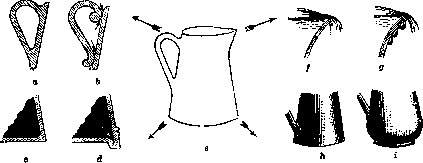
The shape of tableware and utensils is extremely diverse. Establishing a specific standard for shape appears extremely difficult. Regarding individual parts of tableware or specific items, the following rules should be adhered to: 1. Tableware and utensils should have fewer depressions, ribs, decorations, etc. (Fig. 1); areas where the bottom contacts the body should be rounded as much as possible (cylindrical pots, boilers, etc.). 2. Boilers, measuring vessels, and spoons should, as far as possible, have a hemispherical shape, particularly near the bottom. 3. Tableware and utensils should have permanent or removable handles designed in such a way that workers cannot burn themselves and can freely carry or move the object. 4. Small items, such as salt shakers, mustard pots, and pepper shakers, must necessarily have lids and be closed so that customers cannot touch their contents with their fingers. The size of small tableware (plates, cups, etc.) should be such that a full portion can fit freely in the item. The covering (insulating) layer - see Glaze, Tinning. Color coating - the application of paint inside on various tableware and utensils - due to possible toxicity, as well as the instability of the layer and the obscuring of the true condition of items, is generally not permitted, with some exceptions, namely: painting wooden spoons, painting iron tanks used for storing water with natural iron red lead, etc. Paraffining is permitted in cases where paraffin cannot melt and penetrate into the food product. Parchment tableware made from parchment paper must meet standard requirements (see OST 3 526).
Washing and storing tableware and utensils. Maintaining cleanliness of tableware and utensils is the primary requirement of hygiene: dirty tableware, poorly washed, with a fatty layer, with dried food residues, besides epidemiological danger, creates an unpleasant impression on the consumer and causes disgust, which also affects the digestibility of food. For washing and cleaning tableware and utensils, sand, ash, brushes, scrapers, hot water, and soda solution are used. Tableware and utensils on which adhered crusts have not yet had time to form are easily washed, and then there is no need to resort to sand and other substances that strongly abrade the covering layer of tableware or utensils, often exposing the toxic base material. From a sanitary-hygienic point of view, it is recommended to wash tableware in a hot 2% soda solution with soap and then rinse with hot water (plates, cups, glasses, saucers, forks, spoons, knives, tinned and enameled tableware). Aluminum tableware darkens when washed with soda (effect of alkali) and loses its appearance. Cast iron frying pans are not washed but are calcined on an open fire with wiping them with table salt. Washing should be done in marble, cement, glazed porcelain, glazed faience, and galvanized containers, but not in wooden barrels or tubs. Machine washing of tableware is: 1) conveyor, for example, the Alexanderwerk system [the machine consists of 2 tanks (Fig. 2) and a conveyor with inserts].
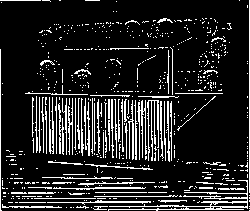
Fig. 2. Dishwashing machine: 1-tank for water with temperature 50-60°; 2-the same with temperature 90°; 3^~conveyor chain; 4-inserts for plates.
for plates; duration of washing and drying up to 1.5 minutes] and 2) cabinet-type of periodic action, e.g., Crescent system; the cabinet has showers arranged at the top and bottom. The washing process itself consists of three phases: a) removal of food residues, b) washing and rinsing, and c) drying. Washing and rinsing of cleaned tableware is done with hot water at t° 50-60° in manual washing and at 50-60° in the first tank of mechanical washing and 90° in the second tank (rinsing). Washing water is drained as it becomes dirty and is discharged through drain holes in the tank. Washing of tinned tableware is done with hot water with the addition of soda using hair or vegetable brushes or sponges; the use of sand, grated brick, or emery powder should not be allowed; in case of burnt-on and adhering particles, scraping is done with wooden spatulas (not with a knife or other scratching implement). After washing, the tableware is dried and is usually placed upside down or is put and hung for storage in special closed cabinets protected from dust, moisture, and insects, especially flies and cockroaches. - Epidemiological significance of tableware. The possibility of transmitting infection through tableware, such as: syphilis, tbc, streptococci, diphtheria, and other pathogens, is quite possible. Thus, washing tableware in water up to 50° for 10 minutes and subsequent wiping does not kill live spirochetes of syphilis (Pinkus), streptococci, diphtheria bacilli, etc. Bronstein (Institute of Social Diseases, Moscow) when examining wash waters after washing tableware with ordinary water at 62-63° also found tuberculosis bacteria and obtained positive results on guinea pigs. Hemolytic streptococcus was often found on 'clean' tableware. Usually after washing tableware, the total number of microbes decreased 650-1,500 times. Particularly large numbers of microbes are found on spoons and glasses, i.e., those objects that have the closest contact with the mucous membrane of the mouth. - Poisonings from tableware can depend on the transition into food of lead, tin, zinc, mercury, arsenic, antimony, bismuth, copper. Cases of lead poisoning from beverages, the tableware for which was washed with shot, from lead syphon heads, lead wrappings of chocolate and tea, when consuming canned goods, from food cooked in boilers with tin containing lead; with fatty and acidic marinades, sauerkraut, kvass, wine, fruit drinks, etc., stored in glazed earthenware tableware. Poisonings from zinc have been noted when consuming products stored in galvanized tableware (wine, beer, compote, meat). A case of poisoning of 70 children with cranberry jelly, cooked in a galvanized vat (0.093% metallic Zn), and 40 children with compote (0.46% metallic Zn) is known. Experimental storage of cranberry juice for 2 hours in galvanized buckets gave from 0.4 to 1.876 g of zinc per 1 liter of juice; boiling cranberry juice for 1/2 hour gave 1.293 g per 1 liter (Reisler). The manufacture of kettles from galvanized iron (Resolution of the Scientific Medical Council of the People's Commissariat of Health of 12/III 1931) is permitted, provided they are made from tin galvanized by the galvanic method. - Legislation - see references to standardization in the text. There are also OSTs No. 1,790-1,799 for faience tableware: deep plate, shallow plate, round dish, small oval dish, deep oval dish, herring dish, salad bowl, faience saucer, bowl, bowl with rim - for each type a drawing and dimensions are given; No. 3,287-aluminum saucepans, capacity (2,330 cm³), dimensions and technical specifications are given; No. 2,988-aluminum cups with capacity of 0.35 and 0.55 liters - same; No. 3,320-3,326-for glass tableware for All-Animal Union: saucer, glass (capacity 225 cm³), salad bowl, vase, salt shaker, herring dish and plate; No. 3,538-3,556-for blown and pressed glass tableware of various names. There are also OSTs for bottles for vodkas and liqueurs (OST 102), grape wines (OST 472, 2,927), acetic essence (OST 2,478), beer, kvass, honey (OST 3,318) and some others.
A. Khrustalev. Sweat, a product of secretion of sweat glands, is a colorless, poor in solid components, slightly opalescent, salty-tasting liquid. Sweat contains 98-99% water, of solid substances-traces of protein (?), urea (about 0.1%), uric acid, creatinine, salts, fats, volatile fatty acids, soaps, cholesterol, salts of alkali metals (predominantly NaCl, about 0.3%), paired ester-sulfuric acids and aromatic oxyacids. Similar to urine, sweat is a product of excretion from blood primarily of water and other its easily diffusing normal ingredients. Under physiological conditions, the qualitative composition of sweat varies little. However, sweat secreted in different areas of the body shows significant fluctuations in quantitative composition and in its active reaction. This especially applies to sweat secreted in the area of the armpits and pubic areas by the so-called apocrine glands. Human sweat and that of carnivorous animals is mostly acid to litmus reaction, but can also have an alkaline reaction, usual in herbivores (e.g., after profuse sweating). The active reaction of sweat secreted over the entire body surface by the so-called eccrine glands ranges within pH=3.8-5.6; apocrine glands secrete a secretion of almost neutral reaction (pH=6.2-6.9). The most acidic is sweat secreted during profuse sweating. After prolonged secretion of sweat, its active reaction gradually approaches neutral. The specific gravity of sweat fluctuates between 1.001 and 1.006, rarely reaching 1.010. The cryoscopic index of sweat, resp. its molecular concentration, corresponds to d=-0.32°. Sweat can have a very unpleasant smell (foot sweat), caused mainly by the presence of volatile fatty acids, easily formed by bacterial decomposition of sweat. During muscular work and especially during sports competitions, sweat contains very large amounts of lactic acid (up to 500 mg% and more) and increased against normal amounts of nitrogenous substances (up to 1 g N per day). The total amount of substances excreted with sweat is determined mainly by the degree of sweating, i.e., the amount of sweat formed during the day, often reaching 800 g-1 liter, and under certain conditions even 2 liters. In this way, up to 2 g NaCl and up to 1.0 g N can be excreted with sweat. Under pathological conditions, glucose (in diabetes), bile pigments (?), cystine (in cystinuria) can be found in sweat. In uremia and choleric anuria, the amount of urea excreted by sweat glands can increase so much that it is deposited in the form of crystals on the skin. Mercury, arsenic, iron, iodine, bromine, quinine, benzoic, succinic, tartaric, hippuric, salicylic acids, salol, antipyrine, methylene blue, when introduced into the body, appear in sweat. Blue coloring of sweat has been observed from the presence of indigo, pyocyanin, ferrous phosphate. Bloody sweat (appearance of erythrocytes in sweat) is also observed, although very rarely. The cause causing the stickiness of some pathological sweats has not yet been clarified. Pathogenic microorganisms - cocci, bacilli of leprosy and typhoid - excreted by sweat glands have also occasionally been found in sweat. In infectious diseases, sweat also contains a number of little-studied poisonous substances, as it shows considerable toxicity compared to sweat of healthy, non-working subjects. (On the regulation of sweating and its significance in clinical practice - see Sweating, Diaphoretics, Diaphoretic treatment.)-Sweat glands - see Apocrine glands. Skin.
M. Vovsi.
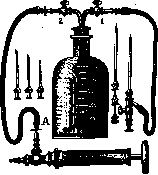
POTAIN APPARATUS (Potain) is used primarily for the aspiration of fluids from body cavities (see Aspirators). It can also be used for introducing large quantities of fluid under the skin, into a vein, and into body cavities (see Infusion). The P. a. is most commonly used for removing exudates and transudates from the pleural cavity. The P. a. consists of a graduated glass bottle with a rubber stopper through which two metal tubes pass. One of them ends at the lower edge of the stopper, while the other, onto which a rubber tube is placed, extends inside the bottle, almost reaching the bottom. Above the stopper, both metal tubes are bent at a right angle. Each of these bent branches is equipped with a shut-off cock. The long tube reaching to the bottom of the vessel is connected by means of a drainage tube to a puncture needle or trocar, while the short one is connected to a pump. The pump has a round head, equipped inside with a valve apparatus, and outside with two cannulas. One of them, the direction of which coincides with the axis of the pump, serves for forcing in air and is marked T; the other, located perpendicular to the axis of the pump, serves for creating a vacuum in the air and is marked A. To remove fluid from the pleural cavity, all parts of the apparatus are tightly connected, with the short tube connected to cannula A, cock 1 is closed, cock 2 is opened, and air is pumped out of the bottle by moving the piston in the pump. Then, with cock 2 closed, a puncture is made in the chest wall and cock 1 is opened. Due to the reduced pressure in the bottle, fluid from the pleural cavity begins to flow into the bottle. As the pumped-out air is replaced by fluid, its flow weakens and finally stops. Then cock 1 must be closed again, cock 2 is opened, and air is again pumped out of the bottle. Then, with cock 2 closed again and cock 1 opened, the flow of fluid into the bottle resumes. This is done until the bottle is full, after which it is emptied. Before emptying the bottle, it is necessary to close cock 1 to eliminate communication with the pleural cavity. If air bubbles enter the bottle along with the fluid, this indicates a loose connection of the parts of the apparatus; to eliminate this, the connection points of the parts should be greased with vaseline. A disadvantage of the P. a. is the sharply negative pressure in the bottle at the beginning of aspiration and its rapid increase as pleural fluid accumulates in the bottle. When using the apparatus for injections, the short tube must be connected to the cannula marked T, and the stopper must be secured with the lock available on the bottle's neck; otherwise, when air is forced into the bottle, the stopper may be ejected. a. Molchanov.
Related articles
Mentioned in
Cite this page
“Tableware.” Soviet Medical Encyclopedia. English translation of Bolshaya Meditsinskaya Entsiklopediya, 1st ed. (Moscow, 1928–1936), ed. N. A. Semashko. https://sovietmedicalencyclopedia.pages.dev/article/tableware/