Mustard
Historical document, translated for reference. It reflects medical knowledge of the 1920s–30s and is not medical advice.
Summary
This article from the 1928–1936 Soviet medical encyclopedia details the botany, chemical composition, and therapeutic uses of mustard plants, focusing on black and Sarepta varieties, and their application in medicine and cuisine.
Encyclopedia article (1928–1936)
MUSTARD, the name given to several species of plants from the crucifer family (Cruciferae), of which those having medical significance (Ph VII) are black mustard—Brassica s. Sinapis nigra (see figure), and Sarepta mustard—Brassica s. Sinapis juncea. Black mustard grows wild throughout Europe and is cultivated in Germany, Holland, and the southern part of the European USSR. Sarepta mustard is cultivated in Russia in the black-earth zone, especially in the Volga region (Saratov province). For therapeutic purposes, mustard seeds are used. Seeds of black mustard—ellipsoidal or almost spherical, 1 to 1.5 mm in diameter, reddish-brown on the outside, enclosing a greenish, sticky, or dark-yellow oily embryo. The outer layer of the seed coat becomes mucilaginous on contact with water. Whole seeds have no odor; when chewed, they have a sharp, pungent taste. Moistened with water, the powder emits a characteristic odor and strongly irritates the mucous membranes of the nose and eyes. The powder is light brown or greenish-brown. Seeds of Sarepta mustard have a more regular spherical shape covered with a brown, smooth coat. The powder from Sarepta mustard seeds resembles that from black mustard, but commercial Sarepta mustard is a soft flour of dark color with a slight greenish tint and is obtained from seeds deprived of their coat and freed from fatty oil. When moistened with water, a strongly smelling and strongly irritating substance for the nose and eyes is released from the powder of Sarepta mustard. When 1 g of powder of either black or Sarepta mustard is boiled with 50 cubic cm of water, after cooling and filtration the filtrate must not give a blue coloration with an iodine solution (reaction for starch admixtures). The ash content must not exceed 9% (Ph VII). According to König, the average composition of black mustard seeds is: water—6%, nitrogenous substances—28%, fatty oil—31%, non-nitrogenous extractive substances—12%, woody matter—10%, ash—5%. The most important components of mustard (black and Sarepta) are: fatty mustard oil, which has nutritional value, the glucoside sinigrin, which is a potassium salt of sinapinic acid, C10H16NS3KO4, and the enzyme myrosin. In the presence of water, under the influence of the latter, sinigrin decomposes into acid potassium sulfate, grape sugar, and volatile mustard oil—isothiocyanate, a new allyl compound that determines the irritating properties of mustard: C10H16NS3KO4 + H2O = KHSO4 + C6H12O6 + CH3NCS. There is no ready essential oil in mustard seeds. In good varieties of mustard, the amount of volatile mustard oil formed can reach 1.4% of the weight of the seeds; but usually less is obtained, on average (according to Caesar and Loretz)—0.67–0.87%. According to Ph VII this amount must not be less than 0.69%. Seeds and mustard powder must be stored in a dry place, in well-closed tins. According to therapeutic action, mustard oil, as well as mustard preparations in which it is the active principle, belong to the group of skin-irritating substances, mustard oil being capable of penetrating through the skin as an irritating and volatile substance. When applied to it, it causes hyperemia accompanied by burning and pain. Compared to mussels, the hyperemia caused by mustard oil is more diffuse and penetrates to a greater depth. Large doses can cause severe inflammation and the formation of blisters ending in suppuration and necrosis of tissues. Vapors of mustard oil cause strong irritation of the respiratory tract (cough) and lacrimation. When mustard is taken internally, hyperemia of the mucous membrane of the digestive tract is observed and the secretion of digestive juices, in particular pancreatic juice, is increased, partly as a reflex to the irritation of the organ of taste, and partly due to the irritation of the mucous membrane of the digestive tract. Large doses cause vomiting and signs of gastroenteritis. In addition to local symptoms, signs of general poisoning may be observed: shortness of breath, trembling, drop in temperature, collapse, and finally signs of nephritis (in the urine—besides protein, sometimes blood). In the digestive tract, mustard essential oil acts as a fairly strong antiseptic. Therapeutic applications of mustard: externally as a skin-irritating, resp. drawing agent in various diseases of a cold and rheumatic nature; in cardialgia, fainting, etc. Most often mustard is used in the form of mustard plasters, for which mustard (powder from defatted mustard seeds) is mixed with hot (40–50°) water, but not boiling water (myrosin coagulates at high temperatures). Usually potato or other inert flour is added to mustard to weaken its action. The resulting paste is applied to cloth or paper and placed on the skin for 5–15 minutes. Mustard paper—Charta sinapina (Ph VII)—is paper smeared with a solution of rubber and turpentine in gasoline and then covered with a layer of defatted mustard seed powder. It is used instead of simple mustard plasters; before use it is moistened with warm water. Externally, mustard is also used in the form of mustard baths, local (foot) and general, to which warm water is added mustard (for foot baths—50–60 g, for general baths—200 g mustard). In pediatric practice, mustard wrappings are used as an irritant in inflammation and congestion of blood to internal organs, especially in diseases of the respiratory tract, asphyxia of newborns, etc. For the production of mustard wrappings, 30 g of mustard is stirred in 1/2 l of hot (about 70°) water. Then 1/2 l of cold water is added, filtered, and the filtrate is used to moisten a sheet, in which the child is wrapped for 15–30 minutes, wrapped on top with a blanket, until intense redness appears on the skin. Essential mustard oil, Oleum Sinapis aetherinum (Ph VII), obtained from mustard seeds, as well as synthetically, is applied in the form of a liquid ointment (linimentum) or a 2% alcoholic solution Spiritus Sinapis (Ph VII), which is a colorless liquid with a sharp mustard odor. One must distinguish white or yellow mustard—Brassica s. Sinapis alba, which contains not sinigrin but the glucoside sinalbin, which yields fewer irritating products upon decomposition than sinigrin. Seeds of white mustard are not official, but are used in mixture with black mustard for the preparation of TABLE MUSTARD.
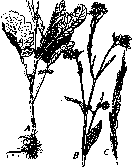
Brassica nigra: A—root; B—stem; C—fruits.
The article continues from the previous paragraph, discussing the chemical properties and therapeutic uses of mustard, including its effects on the body and various applications in medicine.
m. Likhachev. Table mustard belongs to the number of the most common flavoring substances (see)—spices for ready-made dishes. Along with salt and pepper, mustard is almost a constant attribute of every lunch table both in domestic life and in public canteens. Well-prepared table mustard has the appearance of a liquid paste of sour cream consistency, with a characteristic pungent taste and sharp odor. It is prepared from mustard seeds ground into powder, i.e., from mustard flour, by stirring it with water and vinegar, often with the addition of salt, sugar, and various spices, for example cinnamon, cloves, etc. Depending on the method of preparation, the taste and odor of table mustard vary. Russian cooks distinguish 'Russian' table mustard, which possesses an especially sharp taste and odor, and 'French' table mustard, which has a faint mustard odor, a sour vinegar taste, and the taste of the spices added to it. Mustard flour used for making table mustard is often falsified by the addition of wheat flour, starch, clay, etc. To give a bright yellow color to mustard flour, various coloring substances are added, for example turmeric, saffron, ochre, gamboge (poisonous), etc. The admixture of flour and starch can be detected by the staining of mustard with a weak iodine tincture in a blue color; pure mustard does not change its color from the action of iodine tincture. The admixture of turmeric can be detected by extracting mustard flour with hot diluted alcohol, which is colored yellow, turning brown after the addition of alkali. Gamboge is extracted from dried mustard with strong alcohol. Alcohol colored with gamboge turns red upon the addition of sulfuric acid, and a yellow precipitate falls from the alcoholic solution upon the addition of water. From a hygienic point of view, the use of small quantities of table mustard as a flavoring substance does not meet with objections; excessive use of it, due to its strong irritating action on the mucous membrane of the stomach and intestines, should be considered irrational.
Related articles
Mentioned in
Cite this page
“Mustard.” Soviet Medical Encyclopedia. English translation of Bolshaya Meditsinskaya Entsiklopediya, 1st ed. (Moscow, 1928–1936), ed. N. A. Semashko. https://sovietmedicalencyclopedia.pages.dev/article/mustard/