Juniper Berries
Historical document, translated for reference. It reflects medical knowledge of the 1920s–30s and is not medical advice.
Summary
Juniper berries are the fruit of the common juniper plant, containing essential oil, sugars, and other compounds. They have diuretic properties but require caution in use, especially for patients with kidney conditions.
Encyclopedia article (1928–1936)
JUNIPER BERRIES, Fructus, seu Baccae Juniperi (Ph. VII), the fruit of the evergreen shrub or small tree of the common juniper, Juniperus communis L., of the cypress family (Cupressineae), growing throughout Europe, in central and northern Asia. The fruit is a false berry, a cone-berry, green and egg-shaped in the first year; it ripens by autumn of the second year, becoming spherical, 5-9 mm in diameter, shiny, blackish-brown or almost black with a bluish wax coating; at the top of the fruit are three diverging grooves from the center of the upper pole, representing the boundaries (sutures) of the fused fleshy scales of the false berry; at the lower pole are two whorls of three dry, brownish, small triangular scales. The flesh of the fruit is greenish-brown, loose, fleshy, and contains three yellowish-brown seeds. - The fruit contains: essential oil (0.5-1.2%), similar to turpentine, consisting of pinene C10 H16, camphene C10 H16, terpinene C10H17OH, cadinene C15H24; sugar (13-42%); resin, wax, yellow amorphous, little studied bitter substance - juniperin; proteins (about 5%); formic, malic, acetic acids and ash (according to Ph. VII not more than 7%). The pharmacologically active substance in J. b. is the essential oil, which acts irritantly on the kidneys during its excretion from the body; when administered in small amounts, juniper essential oil enhances circulation and increases the filtration and excretory activity of the kidneys; in large doses, it causes severe irritation of the kidneys up to the phenomena of acute nephritis. Therefore, in medical use of J. b., or juniper essential oil, or other preparations of J. b., special caution must be observed, and in patients with kidney disease, J. b. and juniper essential oil are contraindicated. The essential oil also has an antiseptic effect, and therefore can be given internally in gonorrhea
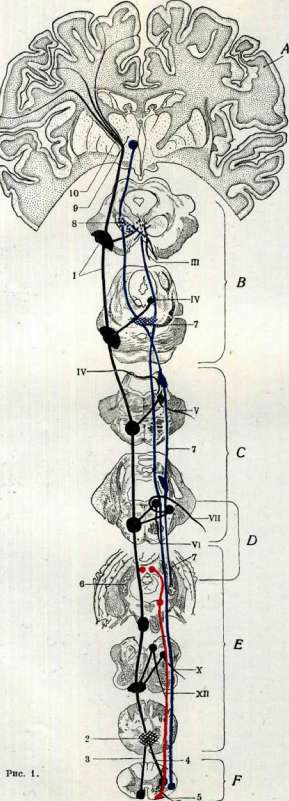
Figure 1. Pyramidal and extrapyramidal conducting paths: A-cerebral hemispheres; B-cerebral peduncles; C-Varolian bridge; D-cerebellum; E-medulla oblongata; F-spinal cord; 1-pyramidal tract; 2-decussation of pyramidal fibers; 3-direct pyramidal bundle; 4-crossed pyramidal bundle; a-anterior pyramidal tract; b-nucleus dentatus; 7-pedunculus cerebelli ad corpora quadrigemina; along this path from nucleus ruber to the spinal cord goes the rubrospinal tract; *-nucleus ruber; d-thalamus opticus; j-capsula interna; III, IV, V, VI, VII, X, XII-motor cranial nerves and their nuclei; the vestibular system is marked in red-the path from nucleus fastigii to the spinal cord through Deiters' nucleus
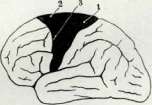
Figure 2. Outer surface of the left hemisphere (motor centers marked in black): 1-gyrus centralis anterior; 1'-gyrus frontalis superior; 3-gyrus frontalis medius
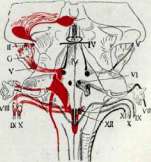
Figure 3. Location of nuclei of cranial nerves on the floor of the fourth ventricle. Motor nuclei and motor portions of nerves are marked in black, and sensory ones in red. O-Gasser's ganglion.
B. M. E. to art. J. b. Figure 4. Sensory conducting paths: A-cerebral hemispheres; B-cerebral peduncles; C-Varolian bridge; D-cerebellum; E-medulla oblongata; F-spinal cord; 1-spinal ganglia; 2-posterior roots; 3 and 4-tracts of Goll and Burdach and their nuclei; 5-lemniscus medialis; 6-florae arcuatae internae; 7-lemniscus medius; 8-thalamus opticus; 9-florae thalamocorticales; 10-bundle of Gowers; 11-lemniscus lateralis; 12-sensory nucleus of n. trigeminus (substantia gelatinosa Rolandi); 13-sensory nucleus of n. glossopharyngei et vagi.
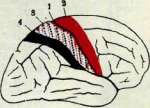
Fig. 5. Outer surface of the right hemisphere of the brain (sensory centers). Deep sensitivity is marked in red; superficial sensitivity in blue; dots-both types of sensitivity. 1-fissura Rolandi; 1'-gyrus centralis anterior; 3-gyrus centralis posterior; 4-gyrus parietalis. To art. J. b. urinary tract diseases.-J. b. are used in the following forms: in infusion (5.0-25.0 in 100.0) as a diuretic; for the same purpose serves the concentrated berry juice - Succus Juniperi inspissatus, also used in urethritis by teaspoonfuls. The juice pressed from J. b. is a favorite folk remedy for dropsy, in the treatment of which various diuretic collections containing J. b. are also used in folk medicine.-Juniper essential oil (Ph. Juniperi baccarum aetherum)* is prescribed in doses of 0.1-0.2 per dose internally in the form of Elaeosaccharum or in an alcoholic solution. Externally, J. b. are used in infusion (100.0-200.0 in 1 liter of water) as an additive to aromatic baths for skin irritation; in the form of Spiritus Juniperi compositus; essential oil in ointments or in mixture with fatty oils. As aromatic fumigation, J. b. are burned on hot coals. Since J. berries are rich in sugar, from them they distill vodka (gin - in Scotland, genievre - in France).
Related articles
Mentioned in
Cite this page
“Juniper Berries.” Soviet Medical Encyclopedia. English translation of Bolshaya Meditsinskaya Entsiklopediya, 1st ed. (Moscow, 1928–1936), ed. N. A. Semashko. https://sovietmedicalencyclopedia.pages.dev/article/juniper-berries/