Myrrh
Historical document, translated for reference. It reflects medical knowledge of the 1920s–30s and is not medical advice.
Summary
Myrrh is the dried sap that exudes from cracks in the bark of the Commiphora abyssinica tree, found in Eritrea, Abyssinia, and southern/southwestern Arabia. It is used in medicine as a tonic for chronic bronchitis, to stimulate appetite, and externally for dental care and wound treatment.
Encyclopedia article (1928–1936)
Myrrh (Gummi-resina Myrrha) (VII), dried sap that spontaneously exudes from cracks in the bark of the tree Commiphora abyssinica Engler (family Burseraceae), growing in Eritrea, Abyssinia, southern and southwestern Arabia. Irregularly shaped and of various sizes, lumps of yellow, reddish or brown color, with a shell-like fracture, a characteristic balsamic smell, and a bitter, spicy, irritating taste. Powdered myrrh, triturated with water, forms a yellow-colored emulsion. M. consists of essential oil (2-6%), which easily resinifies; of gum (50-55%) C10H10O7, soluble in water; of resin (30%) and small quantities of a bitter substance soluble in water, enzyme. The essential oil of M. acts irritantly on animal tissues and in addition possesses antiseptic properties. In medicine, M. is taken internally in doses of 0.3-1.5 in powders and pills as a tonic in chronic bronchitis with abundant mucus secretion but difficult expectoration; M. limits mucus secretion. M. was reputed in the treatment of pulmonary tuberculosis. In small doses, myrrh is given to stimulate appetite (stomachicum). Together with iron preparations, M. is given in chlorosis, and with Aloe as a 'blood purifier' (emmenagogum). Externally, myrrh is used in the form of tooth powders, as well as for gargles and application to wounds and ulcers on the gums and oral mucosa, for which the preparation Tinctura Myrrhae is used. As an aromatic, myrrh serves for fumigations; for this purpose it is burned on hot coals. M. was an ingredient of the compound preparation 'Kyphi', which was used by the ancient Egyptians as a fragrant incense and from which aromatic balls were prepared.
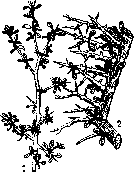
Commiphora abyssinica: 1-branch with fruits; 2-branch with resin exudations.
The essential oil of M. acts irritantly on animal tissues and in addition possesses antiseptic properties. In medicine, M. is taken internally in doses of 0.3-1.5 in powders and pills as a tonic in chronic bronchitis with abundant mucus secretion but difficult expectoration; M. limits mucus secretion. M. was reputed in the treatment of pulmonary tuberculosis. In small doses, myrrh is given to stimulate appetite (stomachicum). Together with iron preparations, M. is given in chlorosis, and with Aloe as a 'blood purifier' (emmenagogum). Externally, myrrh is used in the form of tooth powders, as well as for gargles and application to wounds and ulcers on the gums and oral mucosa, for which the preparation Tinctura Myrrhae is used. As an aromatic, myrrh serves for fumigations; for this purpose it is burned on hot coals. M. was an ingredient of the compound preparation 'Kyphi', which was used by the ancient Egyptians as a fragrant incense and from which aromatic balls were prepared.
Related articles
Mentioned in
Cite this page
“Myrrh.” Soviet Medical Encyclopedia. English translation of Bolshaya Meditsinskaya Entsiklopediya, 1st ed. (Moscow, 1928–1936), ed. N. A. Semashko. https://sovietmedicalencyclopedia.pages.dev/article/myrrh/