Filtration
Historical document, translated for reference. It reflects medical knowledge of the 1920s–30s and is not medical advice.
Summary
Filtration is a method for separating the liquid phase from solids (sediments, turbidity) by passing a system through porous materials that retain dense particles. The article describes various laboratory and industrial filtration techniques, equipment, and methods for accelerating the process.
Encyclopedia article (1928–1936)
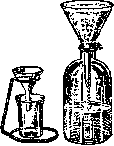
FILTRATION (from the Greek philtron - a love potion; such was considered a particularly clear wine in ancient times), one of the methods for separating the liquid phase from the solid (sediments, turbidity) by passing the system through porous materials that retain dense particles. It differs from straining in the use of denser porous materials: in the filtered liquid (filtrate) no particles visible to the naked eye should be detectable. In laboratory and pharmaceutical practice, filtration is usually performed through filter paper using glass or funnels. When using funnels with a 60° angle, filters are prepared for them (Berzelius filters) (fig. 1), especially convenient in cases where it is desirable to collect the precipitate. To accelerate filtration, grooved funnels (see Funnel, fig. 8) or glass rods are inserted between the funnel walls and the filter (fig. 2). On Büchner funnels (see Funnel, fig. 3) and suction flasks (fig. 3), which operate under reduced air pressure in the receiver, flat filters in the form of circles of appropriate size are used. To accelerate filtration in cases where preservation of the precipitate is not required, funnels of other shapes (see Funnel, fig. 1,2) and perforated funnels (fig. 4) are used; for all these funnels, pleated or folded Gay-Lussac filters are prepared by folding paper in a fan shape (fig. 5). Funnels with filters should be used in stands to prevent liquid from overflowing (fig. 6); when filtering directly into a flask, a thread, paper strip, or glass rod should be placed between the flask neck and the funnel, thereby creating a slit for air to escape. In recent years, glass filters with porous glass bottoms have been produced in our country, through which filtration is done without paper (fig. 7). The first to produce such filters was the Schott factory in Jena. The size of the pores of these filters is indicated by numbers: N° 1 still passes particles with a diameter of about 100 μ, N° 2-50 μ, N° 3-20 μ and N° 4-5 μ. The most commonly used forms of these glass filters (Goslaborreactivsbyt) are shown in fig. 7; forms "d" and "e" are used for drawing off liquid from easily disturbed precipitates. To facilitate filtration, methods of precipitate enlargement (e.g., preliminary centrifugation), reduction of the liquid phase viscosity (filtration while heating, see Funnel, fig. 10 and 11) or preliminary clarification of the liquid by causing the formation of coarse-grained precipitates that carry away (adsorb) fine turbidity are used. For this purpose, beaten egg white, gelatin, serum (in the presence of tannins), milk (for acidic liquids, e.g., berry juices) or boiled fragments of filter paper are added to the liquid being clarified; sometimes clarifying clays (floridin, humbrin) etc. are added; sometimes proteins are added and then coagulated by boiling. Filtration through porous candles (Berkefeld, Chamberland, etc.) - see Berkefeld candle, Filters in laboratory practice. - On an industrial scale, methods of filtration allowing greater productivity are used; mainly filter presses are used - devices invented by engineer Nidgheim in 1828 (fig. 8). For laboratory and pharmaceutical purposes, small filter presses exist. Filters of continuous action, drum, disk, and flat (planfilters) have greater productivity. On filtration of gases - see Gas masks. - In drop analysis (qualitative microanalysis by Feigl and Tananaev), filtration refers to the passage of liquid through the capillaries of filter paper; in this sense, the "filtrate" is considered the spot of liquid at some distance from the drop applied to a certain point on the paper. I. Obergard*
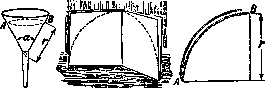
Figure 1. Funnel with a 60° angle and folding of paper for a Berzelius filter.
Figure 2.

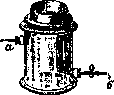
Figure 3.
Figure 2. Funnel with glass rods to accelerate filtration. Figure 3. Parts: a-to pump; b-for draining filtrate. For them, Berzelius filters (fig. 1) are prepared, especially convenient in cases where it is desirable to collect the precipitate. To accelerate filtration, grooved funnels (see Funnel, fig. 8) or glass rods are inserted between the funnel walls and the filter (fig. 2). On Büchner funnels (see Funnel, fig. 3) and suction flasks (fig. 3), which operate under reduced air pressure in the receiver, flat filters in the form of circles of appropriate size are used. To accelerate filtration in cases where preservation of the precipitate is not required, funnels of other shapes (see Funnel, fig. 1,2) and perforated funnels (fig. 4) are used; for all these funnels, pleated or folded Gay-Lussac filters are prepared by folding paper in a fan shape (fig. 5). Funnels with filters should be used in stands to prevent liquid from overflowing (fig. 6); when filtering directly into a flask, a thread, paper strip, or glass rod should be placed between the flask neck and the funnel, thereby creating a slit for air to escape. In recent years, glass filters with porous glass bottoms have been produced in our country, through which filtration is done without paper (fig. 7). The first to produce such filters was the Schott factory in Jena. The size of the pores of these filters is indicated by numbers: N° 1 still passes particles with a diameter of about 100 μ, N° 2-50 μ, N° 3-20 μ and N° 4-5 μ. The most commonly used forms of these glass filters (Goslaborreactivsbyt) are shown in fig. 7; forms "d" and "e" are used for drawing off liquid from easily disturbed precipitates. To facilitate filtration, methods of precipitate enlargement (e.g., preliminary centrifugation), reduction of the liquid phase viscosity (filtration while heating, see Funnel, fig. 10 and 11) or preliminary clarification of the liquid by causing the formation of coarse-grained precipitates that carry away (adsorb) fine turbidity are used. For this purpose, beaten egg white, gelatin, serum (in the presence of tannins), milk (for acidic liquids, e.g., berry juices) or boiled fragments of filter paper are added to the liquid being clarified; sometimes clarifying clays (floridin, humbrin) etc. are added; sometimes proteins are added and then coagulated by boiling. Filtration through porous candles (Berkefeld, Chamberland, etc.) - see Berkefeld candle, Filters in laboratory practice. - On an industrial scale, methods of filtration allowing greater productivity are used; mainly filter presses are used - devices invented by engineer Nidgheim in 1828 (fig. 8). For laboratory and pharmaceutical purposes, small filter presses exist. Filters of continuous action, drum, disk, and flat (planfilters) have greater productivity. On filtration of gases - see Gas masks. - In drop analysis (qualitative microanalysis by Feigl and Tananaev), filtration refers to the passage of liquid through the capillaries of filter paper; in this sense, the "filtrate" is considered the spot of liquid at some distance from the drop applied to a certain point on the paper. I. Obergard*
Figure 4.
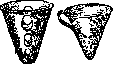

Figure 5. Figure 4. Perforated porcelain funnels. Figure 5. Pleated (folded) Gay-Lussac filter. For them, Berzelius filters (fig. 1) are prepared, especially convenient in cases where it is desirable to collect the precipitate. To accelerate filtration, grooved funnels (see Funnel, fig. 8) or glass rods are inserted between the funnel walls and the filter (fig. 2). On Büchner funnels (see Funnel, fig. 3) and suction flasks (fig. 3), which operate under reduced air pressure in the receiver, flat filters in the form of circles of appropriate size are used. To accelerate filtration in cases where preservation of the precipitate is not required, funnels of other shapes (see Funnel, fig. 1,2) and perforated funnels (fig. 4) are used; for all these funnels, pleated or folded Gay-Lussac filters are prepared by folding paper in a fan shape (fig. 5). Funnels with filters should be used in stands to prevent liquid from overflowing (fig. 6); when filtering directly into a flask, a thread, paper strip, or glass rod should be placed between the flask neck and the funnel, thereby creating a slit for air to escape. In recent years, glass filters with porous glass bottoms have been produced in our country, through which filtration is done without paper (fig. 7). The first to produce such filters was the Schott factory in Jena. The size of the pores of these filters is indicated by numbers: N° 1 still passes particles with a diameter of about 100 μ, N° 2-50 μ, N° 3-20 μ and N° 4-5 μ. The most commonly used forms of these glass filters (Goslaborreactivsbyt) are shown in fig. 7; forms "d" and "e" are used for drawing off liquid from easily disturbed precipitates. To facilitate filtration, methods of precipitate enlargement (e.g., preliminary centrifugation), reduction of the liquid phase viscosity (filtration while heating, see Funnel, fig. 10 and 11) or preliminary clarification of the liquid by causing the formation of coarse-grained precipitates that carry away (adsorb) fine turbidity are used. For this purpose, beaten egg white, gelatin, serum (in the presence of tannins), milk (for acidic liquids, e.g., berry juices) or boiled fragments of filter paper are added to the liquid being clarified; sometimes clarifying clays (floridin, humbrin) etc. are added; sometimes proteins are added and then coagulated by boiling. Filtration through porous candles (Berkefeld, Chamberland, etc.) - see Berkefeld candle, Filters in laboratory practice. - On an industrial scale, methods of filtration allowing greater productivity are used; mainly filter presses are used - devices invented by engineer Nidgheim in 1828 (fig. 8). For laboratory and pharmaceutical purposes, small filter presses exist. Filters of continuous action, drum, disk, and flat (planfilters) have greater productivity. On filtration of gases - see Gas masks. - In drop analysis (qualitative microanalysis by Feigl and Tananaev), filtration refers to the passage of liquid through the capillaries of filter paper; in this sense, the "filtrate" is considered the spot of liquid at some distance from the drop applied to a certain point on the paper. I. Obergard*
Figure 6. Setups for filtration.
/

f=™*3j
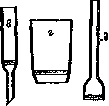
Figure 7. Glass porous filters. For them, Berzelius filters (fig. 1) are prepared, especially convenient in cases where it is desirable to collect the precipitate. To accelerate filtration, grooved funnels (see Funnel, fig. 8) or glass rods are inserted between the funnel walls and the filter (fig. 2). On Büchner funnels (see Funnel, fig. 3) and suction flasks (fig. 3), which operate under reduced air pressure in the receiver, flat filters in the form of circles of appropriate size are used. To accelerate filtration in cases where preservation of the precipitate is not required, funnels of other shapes (see Funnel, fig. 1,2) and perforated funnels (fig. 4) are used; for all these funnels, pleated or folded Gay-Lussac filters are prepared by folding paper in a fan shape (fig. 5). Funnels with filters should be used in stands to prevent liquid from overflowing (fig. 6); when filtering directly into a flask, a thread, paper strip, or glass rod should be placed between the flask neck and the funnel, thereby creating a slit for air to escape. In recent years, glass filters with porous glass bottoms have been produced in our country, through which filtration is done without paper (fig. 7). The first to produce such filters was the Schott factory in Jena. The size of the pores of these filters is indicated by numbers: N° 1 still passes particles with a diameter of about 100 μ, N° 2-50 μ, N° 3-20 μ and N° 4-5 μ. The most commonly used forms of these glass filters (Goslaborreactivsbyt) are shown in fig. 7; forms "d" and "e" are used for drawing off liquid from easily disturbed precipitates. To facilitate filtration, methods of precipitate enlargement (e.g., preliminary centrifugation), reduction of the liquid phase viscosity (filtration while heating, see Funnel, fig. 10 and 11) or preliminary clarification of the liquid by causing the formation of coarse-grained precipitates that carry away (adsorb) fine turbidity are used. For this purpose, beaten egg white, gelatin, serum (in the presence of tannins), milk (for acidic liquids, e.g., berry juices) or boiled fragments of filter paper are added to the liquid being clarified; sometimes clarifying clays (floridin, humbrin) etc. are added; sometimes proteins are added and then coagulated by boiling. Filtration through porous candles (Berkefeld, Chamberland, etc.) - see Berkefeld candle, Filters in laboratory practice. - On an industrial scale, methods of filtration allowing greater productivity are used; mainly filter presses are used - devices invented by engineer Nidgheim in 1828 (fig. 8). For laboratory and pharmaceutical purposes, small filter presses exist. Filters of continuous action, drum, disk, and flat (planfilters) have greater productivity. On filtration of gases - see Gas masks. - In drop analysis (qualitative microanalysis by Feigl and Tananaev), filtration refers to the passage of liquid through the capillaries of filter paper; in this sense, the "filtrate" is considered the spot of liquid at some distance from the drop applied to a certain point on the paper. I. Obergard*
Figure 8. Details of filter press and its operating scheme: A-liquid for laboratory and pharmaceutical purposes; B-wash; C-precipitate liquid; D-filtrate.
Related articles
Mentioned in
Cite this page
“Filtration.” Soviet Medical Encyclopedia. English translation of Bolshaya Meditsinskaya Entsiklopediya, 1st ed. (Moscow, 1928–1936), ed. N. A. Semashko. https://sovietmedicalencyclopedia.pages.dev/article/filtration/