Laboratory Baths
Historical document, translated for reference. It reflects medical knowledge of the 1920s–30s and is not medical advice.
Summary
Laboratory baths are devices used for even heating during various laboratory procedures like extraction, dissolution, evaporation, and chemical reactions. They distribute heat uniformly and allow precise temperature control, with different types including air baths, steam baths, oil baths, and sand baths.
Encyclopedia article (1928–1936)
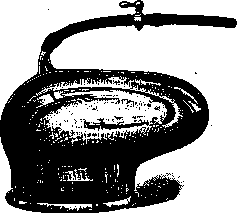
Laboratory Baths, serve to avoid excessively sharp and uneven heating during various works conducted at elevated temperatures (extraction, dissolution, evaporation, distillation, drying, various chemical reactions, etc.). Laboratory baths distribute the heat coming from the burner evenly across the entire surface of the heated vessel and, in addition, allow for more precise regulation of the degree of heating and maintaining it more or less constant. The simplest laboratory baths are air baths, of which the so-called Babo funnels are most commonly used (a set of them is shown in Fig. 1); the middle part of their lower opening is closed with a metal disk, so that the hot gases from the burner evenly surround the bottom and edges of the flask inserted into the funnel, passing between the walls of the two. Based on the type of air baths, various drying cabinets are also constructed, in which hot air from the burner circulates between double walls. More uniform heating is achieved in baths filled with one liquid or another, where the heated vessel is immersed in the liquid or surrounded by its vapors (steam baths). In baths of the latter type, the evaporating liquid must be constantly replenished; therefore, it is convenient to equip them with a device that automatically maintains a constant liquid level. A simple device that allows any vessel to be converted into a bath with a constant level is shown in Fig. 2. Of the steam baths, conical ones with a constant level are most convenient, in which

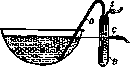
Figure 2. A - water in the bath; B - test tube serving as a level regulator; C - drain for excess water; E - incoming water; DF - siphon connecting the test tube with the bath.
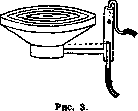
a very small amount of water is heated to boiling, so that a small flame is sufficient (see Figure 3). For heating at temperatures above 100°C, laboratory baths are filled with higher-boiling substances - oil (preferably rape oil), for temperatures up to 250°C - paraffin. For even higher temperatures, and when there is no need for particularly uniform and constant heating, sand baths are used, which are metal receptacles (cups, sheets with turned-up edges) filled with fine, washed, and calcined sand. When working with easily flammable substances (for example, ether, alcohol), laboratory baths are used, in which the burner flame is surrounded by a protective net.
V. Engelhardt. CUPS (for bloodletting and suction). Local bloodletting, by means of vessels applied to the skin in which a vacuum was produced by heating or suction (followed by sealing the opening with wax), was used by various peoples in ancient times. For this purpose, hollow animal horns and vessels of various shapes and sizes made of metal or glass were used. Cupping therapy is still widely applied today. - Modern instruments for bloodletting and technique of their application.-1. Ordinary cups have the shape of round glass cups with a thickened edge and an expanded semicircular bottom, with a capacity of approximately 30-70 cubic cm (see Figure 1). A vacuum in them is produced by rapid heating over a flame or by burning pieces of paper soaked in flammable liquid in their cavity; this is more conveniently achieved by briefly introducing a piece of cotton wool, wrapped around a wooden or metal stick and soaked in flammable liquid (alcohol, ether, etc.), into the cavity of the cup and igniting it. Immediately after this, the cup is quickly applied to the skin surface with its entire circumference. The skin is drawn into the cup by 1-3 cm, acquiring a bright pink or dark red color. To remove the cup without causing pain, one hand should slightly tilt it to the side, and with the fingers of the other hand, apply light pressure on the opposite side of the cup's edge, as a result of which air enters it, and suction immediately ceases. - 2. Cups with a rubber bulb, introduced into widespread use by Bier, of various capacities, mostly in the form of a short cone or bell with the top cut off and the upper edge slightly turned outward, around which the edge of the rubber bulb is secured (see Figure 2).
Figure 1.

b. m. e. t. i. The bulb is compressed, the cup is applied to the skin, and the bulb is released, which causes suction. To remove such a cup, the bulb must be compressed again. The advantage of such cups is their simplicity, and the negative pressure developed in them can reach 200-400 mm of mercury or more (Bier).-3. A variation of cups with rubber bulbs are cups and other vessels of various shapes and capacities with a nipple drawn out in the area of the bottom, onto which a rubber tube is placed; its other end is connected by means of a small glass or metal insert to a rubber bulb or pump. As a result of this, it becomes possible to sterilize the suction glass vessel by heating, after disconnecting it from the bulb. Suction devices can be adapted in shape and size for affecting various parts of the body and even an entire organ, for example, the mammary gland (in mastitis). There are suction devices for fingers (see Figure 3), for the entire forearm or the whole lower leg. The
Figure 2.
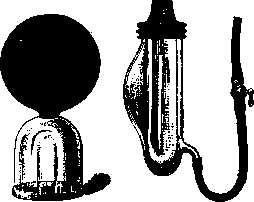
Figure 3.
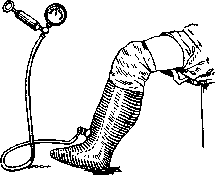
same principle is the basis of the suction device for an entire limb, proposed in 1834 by Jounod and resembling something like rubber boots. This device, hermetically fixed on the limb, is connected by a rubber tube to a pump with which air is sucked out (see Figure 4). Devices of the type of bloodletting cups are also used in gynecology and in rino-laryngotherapy. For collecting fluid flowing from wounds or cavities, suction vessels are given a corresponding shape, with an elongated side reservoir so that the fluid flows downward (see Figure 5). In ordinary medical practice, cups are used mainly on the surface of the torso, where the muscle and fat layers are thicker and where there are no bony prominences and curvatures. The best areas for this are the subclavian, subscapular, and interscapular areas, as well as the lumbar region; here 5-10 cups can be placed. The skin at the site of application of dry cups is washed with warm soapy water and alcohol; to make it more elastic and reduce air penetration under the edge of the cup, the skin should be smeared with vaseline. Cups are left in place for 5-10 minutes. If enhanced blood withdrawal is necessary, then in the same area, but in other places, or in adjacent areas, a new
Fig. 4.
group of cups can be applied immediately. Thus, the total number of cups (e.g., on the chest) can be increased to 60 or more. Blood-sucking cups for the purpose of blood extraction are applied as follows: the skin is disinfected with alcohol and ether (but not iodine); then with a sterile scalpel or razor, several shallow short incisions are made in several places in an area smaller than the circumference of the existing cups, close to each other. The blood that appears is wiped with sterile material, a cup is immediately applied to the group of incisions, and as a result, significant blood extraction is achieved. Incisions are made much more conveniently if a bloodletting (scarification) cube, also called a shnep, is used. This is a copper box; on its lower surface, with an area of about 9 sq. cm, there are 12-20 narrow slits, from which, when the spring is cocked, if the side button is pressed, small
Figure 5.
cutting plates jump out (see Figure 6). The instrument is sterilized before and after use. A cup applied at the site of scarification can extract 15-30 cubic cm of blood. Depending on the indications, usually 2-10 cups are used; thus, up to 300 cubic cm of blood can be extracted. If a small amount of blood is needed without resorting to venipuncture, a blood-sucking cup can be used; for example, for the Wassermann test, the blood extracted from one cup is sufficient. Mechanism of action. Dry cups cause temporary hyperemia in the area of skin, which can have the character of arterial influx or venous congestion. In any case, cessation of blood circulation must not be allowed, the skin should not become pale, and the cups should not cause pain. According to Bier, hyperemia also spreads to deeper lying parts, as evidenced by the analgesic effect of cups in spondylitis, coxitis, etc. According to Bier, hyperemia also has a
resolving effect in inflammatory processes, enhances lymphatic
circulation, improves tissue nutrition and their resistance to
bacteria and toxins. In this sense, it is prescribed not to apply
cups to inflamed
areas
unjustifiably, since increasing existing hyperemia gives especially favorable results. At sites of hemorrhages into the skin, undoubtedly, clotting of blood and lymph occurs with subsequent resorption of decay products and autolysis of erythro-, leuco- and thrombocytes, with liberation of leucocytic enzymes and formation of albuminoid substances. All this stimulates hematopoiesis and has an irritating effect, similar to what occurs in autogenous blood therapy. Furthermore, it must be borne in mind that B. and other suction apparatus reduce the absorption of pathological products and actively suction them out if applied to areas where there is a violation of the integrity of the coverings with pathological discharge, for example, in the vicinity of various kinds of abscesses, furuncles, or at the opening of natural cavities with pathological contents. The mechanism of action of blood-sucking cups, although the amount of blood extracted is usually not great, is identical to bloodletting. After applying cups to the chest, patients experience less tension and constriction in the chest, reduction of pain and easier breathing, and objectively a decrease in respiratory and pulse rate, lowering of temperature, and reduction of signs of stagnation in the lungs can be established. -Indications: 1) inflammatory processes in the organs of the chest - bronchi, lungs, pleura and pericardium; 2) signs of stagnation in the pulmonary circulation; 3) inflammatory and congestive phenomena in the kidneys (blood-sucking cups often have a good effect here); 4) acute and chronic myositis, neuromyositis, neuralgia, neuritis and perineuritis, especially in the lumbar region; 5) deeper inflammatory processes in the skin and subcutaneous tissue, such as carbuncles and furuncles; 6) purulent tendovaginitis, inflammation of the joints.
Related articles
Mentioned in
Cite this page
“Laboratory Baths.” Soviet Medical Encyclopedia. English translation of Bolshaya Meditsinskaya Entsiklopediya, 1st ed. (Moscow, 1928–1936), ed. N. A. Semashko. https://sovietmedicalencyclopedia.pages.dev/article/laboratory-baths/