Paraffin
Historical document, translated for reference. It reflects medical knowledge of the 1920s–30s and is not medical advice.
Summary
This article from the 1928–1936 Soviet Great Medical Encyclopedia details the physical properties, chemical composition, and manufacturing of solid paraffin and ceresin. It also describes their widespread applications in medicine, pharmacy, histological technique, and physical therapy.
Encyclopedia article (1928–1936)
PARAFFIN, solid (Ph. U.), Paraffinum solidum, ceresin, is a dense mass consisting of saturated and cyclic hydrocarbons obtained from various grades of petroleum by further distillation of petroleum residues, as well as by the dry distillation of brown coals, peat, shales, and the like; furthermore, paraffin was formerly also extracted by the distillation of ozokerite (earth wax), which occurs in nature in the form of deposits in Galicia, the Caucasus, and on the island of Cheleken. At present, ozokerite is not subjected to distillation, but is purified with strong sulfuric acid and various bleaching agents, which yields a large output of white and yellow paraffin (ceresin), high-melting and very similar to wax. Such ceresin can also be obtained by freezing Grozny petroleum, which is rich in high-melting hydrocarbons. The Ph. VII, as well as the German Pharmacopoeia under the name of paraffin, refer to ceresin obtained by the purification of ozokerite, and not to paraffins obtained by distillation. In commerce, a distinction is made between low-melting paraffins (melting point 44–48°, specific gravity 0.88–0.89) and high-melting paraffins (melting point 52–56°, specific gravity 0.898–0.915). Ceresin melts at 68–72° (Ph. U. requires not lower than 71°) and has a specific gravity of 0.920–0.940. According to its chemical composition, paraffin is a mixture of high-molecular saturated hydrocarbons, resistant to acids and alkalis (parum affinis), from C29H60 (nonacosane) to C35H72 (pentatriacontane); whether carbocyclic compounds are present in paraffin, there are no definitive indications in the literature. Depending on the cooling conditions, paraffin has the appearance either of a flaky, coarsely crystalline mass or of a transparent amorphous one; ceresin is a white, solid, microcrystalline (an important feature) mass without odor and taste; paraffin is insoluble in water, very sparingly soluble in alcohol, easily soluble in ether, chloroform, benzene, fatty and essential oils, and the like; it is not altered by strong sulfuric acid; it is not saponified by caustic alkalis (cf. Vaseline and Liquid Petrolatum). Paraffin is used quite widely in medicine. In histological technique, it is used for embedding specimens when sectioning them with a microtome (see below). For the preparation of paraffin paper (wax paper, Charta cerata), thin ordinary paper is impregnated with molten paraffin and used as a moisture-impermeable material for compresses; in pharmacy and laboratory practice, bottles and jars whose contents must be well isolated from the action of air and moisture are sealed with paraffin; rubber articles (gloves, drains, etc.) are immersed in molten paraffin for their preservation. Paraffin is frequently used in ointments, as well as low-melting grades for plastic operations in deformities and defects of the nose and face (see below). In recent times, low-melting paraffin has been used as a remedy against obesity; entire regions of the body are covered with molten paraffin; under the solidified crust, very strong sweating soon begins, and the patient loses weight. A. Ginzburg. Paraffin in histological technique is used for embedding tissue blocks in order to obtain thin sections (5 µ and less). Ordinary paraffin with a melting point of 50–54° can be used (at a high room temperature, even up to 56–58°), best prepared by mixing soft paraffin (melting point 45°) and hard paraffin (58–60°) in the required proportion. It is even better to use the so-called superheated homogenized paraffin, obtained from ordinary white paraffin by prolonged boiling until it acquires a yellowish color like honey. The thinner the sections desired, the higher the melting point of the paraffin should be, but, on the other hand, it must be borne in mind that prolonged and strong heating is poorly tolerated by some tissues, and their structure is altered. Therefore, it is generally recommended that the temperature of the paraffin oven should not exceed the melting point of the paraffin used by more than 2–3°. In ordinary embedding in paraffin (see Histological technique), after absolute alcohol, xylene, chloroform, or benzene is most often used as the first intermediate medium dissolving the paraffin, while pieces stained for fat with osmic acid are passed through benzene or paraffin oil (Ol. paraffini—see below) instead, to avoid bleaching the specimen. The second intermediate medium, following one of the specified liquids, is a solution of paraffin saturated in one of them at 37°. The duration of stay in each of the media, according to the size of the piece and the nature of the tissue, ranges from ⅓ to 3 hours; this is followed by pure molten paraffin for 3–6 hours, changed twice or thrice. Some advise starting with paraffin of a lower melting point (48°) and from there transferring the pieces to paraffin with a higher melting point (e.g., 51–54°). Then, after impregnation of the tissue pieces with paraffin, the so-called paraffin block is prepared. For this purpose, paper boxes, watch glasses, or special metal frames are used. The piece impregnated with paraffin is transferred here from the thermostat with warmed forceps; the box is filled with molten paraffin of the same melting point and rapidly cooled with water or snow to avoid crystallization of the paraffin, which would render it unsuitable for sectioning. Sectioning of the paraffin block is performed with a transverse or nearly transversely positioned knife. This is followed by mounting the sections on glass, most commonly either with water by the capillary method or, better, with albumin by the Japanese method. In both cases, the slides must be thoroughly cleaned of fat, most simply by flaming. For the Japanese method, a mixture of egg white and glycerin in equal parts is prepared, applied in the thinnest layer to the glass, and the glass is then heated (it can be done directly over a flame) to approximately 70°. Sections from water are placed on the albumin-coated microscope slide or coverslip and dried for 3–4 hours in a thermostat at 37°. Mounting of the sections is followed by their staining with preliminary extraction of the paraffin with xylene for 5–10 minutes and passing from there through alcohol and water. In addition to ordinary embedding in paraffin, the so-called accelerated embedding is used, most simply by the Henkel-Zeller method: 1) fixation and hardening of tissue blocks in acetone for 1–1½ hours, 2) molten paraffin also for 1–1½ hours, 3) embedding proper (i.e., making the paraffin block). A preliminary brief fixation in formalin and the introduction of xylene between the 1st and 2nd phases are useful. Failures in paraffin embedding and their elimination: 1) upon prolonged stay for more than 3 hours in xylene or more than 1½ hours in anhydrous acetone, specimens shrink severely and become brittle; 2) if the paraffin crumbles during sectioning, this indicates that it still contains residues of the intermediate medium; in such a case, the piece must be re-embedded by transferring it to pure molten paraffin; 3) if the paraffin at the edges of the block cuts well, but the embedded piece itself crumbles when cut, this is a sign that the object was insufficiently dehydrated before entering the intermediate medium; in this case, the piece must be transferred in reverse order, i.e., through molten paraffin, then through the intermediate medium into absolute alcohol, and re-embedded in paraffin as usual. Besides solid paraffin, paraffin oil, or liquid petrolatum (Ol. paraffini, s. Paraffinum liquidum), proposed by Altmann for osmicated pieces, is used in histological technique. Recently, it has begun to be used for mounting sections stained with aniline dyes, as well as instead of cedar oil as an immersion liquid.
P. Poznanin. Occupational hazards of paraffin production. The bulk of paraffin is currently extracted from paraffin-base petroleum; the former raw materials—oil shale and brown coal—have lost their significance. The USA ranks first in the amount of paraffin extracted. Before the October Revolution, paraffin production did not exist in Russia. In the USSR, the first paraffin plant was founded in Grozny in 1927; its output in 1931 equaled 13,000 tons. The process of obtaining paraffin is quite complex. Paraffin is extracted from paraffinous fuel oil, from which, after two distillations, paraffin distillate is obtained; the latter goes to crystallization, then to filter presses—50-75% of liquid oils are removed; the remaining paraffin "gach" (slack wax) goes to hydraulic presses, then is purified with sulfuric acid, caustic alkali, and water, after which it is subjected to "sweating"—upon a gradual increase in temperature (according to specification), the sweating out of liquid oils occurs. The remaining paraffin is melted and discharged into reservoirs. This "crude" paraffin has a yellowish color, an unpleasant odor and taste; if it is necessary to obtain pure paraffin, it is bleached with sulfuric acid, washed, and treated with floridin; a transparent or whitish mass without odor and taste is obtained, specific gravity 0.907-0.915. In industry, paraffin finds diverse applications: most of all it goes into the manufacture of candles and matches, further it is used in electrical engineering (insulation), the perfume business, the textile industry (sizing), paper industry (obtaining waxed paper), chemical, printing, and ceramic industries; waxes, creams, ointments, and various medical preparations are prepared from it. Paraffin belongs to the numerous group of substances—products of the distillation of petroleum and coal tar—that cause various skin lesions in workers dealing with them, ranging from erythema to malignant neoplasms (see Cancer). In workers employed in paraffin production, these lesions are observed especially frequently and, moreover, in the most diverse forms; the authors who described them subdivided them variously. The classification given by A. Scott, who provided a detailed description of them, is the most detailed; he distinguishes the following forms of lesions: widespread comedones, folliculitis and perifolliculitis, pustular dermatitis, simple superficial erythema, papular dermatitis, erythematous dermatitis, and epitheliomas. Popel, who examined 221 workers of the Grozny Paraffin Plant in 1928, found skin lesions in 82 people (37%), with the most frequently encountered forms being: papular dermatitis (in 42% of cases), the same in combination with comedones (26%), and in combination with associated folliculitis (27%); confluent macular dermatitis, pyodermas, and ulcerations are also encountered. The lesions are localized mainly in the places most often coming into contact with paraffin and oils: hands, extensor surfaces of the forearms and elbows, anterior surfaces of the thighs and knees; in rarer cases, the process develops on the remaining surfaces of the limbs, on the chest, abdomen, back, etc. A relatively infrequent, but very serious outcome of dermatitis is skin epithelioma (see Cancer). In recent years, in connection with the improvement of working conditions, the number of epitheliomas has sharply decreased. The course of epitheliomas is benign, metastases are rare; in rare cases, the development of septic abscesses of the glands and general metastases are possible; histologically, squamous cell carcinoma is most often encountered. Regarding the cause causing the development of dermatitis and epitheliomas, various opinions have been expressed: it is believed that paraffin clogs the excretory ducts of the sebaceous and sweat glands, the result of which is the retention of secretion with subsequent changes, while oils dissolve the fat of the skin sebum and thereby deprive the skin of its protective cover; Bayet expresses the opinion that arsenic contained in the oils should be considered the cause of the lesions; Ullmann and others, based on the fact that lesions are not observed in workers working with pure paraffin (candle factories, manufacture of pharmaceutical preparations, etc.), believe that the cause of the latter is not paraffin, but oils containing unsaturated hydrocarbons and impurities; Koelsch suggests that a certain role is played by the presence in oils of anthracene—a substance possessing photosensitizing action, etc. Prophylaxis: complete mechanization of the production process and sealing of equipment, in particular the work of hydraulic presses and filter presses, where contact with oils is most intense and where skin lesions were found in almost all workers. Of very great importance is the provision of warm showers taken daily after the end of work, wearing impermeable pads (made of vulcanin) on clothing in places where soaking is possible, frequent changes of underwear and other personal hygiene measures; periodic medical examination with the removal from production of those suffering from dermatitis, temporarily or permanently.
N. Rosenbaum. The use of paraffin in surgery, paraffinoplasty. Lawson Tait as early as the 1870s used hard paraffin for hardening bandages in fractures. Taederl in Billroth's clinic used paraffin plates as a spacer between joint ends after joint resection. The introduction of liquid paraffin into the human body when injecting suspensions of heavy metals caused much controversy and disagreement in the 1870s regarding its absorbability and the possibility of the occurrence of emboli carried to various organs by the bloodstream. On a vast amount of material, it was proved that these complications are extremely rare and end in complete recovery. In the 1890s, Corning in New York and Gersuny in Vienna independently proposed paraffin injection for surgical purposes. Corning injected paraffin between the ends of a severed nerve to avoid adhesion. Gersuny for the first time used paraffin injection to narrow the female urethra in sphincter insufficiency with a good result. Initially, paraffin was most often injected for cosmetic purposes to correct the shape of sunken, retracted tissues, mainly for the correction of a saddle nose, and then to obtain a functional effect by filling missing tissues with paraffin, e.g., to narrow the urethra, to narrow a congenital defect (cleft) of the soft palate (paraffin injection into the edges of the defect), to narrow the mesopharynx (paraffin injection into the posterior wall of the pharynx to make up for an insufficiently closing valve between the oral and nasal cavities), to narrow the hernial orifice in prolapses of the rectum, uterus, vagina; in ozenas to narrow the nasal passages (injection under the mucous membrane of the nose). To create a good support for an eye prosthesis, paraffin was injected into the eye stump or inserted into it in the form of a ball of hard paraffin through an incision. Paraffin was also used to give shape to a partially resected mammary gland, to fill the scrotum instead of missing testicles, etc. In all these cases, the property of paraffin to retain its volume and imparted shape without undergoing resorption for a more or less long time is utilized. Thus, the injected paraffin plays the role of an interstitial prosthesis, differing from implanted metal, bone, ebonite foreign bodies mainly in that no blood-letting intervention is required here. Indications for paraffinoplasty in the above cases have currently narrowed considerably in view of the improvement of the technique of transplantation of living tissues (fat, cartilage, bone) and the proposal of new plastic surgeries to restore the impaired function of various organs: sphincteroplasty with transplantation of a neurotized muscle, the operation of closing cleft defects of the hard and soft palate according to Ernst, etc. The use of paraffinoplasty for the restoration of the nose shape by rhinologists holds on more tenaciously. In connection with new works on rhinoplasty (Josepha), there will probably be fewer and fewer supporters of the use of paraffin in this area as well. Further observations showed, however, that paraffin is eventually resorbed and does not remain an indifferent foreign body to the surrounding tissues. Experimental work with the introduction of paraffin to animals (infusion of liquid paraffin through the mouth, rubbing through the skin, and subcutaneous injection) established the toxicity of large doses of liquid paraffin (22.0-31.0 per 1 kg of weight) and vaseline (39.0-45.0 per 1 kg of weight); at the same time, small doses with prolonged use caused a weight drop of 18-30%. Fatal outcomes are explained by many authors mainly by the displacement of paraffin in tissues and blockage of tissue clefts, sometimes stomach ulcers due to embolism of the stomach vessels. Stein, who used medium doses and pure preparations for his experiments, did not observe toxic phenomena. Subcutaneously injected paraffin penetrates first of all into the clefts of connective tissues, bypassing lymphatic vessels, and moves into distant tissues under the influence of connective tissue growth, gravity, and muscle action. When injecting liquid, semi-liquid, and molten hard paraffin, one must not forget the dangers of vascular embolism, since the injection is performed under significant pressure. The elements of subcutaneous tissue, blood and lymphatic vessels, elastic fibers of connective tissue, and adipose tissue subjected to strong pressure divide the injected paraffin into separate layers and small lobules, and the latter can get into the lumen of ruptured vessels with the further movement of the thrombus into the right heart and pulmonary artery. Massaging with the aim of moving the injected paraffin further increases this danger. When injecting hot paraffin, thrombs can form from blood coagulation in the vessels lying here. Continuing from here to the nearest branches, thrombs can get into other branches of vessels, forming secondary thrombs. Pavlov-Sylvansky cites 9 cases from the literature where, when injecting paraffin to correct a saddle nose, complete blindness in one eye resulted. In one case, after paraffin injection for ozena, phenomena of pulmonary embolism appeared. In 6 cases, when injecting paraffin with vaseline into the parametrium for the treatment of uterine prolapse, including a case of injection into the paravesical tissue with paraffin, pulmonary embolisms were observed, and one case ended in death. The cited cases of embolism are not isolated; nevertheless, with the enormous number of cases of injection of paraffin mixtures, the percentage of accidents is generally insignificant, and it falls even further in connection with the use of semi-liquid paraffin and the improvement of technique. Unpleasant complications of paraffin injection also include the uneven distribution of paraffin at the injection site. The resulting bumps from the accumulation of paraffin are most often located at the inner corner of the eye or represent an abnormal thickening of the nose at the site of depression (see Paraffinoma). These tumors cause a new psychological depression in patients and a demand for the removal of paraffin. Since the injection is performed under high pressure, sometimes due to vascular compression and nutritional disorders of the skin, necrosis of the skin at the injection site or prolonged redness with the development of a translucent vascular network is observed. To avoid these complications, careful technique with observance of certain precautions is required. Paraffin is most often injected in a mixture with vaseline with a melting point of the mixture of 42-43° according to Stein, in a cold state, using strong metal or glass syringes in a frame with a thicker cannula, straight or bent. For more even injection,
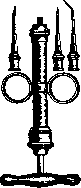
Figure 1.
the piston is moved using a screw, or a syringe in the form of a pistol according to Brockaert (Figures 1 and 2) is used. Sterile semi-liquid paraffin is kept in metal or glass tubes, from which it is pushed out into the cylinder of the syringe using a metal rod. For the injection of hard paraffin with a melting point of 50-60° according to Eckstein's method in a molten form, syringes with a thick rubber frame are used, or a coil through which hot water passes is put on the syringe.
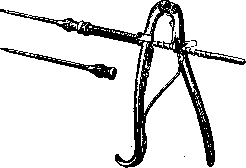
Figure 2.
Supporters of hot paraffin injection are becoming fewer and fewer. The injection should be made from the root of the nose towards its tip. Stein recommends the following precautions: 1) avoid cold liquid paraffins during injection, 2) make the injection in small quantities at a time and repeat the injection after a few weeks, 3) avoid areas rich in vessels for injection, 4) limit the operation area with finger pressure during injection to compress surrounding vessels, 5) do not use paraffin with a high melting point in a hot state, 6) after the operation, patients should not move for at least an hour. To preserve the shape of the injected paraffin in the first hours after injection, special forms of compressors are used in the form of clamps with flat jaws conforming to the shape of the nose, or compressors composed of two side plates connected by an arc-shaped spring compressed by means of a transverse screw. Histological changes in tissues after paraffin injection - see Paraffinoma. A. Rauer.
Related articles
Mentioned in
Cite this page
“Paraffin.” Soviet Medical Encyclopedia. English translation of Bolshaya Meditsinskaya Entsiklopediya, 1st ed. (Moscow, 1928–1936), ed. N. A. Semashko. https://sovietmedicalencyclopedia.pages.dev/article/paraffin/