Deferri-zation
Historical document, translated for reference. It reflects medical knowledge of the 1920s–30s and is not medical advice.
Summary
Deferri-zation is the process of removing iron from water, particularly groundwater containing ferrous bicarbonate. This process is essential for making water suitable for drinking and industrial use, as iron-containing water has an unpleasant metallic taste, causes turbidity, and promotes bacterial growth.
Encyclopedia article (1928–1936)
DEFERRI-ZATION (from Latin de - negative part, and ferrum - iron), deironing, purification of water from iron salts. Ground waters, especially those taken from deep layers of the earth, often contain a significant admixture of dissolved ferrous bicarbonate Fe(HCO3)2. Such waters, if their iron content exceeds 0.3 mg per 1 liter, are poorly suitable for water supply to populated areas, as they have an unpleasant metallic taste and, under the influence of atmospheric O2, become turbid, precipitating a brown flocculent sediment of iron hydroxide. If this sediment, accumulating in water pipes, causes muddy deposits, then at times of strong water movement in the pipes, for example during maximum consumption, these deposits can be stirred up and make the tap water turbid. In addition, iron-containing waters provide very favorable conditions for the development of so-called iron bacteria, for example Crenothrix polyspora, Gallionella ferruginea and others. The growth of iron bacteria is sometimes so intense that it causes complete blockage of small-diameter water pipes. Waters containing iron are considered unsuitable for many factory productions, for example for dyeing, for paper and bleaching factories, etc. At a content of 5 mg Fe per ;ЩА
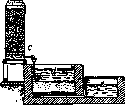
Figure 1. Diagram of an installation for deferri-zation by the Piefke method: a - cooling tower; b - sieve (distributor); c - drainage; d - filter; e - reservoir of purified water.
mg per 1 liter, water becomes unsuitable even for such household purposes as washing laundry. By means of D. water can be freed from iron and turned into water that is quite suitable both for drinking and for various domestic and industrial needs. All methods of D. are based on supplying the water with a sufficient amount of oxygen (approximately 0.08 liters of oxygen per 1 g of ferrous oxide), which converts the ferrous oxide into insoluble iron hydroxide, which gives a precipitate. To retain the latter, the water is passed through a filter of sand or gravel. Devices for D. are divided into two main groups - open and closed. Open installations are made according to the methods of Piefke and Esten (Piefke, Oesten). The Piefke method consists of the following (Fig. 1). Water is supplied to the so-called cooling tower-aerator a. The latter is a reservoir with waterproof walls and bottom; somewhat above this bottom there is a second perforated bottom, the so-called drainage. On the latter lies a packing in the form of coke, brick or wooden slats. Water in thin streams, at a speed of about 1-2 mm per second, passes through the packing, washing it; during this process, the water becomes saturated with O2 of atmospheric air and is freed from CO2; the iron passes into iron hydroxide and precipitates. With sufficient size, the packing, retaining water on its large rough and sticky surfaces, also plays the role of a contact in phys.-chem. and biol. relations. The most rational height of the cooling tower is determined by the required length of the water's path along the packing and is often taken as 3 m. The volume of the packing is taken as approximately equal to the hourly capacity of the installation. For large quantities of water being deironed, the area of the cooling tower becomes significant; then several compartments are arranged, with an area of each about 20-60 m2. With coke packing, the size of the coke pieces is approximately about 100 mm in diameter. With brick packing, bricks are placed crosswise on each other, with gaps of about 20 mm. Wooden packing is made of pine slats, sometimes covered with paraffin, with dimensions of 100 x 10x1 cm. With the help of wooden pins, 16-17 slats are tied together with gaps of about 2 cm and form an element of the packing. Such elements are installed in horizontal rows, with each subsequent row having slats arranged perpendicular to the slats of the previous row. The advantages of wooden packing include: ease of installation, correctness and uniformity of the distribution of gaps between slats, and accessibility for convenient and simple cleaning. In addition, wooden packing turns out to be more expedient than others for treating water that contains, along with salts of ferrous iron, also salts of ferrous manganese. The iron oxide precipitates accumulating on the cooling tower packing gradually clog it, so periodic (approximately every week) washing with a strong water supply is required; in addition, every 1^2-2 years the entire packing is overhauled. The filters necessary after the cooling tower are made according to the type of English or American sand filters. When deironing by the Esten method (Figure 2), the water, in order to increase the surface of its contact with air, is broken into very fine
Related articles
Cite this page
“Deferri-zation.” Soviet Medical Encyclopedia. English translation of Bolshaya Meditsinskaya Entsiklopediya, 1st ed. (Moscow, 1928–1936), ed. N. A. Semashko. https://sovietmedicalencyclopedia.pages.dev/article/deferri-zation/