Gambusia
Historical document, translated for reference. It reflects medical knowledge of the 1920s–30s and is not medical advice.
Summary
Gambusia is a live-bearing American fish that was introduced to the Soviet Union in 1924 for biological control of malaria mosquito larvae. The article details its characteristics, breeding habits, transportation methods, and effectiveness in various water bodies.
Encyclopedia article (1928–1936)
GAMBUSIA, a live-bearing American fish; one of the species of this fish, namely Gambusia affinis, in recent years has been widely distributed for the purpose of combating larvae of the malaria mosquito. In the USSR, gambusia was imported from Italy at the end of 1924. At present, gambusia is widely distributed in Abkhazia, from where it is spreading to all republics of Transcaucasia. In bodies of water inhabited by a sufficient number of gambusia, mosquito larvae are almost never found. Gambusia affinis is a small fish, not more than 5-6 cm in size. The males (see Figure 1) are almost half the size of the females, with a long, thin fin on the ventral side. The female (see Figure 2), after being fertilized in the spring, can bear 50-80 fry every two months at temperatures above 22°, and sometimes even at somewhat lower temperatures. In the autumn, when the water temperature drops to 10° and below, G. goes to the bottom of the body of water for wintering and can bury itself in the silt: in the spring, with the onset of warm days, it again appears on the surface of the water. Gambusia affinis has the following four cardinal properties that explain its advantage over other fish that devour larvae: voracity, fertility, inedibility, and easy adaptability and hardiness. In Abkhazia, a number of observations have been made regarding the use of gambusia, besides rivers, lakes, ponds, etc., also in various kinds of bodies of water and reservoirs, which can be divided into six categories: 1) reservoirs in decorative gardens with water from the water supply network, 2) similar reservoirs with rainwater, 3) cisterns with rainwater, 4) barrels with rainwater or spring water, 5) wells and 6) ditches. In all these places, G. was able to live and perform its anti-larval role. G. perished only in those bodies of water that had any iron parts inside it. It is very important that gambusia is not adversely affected by the treatment of the body of water with petroleum products and Paris green. When breeding G., it is necessary to distinguish two moments: 1) transportation and 2) the arrangement of nurseries for breeding. During transportation, it is desirable to create conditions under which the fish more easily tolerate transportation, do not require food, and do not give birth to fry. The latter circumstance is especially important, since most of the time pregnant specimens have to be sent, and if optimal conditions are maintained during transportation, the fish will give birth and eat its own fry. To achieve the minimum vital functions, it is sufficient for the temperature of the water in which G. is transported to be about 10°; in any case, this temperature should not exceed 15°.

Figure 1 and 2. Gambusia (1-male, 2-female).
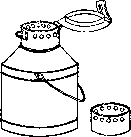
Figure 3. Vessel for transporting gambusia (on the right, a scoop-sieve inserted into the neck of the vessel).
G. is a freshwater fish and must be transported only in fresh water. In the summer, when transporting by rail or by steamship, ice must be placed in the vessel with G. to maintain the specified temperature. For transporting G., the Italians have developed a special vessel (see Figure 3), which is a jar with a wide neck made of galvanized iron, because even the slightest traces of iron oxide are fatal to G. A tightly fitting scoop-sieve is inserted into the neck of the jar so that the fish cannot pass when the water is poured out. Both the neck of the vessel and the inserted scoop-sieve have several holes about 1 cm in diameter on the sides for air to enter the vessel. Such a vessel, with a capacity of two buckets of water, is sufficient for transporting 200-250 fish. The water must be changed 1-2 times a day. Any dead specimens, if there are any, must be removed immediately. For transportation, it is necessary to use adult pregnant specimens. Younger individuals are less hardy and die during the necessary manipulations during transportation. G. can be transported at any time of year. The body of water from which G. is taken for distribution must be free of pathogenic microorganisms. It is not quite easy to catch G. from the basin. For this, a large conical net, 0.5-1 m in diameter, is used. To avoid unnecessary injury to the fish, the bottom of the net is cut and tied with a rope during catching; the net with the fish is immediately transferred from the basin to a basin or bucket, the rope is untied, and all the fish exit into the water. Then, from the basin or bucket, the water with the fish is poured into the transport vessel. A nursery for breeding gambusia must satisfy two basic requirements: first, the water temperature in it should be about 25°, and second, it must contain sufficient food to feed the fish.
Related articles
Mentioned in
Cite this page
“Gambusia.” Soviet Medical Encyclopedia. English translation of Bolshaya Meditsinskaya Entsiklopediya, 1st ed. (Moscow, 1928–1936), ed. N. A. Semashko. https://sovietmedicalencyclopedia.pages.dev/article/gambusia/