Burners
Historical document, translated for reference. It reflects medical knowledge of the 1920s–30s and is not medical advice.
Summary
An overview of burners for lighting and heating from the 1928–1936 Great Medical Encyclopedia, detailing sanitary-hygienic requirements, various types of gas and liquid fuel burners, and their operational principles.
Encyclopedia article (1928–1936)
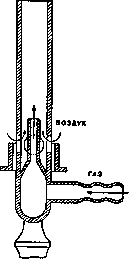
BURNERS, devices used for burning combustible materials for the purpose of lighting or heating. The sanitary and hygienic requirements for burners are as follows: lighting burners must provide a sufficient amount of light, but their flame must not be too bright. Deviations in either direction have a harmful effect on the organ of vision. The burner flame must not flicker, as flickering irritates and fatigues the eyes. When comparing lighting burners at equal luminous intensity, the best should be considered the one whose light is closer in composition to diffused sunlight. The products of complete combustion of any combustible material—carbon dioxide and water vapor—accumulating in a closed room, change the composition of the air in an undesirable direction; therefore, when choosing a burner, one should opt for those which, other things being equal, produce the smallest amount of carbon dioxide and water. A disadvantage of all lighting burners is the release of heat, leading to an excessive increase in air temperature. Burners used for heating, on the contrary, must produce the highest possible temperature. When burners operate, combustion must be complete, because products of incomplete combustion (carbon monoxide, acrolein, aldehydes, soot) are harmful. Combustible materials and their vapors themselves also spoil the air if mixed with it, so when using burners, care should be taken to ensure there is no leakage or evaporation of combustible materials. Burners must be fire safe, meaning their design must not allow ignition or explosion of the fuel. By fuel type, burners are divided into three classes: 1) gas burners, 2) burners for burning liquid petroleum products, and 3) alcohol burners. The luminous capacity of a gas flame depends not only on the composition of the gas, but also on the method of burning it. To obtain the greatest luminous intensity, it is necessary to provide the flame with a sufficient inflow of air required for the complete combustion of carbon particles into carbon dioxide. With a shortage of air, combustion is incomplete, and the burner smokes. With an excess of air, no solid luminous carbon particles are released, and the flame becomes colorless. The most intense combustion occurs at the point of contact between the flame and the air; therefore, it is most advantageous to give the flame the largest surface area with the smallest volume. The following types of gas lighting burners exist: 1) with a round opening, 2) slit burners, 3) Argand burners, 4) regenerative burners, and 5) incandescent gas mantles. 1. Burners with a round opening consist of a small cylinder with one or two round openings at the top. The flame of a single-hole burner resembles a candle flame; the flame of a two-hole burner has the shape of a fish tail. These burners are the least economical. 2. Greater luminous intensity at the same gas consumption is provided by slit burners, in the head of which a rectilinear slot is cut. 3. The Argand burner has from 15 to 40 openings arranged around a circumference. The flame of such a burner, having the shape of a hollow cylinder, is fed by a double inflow of air—from the outside and from the inside. The external air inflow is provided by a cap surrounding the burner, and the internal by the cavity of the burner itself. The Argand burner is equipped with a glass chimney to enhance the draft. 4. Regenerative burners differ from those described above in that the gas and air in them are preheated by the exhaust combustion products, thereby achieving an increase in the lighting effect. 5. In incandescent gas burners, an excess of air is delivered to the flame, and it becomes colorless because its temperature rises so high that the heavy hydrocarbons responsible for the brightness of the flame decompose into methane and hydrogen. The colorless flame obtained in this way turns into a strong source of light if an extraneous body possessing high emissivity and stability at high temperatures is introduced into it. In this case, such a body is the Auer mantle, which, when incandescent in a colorless gas flame, develops eight to ten times more light than the corresponding volume of burned gas. Burners of types 1 and 2 are barely satisfactory because they produce a flickering, smoking flame. This disadvantage is eliminated by the use of glass chimneys in Argand and regenerative burners. Gas lighting burners, with the exception of the incandescent gas burner, generate an excessive amount of heat at a relatively low luminous intensity. A disadvantage of the Auer light is the significant content of ultraviolet rays, which irritate the retina of the eye. There are many gas burners of various systems used for heating, but almost all of them are built on the same principle, namely: gas emerging from a more or less narrow opening is mixed with the amount of air necessary to obtain a non-luminous flame having a high temperature. All efforts to improve gas heating burners boil down to achieving a more uniform mixing of gas with air. Among various kinds of heating gas burners, the Bunsen burner is the most famous and widely used in analytical laboratories (see Figure 1). In this burner, air enters the same tube through which the combustible gas is supplied to the flame. To regulate the proportion in which the gases mix, the slots through which the air is sucked in can be more or less covered by a ring slipped onto the burner. The Bunsen burner produces a flame that is extremely weakly tinted with a lilac color. Often, when lighting the burner, the flame flashes back inside its tube. In such cases, one should extinguish the flame, reduce or temporarily stop the air supply, and then light the burner again. A variation of the Bunsen burner is the Marshall burner, in which air enters from below. Sometimes Marshall burners are equipped with a device to regulate the air inflow. The Teclu burner, shown in Figure 2, is very conveniently regulated, produces a high-temperature flame, is easy to disassemble and clean, and is usually equipped with a whole series of various attachments, for example, attachment A for uniform heating of large surfaces, attachment B producing a cross-shaped flame, attachment C by means of which a flat flame is obtained for bending glass tubes, and so on. Often several burners with a common gas supply are mounted on a single stem. Their arrangement is clear from Figure 3. The so-called gas kitchen is very common
,
Figure 2.
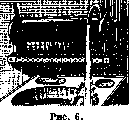
Figure 4. (see Figure 4). The burners of gas stoves are built on the type of the gas kitchen. Blowtorches used by glassblowers are shown in Figure 5. The flame of these burners has a higher temperature because the air in them enters under a certain pressure, regulated by a valve. The Fletcher burner (see Figure 6) is used to obtain a constant stream of hot water. Gas in the burner is supplied from below. The burner itself is a horizontally situated
tube equipped with one or two rows of small openings. The flame of the burner heats a ribbed copper tube having two branches, one of which connects to the water tap, and heated water flows out of the other. The gas bath burner is shown in Figure 7. Inside the casing, in its lower part, a gas tube is located horizontally, bent in the form of a flat spiral and equipped with small openings. Above the burner is placed a coil through which water flows, entering through tap A and flowing out from C. All types of these burners fully serve their purpose if they have tightly lapped moving parts that do not allow gas leakage. However, during their manufacture, incorrect proportions between the diameters of the openings supplying gas and air are sometimes permitted. If this incorrectness leads to a shortage of air, the flame smokes and has a low temperature. In the case of an excess of air, the flame flashes back inside the burner, the burner becomes incandescent, and if left unattended, the possibility of fire arises. Burners for burning petroleum products are divided according to the specific gravity of the combustible material into three groups: 1) gasoline burners, 2) kerosene burners, and 3) solar oil burners. Gasoline lighting burners have not become widespread because gasoline and other light petroleum distillates, which form an explosive mixture with air, are fire hazardous. The best known of this group of burners is the gasoline candle. Kerosene burners used for lighting are divided by the shape of the wick into two groups: flat burners and round burners. Kerosene, rising up the wick, evaporates in the upper, heated part of the burner. The vapors mix with air and burn. Luminous intensity and
Figure 5.



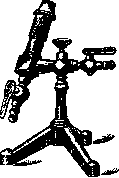
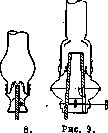
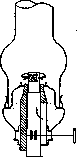
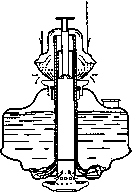
The efficiency of burners depends on a sufficient supply of air and good mixing of the incoming air with kerosene vapors. In flat burners (see Figure 8), there is a cap with a slit above the wick, the edges of which direct the air into the flame. In round burners, a flat wick is rolled into a tube. These burners have a dual air supply: from the outside, through a casing surrounding the wick tube, and from the inside, through the cavity of the wick tube, which has a corresponding slit for this purpose. To mix the external air flow with the combustible vapors, a constriction is made either on the glass chimney (see Figure 9) or on the burner itself. To direct the internal air current, burners are equipped with a button, simple or mesh (see Figure 10). The highest luminous intensity is achieved in burners having a through-tube in the reservoir (see Figure 11). These burners differ from those described above in that the air enters the wick tube not from the side, but from below. A strong draft in the through-tube provides good mixing of kerosene vapors with air, and the brightness of the flame increases. Solar oil burners are made low, and the reservoir is located at almost the same level as the burner, because viscous solar oil rises to the flame with difficulty through the capillaries of the wick. Kerosene lighting burners have many advantages compared to gas and gasoline ones. All of them give an even, steady light (poor in harmful ultraviolet rays), are safer in terms of fire hazard, because kerosene has a relatively high flash point temperature; with proper care, they do not produce products of incomplete combustion, but they do generate a significant amount of heat. A common disadvantage of all lighting burners is that they give uneven luminous intensity in various directions, but this can be combated by using lamp shades and reflectors. The simplest of the gasoline heating burners is the Ignatov "Bunsen-type gasoline burner" (see Figure 12). Into the cup surrounding the tube, alcohol is
Figure 7.
Fig.
poured and ignited, and the burner is heated. Further heating is maintained due to the heat released during the combustion of gasoline and transferred to the reservoir via the burner tube.
Air, necessary for com
bustion, enters
inside the tube through opening o. The Barthel
Figure 10.
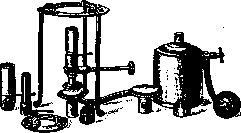
Figure 11. new gasoline lamp (see Figure 13) has a reservoir connected to the burner by a metal tube. The burner is preheated with alcohol, then air is pumped into the reservoir. Gasoline, entering under pressure into the heated burner, evaporates, and its vapors burn at the upper part of the tube; air for combustion is drawn in by the gasoline vapors through an opening in the lower part of the burner. Such a burner completely replaces the Bunsen gas burner. The Barthel gasoline blowtorch is shown in Fig. 14. The Barthel kerosene lamp has the same structure as the gasoline one, with the only difference that the tube of the kerosene burner is subjected to heating over a greater length. The well-known "Primus" burner differs from the Barthel kerosene burner in that in the Primus, the burner itself is directly connected to the reservoir. Kerosene stoves have two wide wicks arranged parallel
Figure 12.
Figure 13.
to each other. Air enters from below from under the casing and through a vertical wide through-slot in the reservoir. The "Gretz" kerosene burners are arranged in the same way. All these burners require careful handling because they easily deteriorate: they begin to smoke and produce other products of incomplete combustion. In addition, they overheat strongly, the pressure in the reservoir rises, and the reservoir can burst, which is often the cause of accidents. Alcohol as a lighting material can be used only in
incandescent alcohol burners with
it burns with a colorless
flame. The diagram of an alcohol lamp burner is shown in Fig. 15. Much more diverse are alcohol burners used for heating. The simplest are glass spirit burners with a metal bushing for the wick and a glass cap. Metal "Ideal" alcohol burners have no wick—alcohol vapors burn in them. Alcohol is ignited directly in the open reservoir of the burner. After a minute, when the burner warms up, alcohol vapors form between its double walls and exit through a series of side openings. A large flame is obtained, consisting of small lights. Since alcohol does not produce soot and other products of incomplete combustion, alcohol burners could be considered more hygienic than all others, if the possibility of alcohol vapors and products of its denaturation entering the air were excluded. In reality, such air pollution is observed very often.




Related articles
Mentioned in
Cite this page
“Burners.” Soviet Medical Encyclopedia. English translation of Bolshaya Meditsinskaya Entsiklopediya, 1st ed. (Moscow, 1928–1936), ed. N. A. Semashko. https://sovietmedicalencyclopedia.pages.dev/article/burners/