Smoke
Historical document, translated for reference. It reflects medical knowledge of the 1920s–30s and is not medical advice.
Summary
Smoke is a product of incomplete fuel combustion consisting of fine carbon and ash particles, gases and vapors, with significant sanitary importance. The article discusses its composition, health effects, and preventive measures against air pollution.
Encyclopedia article (1928–1936)
Smoke, a product of incomplete fuel combustion, consists of very fine carbon and ash particles, gases and vapors and has great sanitary significance. The composition of smoke varies depending on the type of fuel and the method of its combustion. Factory smoke may contain various production impurities. With proper furnace design allowing complete combustion of fuel, no visible smoke is produced, as all carbon particles of the fuel have time to fully oxidize and the products of combustion are only colorless substances: CO2, water vapor, in small amounts nitric and nitrous acids and ammonia; in addition, if the fuel contains sulfur, sulfurous and sulfuric acids are also present. With poor furnace design or insufficient air supply to the fuel, which happens very often, in addition to the above-mentioned combustion products, carbon monoxide, various hydrocarbons, vapors of resinous tar-like substances and numerous coal particles carried by the air current are also formed. The mixture of all these substances causes the formation of visible smoke and the deposition of soot from it. In order for fuel to burn completely without producing much smoke, it is first of all necessary to have a sufficiently high combustion temperature and such an abundant supply of air to the fuel that the amount of O2 contained in the air not only corresponds to theoretical calculations for complete oxidation of the combustible elements of the fuel, but also approximately exceeds these calculations by 2 times. Pavlovsky points out that for complete combustion of 1 kg of firewood, 7.6-9.4 m3 of air is required, for peat 7.8-10.6 m3, for dry coal 15.0 m3, for coke 15.6 m3, for anthracite 16.6 m3, for oil 14.5 m3. Some types of fuel, for example peat, brown coal, even with very good air supply, give many products of incomplete combustion and smoke heavily. Variations in the composition of the main gases contained in smoke under different air supply conditions can be seen from the following analytical data. Normal Abundant Insufficient air supply air supply air supply ... CO2 CO ... 11.85% 79.32% 8.73% 0.10% 16.41% 79.58% 3.95% 0.06% 1.52% 78.64% 16.45% 1.94% 1.45% Based on numerous experiments, it has been established that the air supply to the fuel can be considered normal on average if 8% to 10% CO2 is present in the flue gases. Smoke, along with dust, is one of the main sources of air pollution in industrial areas and cities. Mixing with ordinary street dust and dirt, smoke carbon particles become indistinguishable from them and therefore do not attract much attention; however, there are always many smoke particles in the urban air, especially in winter, and often on snowdrifts one can observe clearly noticeable soot deposits. The largest amount of smoke in cities comes from numerous chimneys of residential buildings, but if there are factories in a given area, they can be the main air pollutant with smoke. Dense fogs in London and many other industrial cities with a humid climate depend primarily on the enormous content of smoke particles in the air, causing condensation of water vapor in the form of tiny droplets. How much soot factory chimneys produce can be judged, for example, by the following facts: on February 24, 1913, in the city of Hagen in Westphalia, freshly fallen snow in a small amount was collected; when it melted, a black, ink-like liquid was obtained, in which there were 0.8 g of carbon particles and 1.6 g of ash substances per 1 liter of water. Calculations showed that 788.4 centners of dirt particles fell on the entire territory of the city of Hagen (3,285 ha), i.e. more than 3 railway cars of finest coal and ash. Research in Hamburg showed that there, during the year, on the territory of the city (7,691 ha), from 1 to 2 million kg of soot falls (6,800-13,600 kg per day). According to the data of the Hygienic Institute, the largest amount of smoke in the air of Hamburg is contained in December and January, the least in June and July. The average amount of soot is 0.205 mg in 1 m3 of air, the maximum is 0.52 mg. For Berlin, Rubner gives an average annual figure of 0.14 mg of soot in 1 m3 of air. The air of rural areas is also not guaranteed against smoke pollution: extensive steppe, forest and peat fires often poison the air with soot and smoke for months. In the vicinity of large cities, a source of air pollution with smoke and soot is sometimes the primitive burning of waste in landfill sites. The air in apartments and various industrial premises is also often damaged by smoke due to malfunction or careless furnace operation, improper lighting of kerosene stoves, from samovars, irons, furnaces and various smoking heating appliances, which one has to deal with in various works. The presence of smoke in the air has a harmful effect on human health. Air containing a lot of soot quickly pollutes the body, clothing, dwelling. Inhaling a large number of fine carbon particles leads to anthracosis of the lungs with all its further consequences. The content of various resinous substances, carbon monoxide, hydrocarbons, caustic acids (e.g. sulfurous and sulfuric, and in factory smoke sometimes also hydrochloric, nitric, hydrofluoric) in smoke makes the air unfit for breathing, irritates the mucous membrane of the respiratory tract, increases the predisposition to acute and chronic diseases of them. The constant presence of smoke in the air of large cities and industrial areas not only deprives residents of clean air necessary for breathing, but also causes poor lighting of the city's territory by sun rays. The gray color of the sky, the dark, from a distance resembling a yellowish-gray cloud color of the atmosphere over large industrial cities and factory districts testifies how heavily the air is polluted and how much solar energy does not reach the residents. Köhl (Fr. Kolsch) points out that Berlin, due to the presence of soot and dust in the air, loses no less than 2/3 of the total amount of solar rays falling on it; other cities with more developed industrial life (for example Hamburg), according to his calculations, lose much more. Sulfurous acid, contained in large quantities in smoke when using types of stone coal rich in sulfur, is harmful not only to humans but also to plants, especially to coniferous trees, then to beech, birch. Fruit trees in the flowering period also suffer greatly from it. Wiler (Wie-ler) points to the strong leaching of lime from the soil by atmospheric water that has absorbed sulfurous and sulfuric acids from the air. Cohen and Leeds (J. Cohen, Leeds) observed the death of nitrifying bacteria in such soil. Finally, the acids contained in smoke act corrosively on metals (e.g. telegraph and telephone wires) and destroy some minerals used in construction. According to the research of Kaiser (Kaiser), partial destructions in the facade of the famous Cologne Cathedral occurred from the action of sulfurous acid contained in smoke on the dolomitic binder of the building stone of this cathedral. Similar phenomena were observed in the Munich Town Hall and other places. To combat smoke in residential and industrial premises, as well as in the external atmosphere, preventive measures are first of all necessary. Heating appliances and various works with fire should not pollute the air of the room with smoke. Therefore, stoves, kitchen hearths, furnaces, etc. must be in good working order and have good air draft into the flue. All smoky works in laboratories and workshops must be carried out in special fume hoods. To protect the atmospheric air from smoke pollution in industrial areas, it is necessary to demand (such a law exists in England) that the smoke coming from factory chimneys should not have a dense black color.
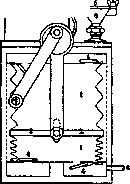
Asher's apparatus for determining soot: 1-bellows; 3- handle that moves the wall between the bellows (2); 4- spring valves - intake and exhaust air; 5- filter; 6- tube for air outlet; 7- counter for the volume of air being tested; 8- funnel for the filter.
Black smoke indicates either poor design of the factory furnace or careless, unskilled work of the stoker. With proper use of fuel, only a slightly noticeable, grayish smoke comes out of the factory chimney, containing a very small amount of carbon particles. Cheaper
Poorly burning varieties of hard coal, peat, etc., which produce heavy smoke, must have specially designed furnaces for complete combustion. Hard coal with a high sulfur content should not be used as fuel, or in extreme cases, the resulting sulfurous and sulfuric acids must be captured from the flue gases. - For neutralizing factory smoke at present, many different methods are used: combustion, precipitation, washing, and dilution with clean air. The burning of black smoke is carried out by passing it through special smoke-burning chambers, into which highly heated air is introduced. Precipitation and washing are practiced rather rarely, as they require complex and expensive equipment. Dilution of smoke with clean air, for example by means of a Wislicenus dissipator, is inexpensive, but it does not destroy coal particles, only disperses them, preventing their rapid settling in the immediate vicinity. In order to protect street air from the harmful effects of factory smoke and soot, factories and plants, in the planning of cities and workers' settlements, should be located far from residential buildings, taking into account the terrain and the direction of prevailing winds in the area. The establishment of factories and plants that pollute the air with smoke is completely unacceptable near hospitals, sanatoriums, schools, as well as in resort areas and dacha localities. - Determination of the amount of soot (coal particles) in the air is most conveniently done with an Asher apparatus (see figure). Air is drawn through a special pump through a white paper filter stretched over a funnel, leaving all the soot on it. The amount of soot is judged by the degree of blackening of the paper filter, comparing it with the scale attached to the instrument. The determination of gaseous and vapor substances present in smoke is carried out by the usual analytical methods used in the study of gaseous impurities in the air (see also Automobile smoke).
N. Ignatov. ♦19 Smoke from the point of view of industrial hygiene. Smoke outdoors. Large masses of smoke noticeably affect the composition of the air in cases where there are significant groups of sources of smoke emission; such are, for example, large heavy industry plants, metallurgical plants with their numerous chimneys, areas where there is a concentration of factories and plants. The task of reducing smoke emitted by chimneys is partly solved by the appropriate design of furnaces to achieve more complete combustion (for example, by installing gas or semi-gas furnaces, eliminating contact between flame and cold surfaces, providing sufficient volume of combustion chambers, using powdered fuel, etc.); this path is also the path of better and more economical use of fuel. Furthermore, a very perfect method of freeing the surrounding air from suspended smoke particles is electrical precipitation (Cottrell method); unfortunately, this method of clarifying the smoke gases is profitable only in very large installations. - Smoke indoors. In industrial and factory premises, smoke is also often a serious hazard that requires the application of special measures to eliminate it. Thus: 1) In forges, smoke is emitted from furnaces, especially at the beginning of their heating, when fresh fuel is ignited or added. 2) In foundries - when pouring flasks and where wood or insufficiently burned charcoal is used for heating ladles, warming molds, etc. Particularly large amounts of smoke are emitted in pipe foundries, where cores contain a lot of straw and other organic substances. 3) In hardening shops, where oil hardening takes place, a lot of smoke is emitted when the objects being hardened are immersed in oil. 4) At metallurgical plants - in those workshops where there are furnaces with flame escaping from dampers; especially large amounts of smoke escape when such dampers are opened. 5) Sometimes the source of smoke in working premises at metallurgical plants are gas generators located directly in the workshops or next to the workshops; smoke escapes mainly during poking and during loading of the generator. This smoke is particularly harmful, as it, like generator gas, contains a large amount of carbon monoxide (about 20% by volume) and hydrocarbons. - In addition to the examples listed, smoke in working premises is also obtained in many other cases. Measures to eliminate smoke indoors are limited to local exhausts where this is technically possible; in other cases, smoke removal is achieved by means of rational supply and exhaust ventilation (general exchange) or by ventilation of premises, using natural factors (the effect of temperature difference and wind force). In a number of cases, the elimination of smoke can be achieved by changing the technological process (for example, in foundries, when transitioning from the conventional method of molding and pouring to the conveyor method) or by the general organization of technical work (introduction of more advanced designs of furnaces, ovens, generators, etc.), as well as more careful maintenance of the workshop's technical equipment.
D. Nagorsky.
Related articles
Mentioned in
Cite this page
“Smoke.” Soviet Medical Encyclopedia. English translation of Bolshaya Meditsinskaya Entsiklopediya, 1st ed. (Moscow, 1928–1936), ed. N. A. Semashko. https://sovietmedicalencyclopedia.pages.dev/article/smoke/