Smut
Historical document, translated for reference. It reflects medical knowledge of the 1920s–30s and is not medical advice.
Summary
This 1930s encyclopedia article discusses smut, a fungal disease of flowering plants and cereals caused by Ustilaginaceae. It details the differences between loose smut and stinking smut, their effects on grain quality, and the potential toxicity of contaminated flour for humans and animals.
Encyclopedia article (1928–1936)
SMUT, a disease of flowering plants, predominantly cereals, caused by parasitic smut fungi (Ustilaginaceae). In certain types of smut, the diseased parts of plants are covered with a black pulverized mass (spores) similar in appearance to soot, and look as if charred—hence the name of the disease "smut".
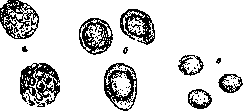
Smut spores: a—stinking smut (Tilletia caries); b—stinking smut (Tilletia laevis); c—loose smut (Ustilago carbo). (According to Moeller.) Several varieties of smut are distinguished, of which two types are most harmful to grain crops: 1) loose, or flying smut (Ustilago carbo), which affects spring wheat, barley, and to a lesser extent oats and millet, and 2) stinking, or covered smut—Tilletia caries and Tilletia laevis, which parasitize predominantly wheat (see illustration). Loose smut affects not only the internal contents of the grain, but also the husks, as a result of which the entire inflorescence blackens from the mass of spores easily carried across the field by the wind. Loose smut is non-poisonous, however, its admixture to flour spoils the color and lowers the nutritional value of the flour. The spores of loose smut are spherical, smooth, with dimensions of 0,009–0,011 mm. Stinking smut forms larger (about 0,017 mm), dark brown spores covered with ridges that divide the entire surface of the spore membrane into quadrangular spaces. The grains affected by it do not turn into dust, as is observed in loose smut, but retain their shape and become lighter than water. They are easily crushed, whereupon a sticky, then powdery mass of brown spores emerges, having an offensive herring-like odor that is transmitted to healthy grains and flour. This smut sometimes affects entire fields. Bread prepared from flour infected with stinking smut also has an unpleasant herring-like odor, an offensive taste, an olive-green color, and strings into threads. There are isolated observations that the consumption of such bread was the cause of mass illnesses in humans (Khlopin). There is still little precise scientific research on the effect of stinking smut spores on the human organism at the present time, however, most hygienists consider them harmful and even poisonous; the harmful effect of this fungus has been repeatedly observed in animals (Nikitin). Flour infected with stinking smut should be considered substandard. Seed grain infected with smut must be subjected to thorough cleaning and sorting and then disinfected in solutions of substances that kill spores (formalin, copper sulfate). In Germany, "upsulium"—a mercuric chloride preparation—is used for this purpose.
Related articles
Mentioned in
Cite this page
“Smut.” Soviet Medical Encyclopedia. English translation of Bolshaya Meditsinskaya Entsiklopediya, 1st ed. (Moscow, 1928–1936), ed. N. A. Semashko. https://sovietmedicalencyclopedia.pages.dev/article/smut/