Snakes
Historical document, translated for reference. It reflects medical knowledge of the 1920s–30s and is not medical advice.
Summary
Snakes are an order of reptiles characterized by their elongated bodies, lack of legs, and specialized venom delivery systems. This article describes their anatomy, classification, venomous species, and the effects of their venom.
Encyclopedia article (1928–1936)
Snakes (Ophidia), an order of the class Reptilia, of the phylum Chordata; they have a thin, more or less long body, consisting of a head, trunk, and tail. For snakes, it is very characteristic the absence of legs, which in most snakes are completely reduced, while in some (boas) rudiments of the hind pair of limbs and pelvis remain in the form of a rod-like bone and a conical protrusion extending outward. Traces of the forelimbs in some snakes are represented by remnants of shoulder muscles and blood vessels. The skin of snakes keratinizes on the surface; due to varying degrees of keratinization, the snake's body appears covered with scales arranged like shingles, or with semicircular shields. There are no glands in the skin, and it is completely dry. From time to time, snakes shed their skin, i.e., they cast off the old keratinized skin, from which the snake actually emerges through a rupture at the front end; the 'shirt' or 'cast' remains in place. The head of snakes is little separated from the trunk and is also covered with keratinized shields, the distribution of which is important for determining the species. Snakes feed on animals that they catch and kill themselves. As a rule, snakes swallow prey much larger than their own body: for example, the grass snake swallows a frog, the horned viper swallows a rat, the boa swallows young antelopes, etc. The lower jaws of snakes in front are connected by a very stretchable elastic fold; the quadrate bone is long and rod-like; it articulates with the lower jaw and with the also elongated and movable os squamosum (fig. 1). All this contributes to the extraordinary expansion of the mouth and swallowing of very voluminous prey. In the oral cavity of snakes there are many teeth: on the upper and lower jaws, palatine and pterygoid bones (fig. 1). The teeth of snakes are for seizing. (For venomous teeth, see below.) Into the oral cavity

Figure 1. Skull of Vipera aspis. The upper jaw (black) is very short and movable, carrying only the venomous grooved tooth: 1--quadrate bone; l-os squamosum. Figure 2. Tropidonotus natrix-common grass snake. Teeth are smooth. The posterior half (1) of the upper lip gland (2) produces venomous secretion.
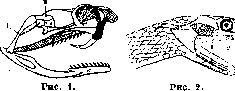
open various salivary glands, abundantly lubricating the swallowed prey with their secretion. The tongue of snakes is narrow and long, forked at the tip (fig. 2), very mobile, and can protrude outward through a slit with the mouth closed. It serves as an organ of touch and is incorrectly called a sting in common speech. The internal organs of snakes are elongated in accordance with the shape of the body; there are two or one lungs. The heart is three-chambered. They reproduce by laying eggs or are ovoviviparous (i.e., the young snake hatches immediately from the laid egg). Snakes are distributed throughout all parts of the world. About 2,300 species of snakes are known. Most snakes are terrestrial animals, living in trees, bushes, grass, under stones, in soil cracks, old burrows; they crawl into gardens, plantations, and human dwellings. Some are good swimmers. There are sea snakes that lead an exclusively aquatic life. Family Boidae- boas- the largest snakes by size; not
Figure 3. Forms of snake teeth: / - grooved (venomous) tooth; II - tubular (venomous) tooth; III- smooth tooth; 1-corresponding cross-sections of teeth; 2-groove; 3- canal; I-opening, through which the canal opens. venomous; they have rudiments of pelvic and hind limb bones. Species: dark python (Python bivittatus) up to 10 m in length (Indochina); almost all pythons live in the Old World; common boa (Boa constrictor) up to 4-6 m in length (Guiana); the dwarf is the steppe, or sand boa (Eryx jaculus) up to 80 cm in length (Caucasus, Central Asia).- Family Colubridae-colubrids-with a horizontally

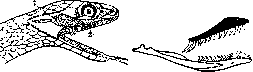
Figure 4.
Figure 5. Figure 4. Venomous apparatus of rear-grooved venomous snake-Coelopeltis monspessulana. At the rear end of the upper jaw is the venomous tooth, above it-the venom gland (1); in front is the salivary gland (2). Figure 5. Upper and lower jaws of rear-grooved snake.s 2 venomous teeth are located at the rear end of the jaw, the other teeth are smooth. lying and immobile in the vertical direction upper jaw. Divided into 3 groups based on tooth shape and position. 1.Smooth-toothed (Aglypha), with homogeneous, smooth and channel-less teeth (fig. 3- III); non-venomous (see Aglyphodonta). 2. Rear-grooved (Opisthoglypha) - with one or two rear teeth of the upper jaw, equipped with a groove or channel on the front surface (fig. 4 and 5). Into the base of the groove opens the duct of the posterior part of the upper lip gland. Its secretion is venomous, but due to the too deep position of the venomous teeth, such snakes in the vast majority of
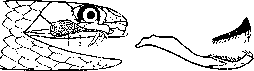
Figure.
Figure 6. Venomous apparatus of front-grooved venomous snake Naja bungarus. In front are large venomous teeth; at the base of the tooth opens the duct of the venom gland (1), sharply separated from the salivary gland (2). Figure 7. Upper and lower jaws in Proteroglypha with anterior venomous teeth. The remaining teeth are smooth. cases cannot inflict a venomous bite on a person, therefore they are otherwise called 'suspiciously venomous'. Tarbophis fallax--cat snake; Oxyrhopus cloelia (Bra- SNAKE VENOM
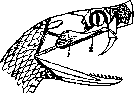
Figure 8. Venomous apparatus of Vipera aspis with tubular venomous teeth: 1-venom gland; 2-salivary gland.
zil)-non-venomous mussurana, remarkable for the fact that it devours venomous Lachesis and other snakes, to whose venom it is naturally immune; Taphrometopon lineolatum-arrow snake (Asia); Dispholidus typus-b boomslang (East and South Africa), which in rare cases can be venomous to humans. 3. Front-grooved (Proteroglypha) - with front. grooved (or tubular) teeth of the upper jaw (fig. 3). With such an advanced forward position of the venomous teeth (figures 6, 7), when bitten by them, venom is always injected into the victim's body. All representatives of this group are venomous. Ellaps corallinus-coral asp (South America); Doliophis intestinalis with record development of venom glands, occupying up to the entire first third of the body length (Malay Archipelago, Indochina); the spectacled snake, or cobra (Naja tripudians; India, Transcaspia) and asp (Naja haje; Africa) are the most dangerous to humans. - Family Viperidae - vipers, or vipers. The short and thick upper jaw (figures 1, 8) is movable. Venomous teeth are tubular (Soleno-glypha; fig. 3-II). As in Proteroglypha, behind the venomous tooth lie several teeth - 'substitutes', which begin to function in case of breakage of the active tooth (figure 9). The venomous apparatus is well developed. To Viperidae belong various vipers (subfamily Vi-perinae; see Viper, Horned viper), echidna (Echis carinata), horned viper (Cerastes cornutus) and subfamily of rattlesnakes (Crotalinae; see Rattlesnakes), to which besides Crotalus and Sistrurus belong many species of the genus Lachesis, or pit vipers (South America), which are similar to copperheads (Ancistrodon, see) silent (i.e., lacking a rattle) rattlesnakes. Lachesis are very dangerous to humans; their venom has been the subject of numerous studies (see Snake venom). Venomous snakes have venom glands and venomous teeth, through
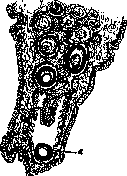
Figure 9. Frontal section through the fold of the mucous membrane (of a viper), covering the venomous tooth (a) and nine substitute teeth. 1
2 Figure 10. Traces of snake bite: 1-of a non-venomous (Colubridae); 2 - of a spectacled (Proteroglypha); 3 - by a viper (Solenoglypha).
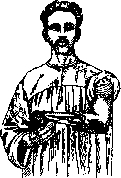
Figure 11. Effect of local action of snake venom. Complete disintegration of tissues down to exposure of the bones of the skeleton.
which they inject venom into the human body. About 230 species of venomous snakes are known-the largest number of them in hot and warm countries. There are no external signs by which venomous snakes can generally be distinguished from non-venomous ones. The only difference is the presence of venomous teeth on the upper jaws. In a killed snake, with forceps, the mouth is opened and the presence or absence of larger arcuate curved venomous teeth, which at rest lie against the palate, is confirmed. The concept of venomous snakes is artificial and inaccurate. It is applied only in relation to the action of a snake bite on a person (fig. 10 and 11). Along with truly venomous snakes, there are also venomous snakes whose bite is practically harmless to humans in most cases (Opisthoglypha). Finally, the smooth-toothed snakes that are completely non-venomous to humans (like the grass snake) still have a separated part of the upper lip salivary gland, the secretion of which in pharmacological experiments turns out to be venomous (fig. 2). There is also an opinion that the secretion of the salivary glands of any snake has one or another toxic properties.
Related articles
Mentioned in
Cite this page
“Snakes.” Soviet Medical Encyclopedia. English translation of Bolshaya Meditsinskaya Entsiklopediya, 1st ed. (Moscow, 1928–1936), ed. N. A. Semashko. https://sovietmedicalencyclopedia.pages.dev/article/snakes/