Viper
Historical document, translated for reference. It reflects medical knowledge of the 1920s–30s and is not medical advice.
Summary
This 1930s encyclopedia article describes the common viper (Vipera berus), its distribution, morphology, venom apparatus, and the effects of its bite on humans along with historical treatment methods.
Encyclopedia article (1928–1936)
VIPER, common viper, Vipera berus L. (family Viperidae, order Ophidia, class Reptilia), a venomous snake widely distributed in the Old World (Europe, Siberia); reaching north to the Murman Coast. It is found in various localities: in forests, steppes, swamps, meadows, fields, mountains, etc. The body is thick, up to 80 cm long, with a flat head. Coloration varies from brownish-gray, olive-green to brownish-black and even black. A longitudinal dark jagged stripe runs down the back (see Fig. 1). It leads a predominantly nocturnal lifestyle, lying in the sun during the day [feeding on] nestlings of ground-nesting birds, etc.
Fig. 1. Viper. The venom glands of the viper lie posterior and inferior to the eye. The duct of the gland connects with the base of the canalicular venom fang (see Figure 2). Behind this fang lie up to 10 replacement tooth germs that grow to replace broken ones. In winter, vipers hide in shelters and become torpid from the cold. Beyond the Arctic Circle, the viper leads an active life for only about three months. Sexual maturity occurs in the 4th year of life. Mating occurs in spring. The viper is ovoviviparous, meaning it produces eggs (5-16 pieces) from which the young hatch out immediately upon laying. The viper does not attack humans on its own, but can bite if stepped on, which happens during hunting, walking barefoot or in low shoes, as well as when gathering brushwood or hay, with which vipers are sometimes brought into dwellings. At the site of the bite, traces of the venom fangs are visible as two dots. The consequences of a bite depend on many causes: the site of the bite, the time when the snake last bit and how many times, the season, etc. Cases of human death from a viper bite are very rare, but the poisoning caused by its venom is serious. The bite site reddens and swells. The patient experiences severe pain; the bitten limb swells. The bite site may undergo necrosis and ulceration. Such local action is characteristic of viper venom.
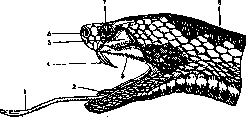
Figure 2. Head of a viper with the venom apparatus: 1-tongue; 2-opening of the windpipe; 3-teeth; 4-venom fang; 5-venom gland; 6-nostril; 7-eye; 8-dorsal stripe.
The general symptoms of poisoning include: drowsiness, fainting or agitation, convulsions, weak and accelerated pulse, drop in body temperature, shortness of breath, blood in the urine, etc. If non-fatal poisoning occurs, heart function stabilizes, body temperature rises, swelling subsides, but significant weakness can persist for 2-3 months or more. In severe cases, death may occur from respiratory arrest within a period of 12 hours to 7-8 days. Blindness is among the severe consequences of poisoning. Viper venom contains hemoragin, which acts on the vascular endothelium; it predominates over neurotoxin. Specific treatment for viper venom poisoning in the form of serum does not yet exist. In treating poisoning, plenty of alcohol is given internally, and a 1% solution of gold chloride (Aur. chlorat.) or potassium permanganate is injected around the bite site. Symptomatic remedies are also used. Immediately after the bite, it is important to suck out the wound, which is incised to better remove blood and venom. Of other viper species in the USSR, the following are found: the steppe viper (V. renardi - steppes of the USSR, Caucasus), the sand viper or nose-horned viper (V. ammodytes L. - Armenia), the blunt-nosed viper (uraza) (see), and others.
Related articles
Mentioned in
Cite this page
“Viper.” Soviet Medical Encyclopedia. English translation of Bolshaya Meditsinskaya Entsiklopediya, 1st ed. (Moscow, 1928–1936), ed. N. A. Semashko. https://sovietmedicalencyclopedia.pages.dev/article/viper/